


5 Principles for Training Businesses Designing Learning in the AI Era
TL;DR
The AI era has flipped the learning industry's biggest problem, shifting it from too little content to too much. For training businesses, the competitive edge is no longer building bigger content libraries. It is designing human-centered, community-driven learning experiences. IDEO U founder Suzanne Howard shares five principles: lead with personalization, use AI to cut logistics (not learning friction), engineer community intentionally, layer human interaction on top of AI practice, and start positioning learning as a business-critical ecosystem rather than a perk.
Key Takeaways for Training Businesses
- Prioritize relevance over volume. In an era of content abundance, the value provided isn't access to information; it's the ability to filter it. What this means for training businesses: Stop selling "libraries" of content. Shift the value proposition to curation and personalization. Use AI to surface the right resource at the exact moment of need, rather than overwhelming learners with everything at once.
- Automate logistics, not the learning struggle. AI should remove the friction of scheduling, finding resources, or grading, but it shouldn't make the actual learning process "easy." What this means for training businesses: Resist the urge to use AI to give learners the answer instantly (the "help abuse" trap). Instead, use AI agents to handle operational overhead so human facilitators can focus entirely on coaching and challenging learners to stretch their thinking.
- Engineer community from the first click. Community is the primary retention driver, but it doesn't happen by accident. What this means for training businesses: Design onboarding like a product. Script the first 24 hours of a learner's journey to ensure they are seen, greeted, and connected to a peer immediately. Use AI community managers to draft these connections, ensuring no learner ever enters a "ghost town."
- Design for "positive peer pressure." Transformation requires social accountability that AI cannot replicate. What this means for training businesses: Don't replace live sessions with AI simulations; combine them. Use AI for safe, repetitive practice (like simulating a difficult conversation), then move learners into live, peer-to-peer roleplay for the high-stakes emotional practice that cements the skill.
- Shift from certification to portfolio. The future of leadership development isn't about completing a course; it's about demonstrating a capability. What this means for training businesses: Move the assessment model away from completion certificates and toward applied projects and portfolios. Create value by helping learners build a body of work that directly translates to job opportunities in the real world.
The world is currently facing a leadership crisis. Navigating unprecedented complexity, chaos, and a rapid pace of change has become the norm, yet organizations are struggling to develop leaders who can face these challenges with confidence.
Historically, the barrier to leadership development was content. It was not accessible or scalable. Today, thanks to generative AI, the industry faces the opposite problem. There is an explosion of content, perhaps too much of it.
The challenge for learning leaders, training businesses, and academies is no longer about scaling content delivery. It is about designing holistic, transformational learning experiences where people actually learn from each other, not just from a video or a PDF.
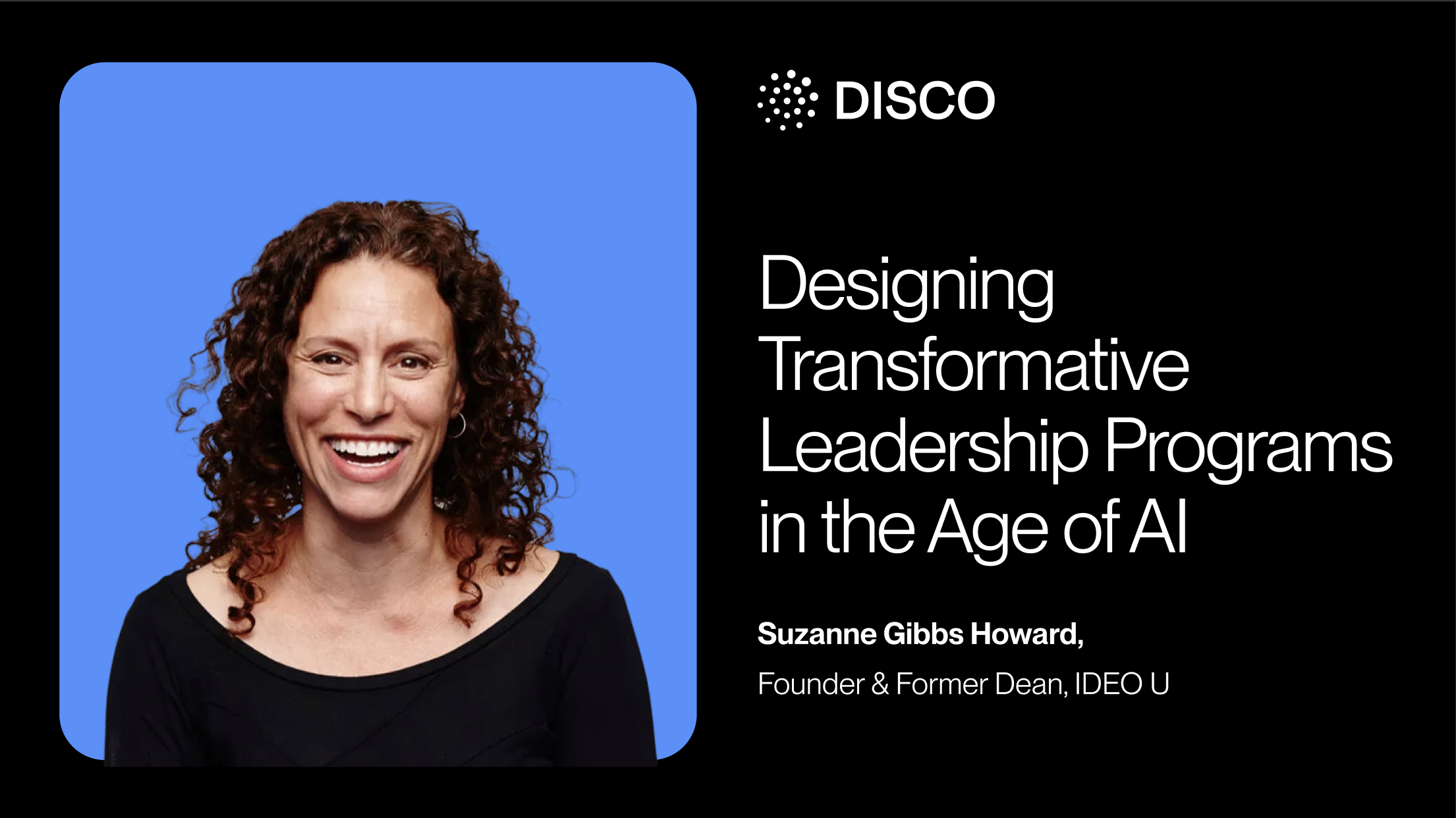
Disco Co-founder Candice Faktor recently sat down with Suzanne Howard, the founder of IDEO U and a partner at IDEO, who has shaped how some of the world's most innovative organizations think about learning. Howard shared her framework for navigating this new landscape, how to leverage AI without losing the human element, and why community is the secret sauce for learning that sticks.
Here are the five core principles from their conversation on designing for transformation in the digital age.
1. Stop Selling Content Libraries: Personalization Is King
As organizations move away from simply pumping out content, Howard identifies three areas where the most innovative players are leaning in. She calls these the "Three Ps": Personalization, Participation, and People.
Personalization is about relevance.
With the flood of content available, personalization is the gateway to engagement. It is no longer effective to present a massive library and say, "Here is everything we have." The industry must shift to saying, "We understand you, and we know this is what you need right now."
"The gateway to learning today is about relevance because of the flood of content in the world. Personalization is all of a sudden possible in ways that perhaps it wasn't previously, and it's even more necessary because the content is just so abundant that it needs to be relevant." — Suzanne Howard\
Participation transforms passive consumption into active learning.
Learning cannot just wash over a student. It must be interactive. This means moving beyond the "dumb megaphone" approach of broadcasting information and designing moments where learners must engage, practice, and apply concepts immediately.
People are the key to the "last mile."
Even in a highly virtual world, true transformation happens in relationship with others. This is especially true for leadership development. One cannot become a leader by reading a book; one becomes a leader through interactions with other human beings.
"The last mile of transformation that happens in a learning experience always happens in relationship with other people, especially in the workplace and especially when it's about learning." — Suzanne Howard
2. Use AI to Cut Admin Overhead, Not the Learning Struggle
There is a danger in getting too clever with AI. Howard warns against "help abuse," a concept where learners rely on technology to give them the answer so quickly that it removes the necessary struggle of learning.
Effective learning requires friction. A little bit of pain is necessary to make progress. If an AI tutor simplifies the experience too much, it robs the learner of the growth opportunity. The friction should be in the stretching of the brain, not in the clunkiness of the technology.
"You need friction. You need a little bit of pain in order to get that progress. AI can oversimplify things and take out the opportunity to really learn. What we need to do to remedy that is constantly put prototypes out in the world, test and tweak." — Suzanne Howard
Instead of removing cognitive load, AI should be used to remove logistical load. At IDEO U, Howard noted that the largest number of people in the organization were often dealing with operational logistics rather than creative design.
By using AI to handle operations like scheduling, finding resources, or drafting initial responses, organizations free up facilitators and community managers to focus on the high-value, human-to-human moments that actually drive transformation.
3. Community Doesn't Happen by Accident: Engineer It
Community does not just happen. It must be intentionally designed.
At IDEO U, Howard found that while people didn't sign up for the community, the community was the reason they stayed, learned, and came back. It became the critical differentiator.
To achieve this, organizations must engineer the touchpoints:
- The Greeting: When someone lands on a platform, they need to be seen and greeted immediately, or they will remain shy and passive.
- Immediate Interaction: Learners need to break the seal and interact within the first few hours to feel comfortable participating later.
- Peer Connection: Facilitators must enable introductions between people with shared lived experiences.
This is where AI can play a supportive role, acting as a "community management agent" that drafts connections or responses for a human to review and send. This creates a high-touch feel without the unmanageable manual workload.
4. AI Practice Alone Won't Cut It: Human Interaction Makes It Stick
In leadership training specifically, social learning is non-negotiable. Howard refers to this as "positive peer pressure." It is the generative potential, stickiness, and motivation that comes from knowing another human is present and watching.
While AI simulations are fantastic for safe practice, allowing a leader to rehearse a tough negotiation five times before doing it for real, they cannot replace the unpredictability and emotional stakes of a live human interaction.
The most effective programs today are using a hybrid approach. They use AI for "conversational retrieval" of knowledge and simulated practice, but wrap that in layers of human interaction, such as facilitated group sessions and side-by-side peer role-playing.
5. Learning Is No Longer a Perk: It's a Business Imperative
Looking two to three years ahead, learning will stop being viewed as a perk and start being viewed as an integrated ecosystem.
Society is moving away from the idea that a degree sets one up for life. As jobs change rapidly, the market needs richer assessments of soft skills and leadership capabilities, things that are historically hard to measure. There is a shift occurring where learning experiences connect directly to work opportunities, moving from simple certifications to applied portfolios that demonstrate real capability.
The winners in this new era will not be the ones who use AI to replace humans. They will be the organizations that use AI to handle the heavy lifting of personalization and operations, allowing their leaders to move at the speed of technology while remaining deeply connected to the people they lead.
About the Experts
Suzanne Gibbs Howard is the Founder and former Dean of IDEO U and a Partner at IDEO. A globally recognized expert in design strategy and digital learning, she led IDEO's Systems and Organizational Change Studio and pioneered human-centered design techniques used worldwide. Her work focuses on transforming individuals and organizations through creativity and insight, and she has been featured in Fast Company, Rotman Magazine, and more.
Candice Faktor is the Co-Founder and Co-CEO of Disco, the AI-powered learning platform for modern training businesses and academies. Previously, she was the Global GM at Wattpad, where she helped scale the platform to over 80 million users. A Venture Partner at Lobby Capital and board member for companies like Coveo, Candice is a leading voice on the future of learning, community-led growth, and the human side of AI.


