


Best Circle Alternatives for AI Training
TL;DR
While Circle offers solid community features, organizations running AI readiness training need a platform purpose-built for structured learning outcomes. Disco combines AI-powered curriculum generation, learner Q&A bots trained on your content, and cohort-based social learning in one platform—eliminating the need for separate LMS and community tools. With built-in assessment tracking, live event integration, and automated operations, Disco helps training businesses and L&D teams launch comprehensive AI fluency programs in days, not months, while maintaining the engagement and accountability that makes learning stick.
Why AI readiness training demands more than a community platform
AI is reshaping every industry, and organizations are racing to upskill their workforce. But teaching AI fluency requires more than discussion forums and shared resources—it demands structured curricula, hands-on practice, real-time support, and measurable outcomes.
Circle has built a strong reputation as a modern community platform with courses, events, and AI-powered engagement tools. Training businesses and L&D teams appreciate its clean interface and member engagement features. However, AI readiness programs have unique requirements that extend beyond what community-first platforms typically offer.
Successful AI readiness training combines multiple elements: multi-week structured programs teaching core AI concepts, hands-on exercises with real tools, live workshops with expert facilitators, peer discussion and knowledge sharing, continuous Q&A support as learners experiment, and trackable assessments measuring skill development.
This article examines the best alternatives to Circle specifically for organizations building AI readiness and AI fluency training programs—platforms that balance community engagement with robust learning operations.
What AI readiness training actually requires
Before evaluating alternatives, it's worth understanding what makes AI readiness training distinct from general community programs or casual courses.
Structured curriculum with clear progression
AI readiness programs typically span 4-12 weeks, covering foundational concepts (what AI is, how it works), practical applications (prompting, tool selection, workflow integration), organizational implications (ethics, governance, change management), and hands-on practice with actual AI tools.
Unlike open-ended discussion communities, these programs need defined learning paths with prerequisites, sequential modules, and clear milestones.
Assessment and skill verification
Organizations investing in AI readiness want to measure outcomes. This means quizzes to verify concept understanding, project submissions demonstrating practical application, peer feedback on real-world use cases, and completion tracking for reporting and compliance.
Community platforms often lack the assessment infrastructure that training programs require.
AI-powered learner support
Ironically, teaching people about AI works better when AI helps with the teaching. Learners benefit from AI Q&A bots that can answer questions about course content 24/7, curriculum generators that create structured programs from source materials, automated summarization of live sessions and discussions, and personalized recommendations based on learning progress.
Cohort-based social learning
AI readiness training works best in cohorts where learners progress together, creating accountability and enabling peer learning. This requires automated cohort management (cloning programs, scheduling, group transitions), live event integration with automatic recording and transcription, discussion spaces organized around program structure, and peer matching and group formation tools.
Enterprise and B2B readiness
Many AI readiness programs serve corporate clients or internal L&D teams, requiring SSO and authentication flexibility, HRIS integration for employee training, detailed analytics and reporting for stakeholders, white-label branding for client-facing programs, and API access for custom workflows.
With these requirements in mind, let's examine the best alternatives to Circle for AI readiness training.
1. Disco – Best AI-native platform for AI readiness training

Why Disco stands out for AI readiness training
Disco is an AI-powered social learning platform built specifically for training businesses, virtual academies, and corporate L&D teams running cohort-based programs. Unlike community-first platforms that added courses as a feature, Disco was designed from day one for structured learning experiences that combine curriculum, community, and AI automation.
For AI readiness training specifically, Disco offers several unique advantages:
AI curriculum builder and content authoring
Disco's AI can generate complete AI readiness curricula from prompts or source materials. Upload your company's AI guidelines, industry reports, or existing training documents, and Disco creates structured modules with lessons, discussion prompts, and assignment ideas. This dramatically reduces the time to launch new AI fluency programs.
Learner-facing Q&A bot trained on your content
Unlike Circle's AI agents (which primarily help with community moderation and navigation), Disco's Q&A bot functions as an AI teaching assistant. It's trained on your specific training materials and can answer learner questions about AI concepts, tools, and applications based on your curriculum.
When a learner asks "How should our marketing team use AI for content creation?" mid-program, they get an answer grounded in your training content—not generic AI responses.
Cohort-based program structure
Disco organizes everything around programs and cohorts. You design an AI readiness program once, then clone it for multiple cohorts (different departments, client organizations, or time periods). Each cohort gets its own space for discussions, shared progress tracking, and automated transitions to alumni groups.
This structure is perfect for rolling out AI training across an organization in waves or running the same program for multiple corporate clients.
Assessment and tracking for measurable outcomes
Disco includes assignments with submission tracking, quizzes with configurable passing thresholds, progress monitoring at individual and cohort levels, completion certificates, and group-level analytics showing engagement and performance across your AI readiness initiative.
Live event integration with auto-transcription
AI readiness programs often include live workshops, office hours, and expert sessions. Disco integrates with Zoom and other platforms, automatically uploading recordings, generating transcriptions, and making them searchable within your program. The AI can even produce summaries of key takeaways from each session.
Social learning features built for training
Beyond basic discussion forums, Disco includes program-specific discussion spaces organized by module and topic, peer matching for accountability partnerships and project collaboration, mentor/advisor assignment for programs with coaching elements, live events calendar integrated into the program flow, and activity feeds showing learner engagement and achievements.

Who Disco is best for
- Training businesses selling AI readiness programs to corporate clients
- Customer success teams building AI fluency academies for clients
- Internal L&D teams rolling out company-wide AI upskilling
- Consultants and agencies delivering AI transformation programs
- Professional associations offering AI certification courses
Considerations
Disco is optimized for structured learning programs with clear outcomes. If your primary goal is an open-ended AI community of practice with no formal curriculum or assessments, simpler community platforms might be sufficient. However, for serious AI readiness training with measurable results, Disco's learning-first architecture provides significant advantages.
Pricing
Disco offers flexible pricing starting at $399/month for training businesses and academies. Enterprise options include dedicated customer success management, API access, and advanced integrations. Learn more about Disco's AI-powered features.
2. LearnWorlds – Strong corporate LMS with AI tools
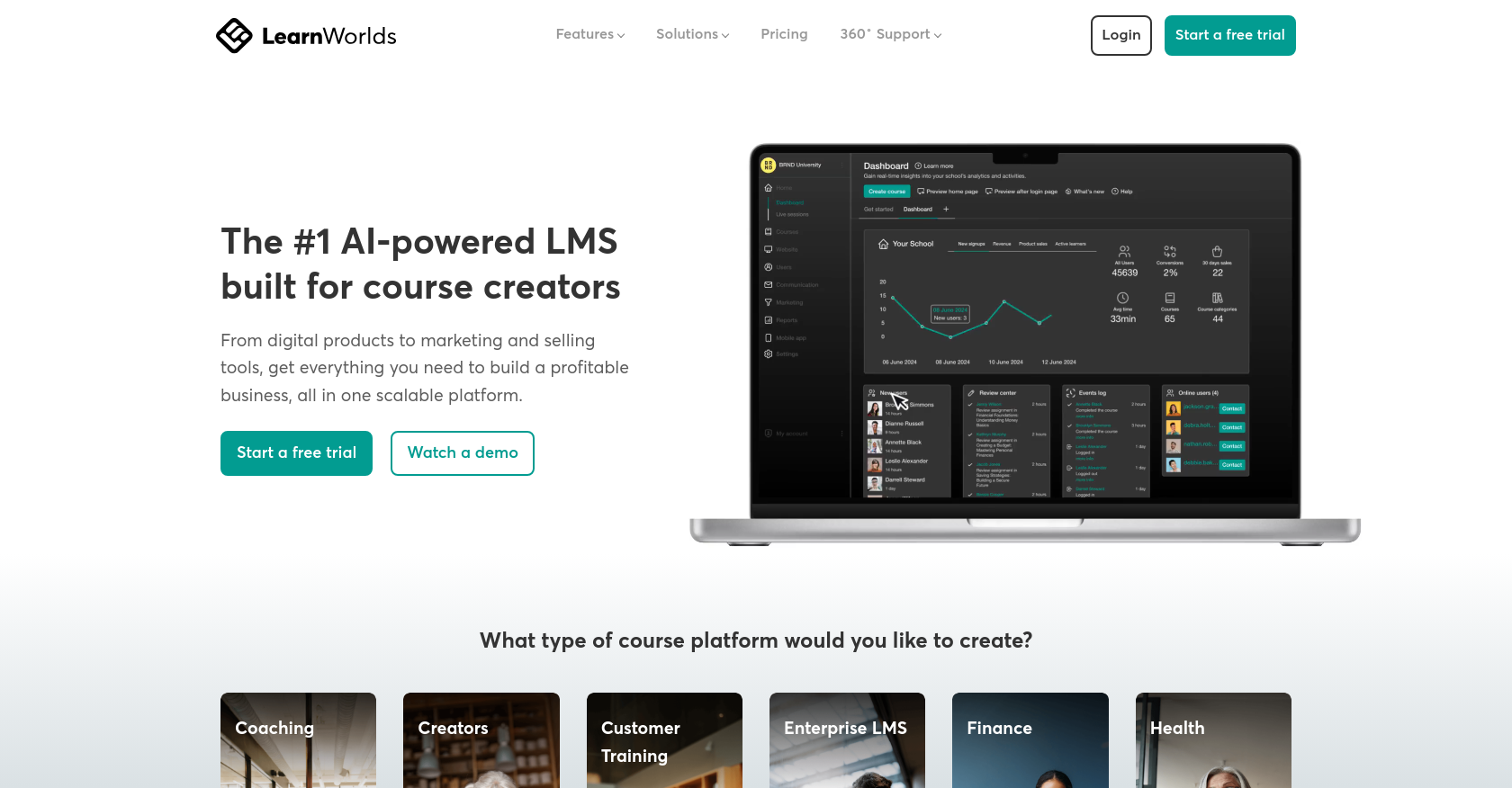
LearnWorlds positions itself as an AI-powered learning management system with a particular focus on corporate training and customer education. For AI readiness programs, it offers several compelling features.
AI capabilities for training
LearnWorlds has invested heavily in AI tools for learning design. The AI course planner helps structure AI readiness curricula, AI-enhanced assessment tools generate questions and provide automated feedback, content editing assistance helps create and refine training materials, and advanced analytics track learner progress and correlate training with business outcomes.
The platform explicitly targets corporate training and customer education, with content and case studies focused on these use cases. Their 2026 State of AI in Customer Education report demonstrates thought leadership in the AI training space.
Learning design and assessment
LearnWorlds offers robust tools for role-based learning paths, automated workflows and triggers, interactive video with embedded questions, and certificates and compliance tracking.
These features make it well-suited for structured AI readiness programs, especially within corporate environments.
What LearnWorlds does well
For organizations that prioritize learning management system capabilities over community engagement, LearnWorlds delivers professional-grade tools. The platform handles complex training operations, supports various content types, and provides enterprise-level analytics.
Where Disco differs
While LearnWorlds excels as an LMS with AI features, Disco was built specifically for social learning communities. The key differences for AI readiness training include:
Disco's community features are core to the platform architecture, not add-ons. AI readiness works better when learners can easily share experiments, troubleshoot together, and learn from peers—Disco's space-based community makes this natural.
Disco's cohort model is more opinionated and streamlined. Rather than configuring complex learning paths, you design a program and launch cohorts. This simplicity accelerates deployment of AI readiness training across multiple teams or clients.
Disco's AI goes deeper into the learning experience itself—the Q&A bot functions as an AI teaching assistant, trained on your specific content. LearnWorlds' AI focuses more on course creation and analytics.
Best fit
LearnWorlds is excellent for organizations wanting a powerful LMS with AI enhancements, particularly those with existing training operations and IT resources to manage implementation. Disco better serves training businesses and L&D teams who want to combine LMS capabilities with vibrant learning communities in a more accessible package.
3. TalentLMS – Affordable AI LMS for SMB training
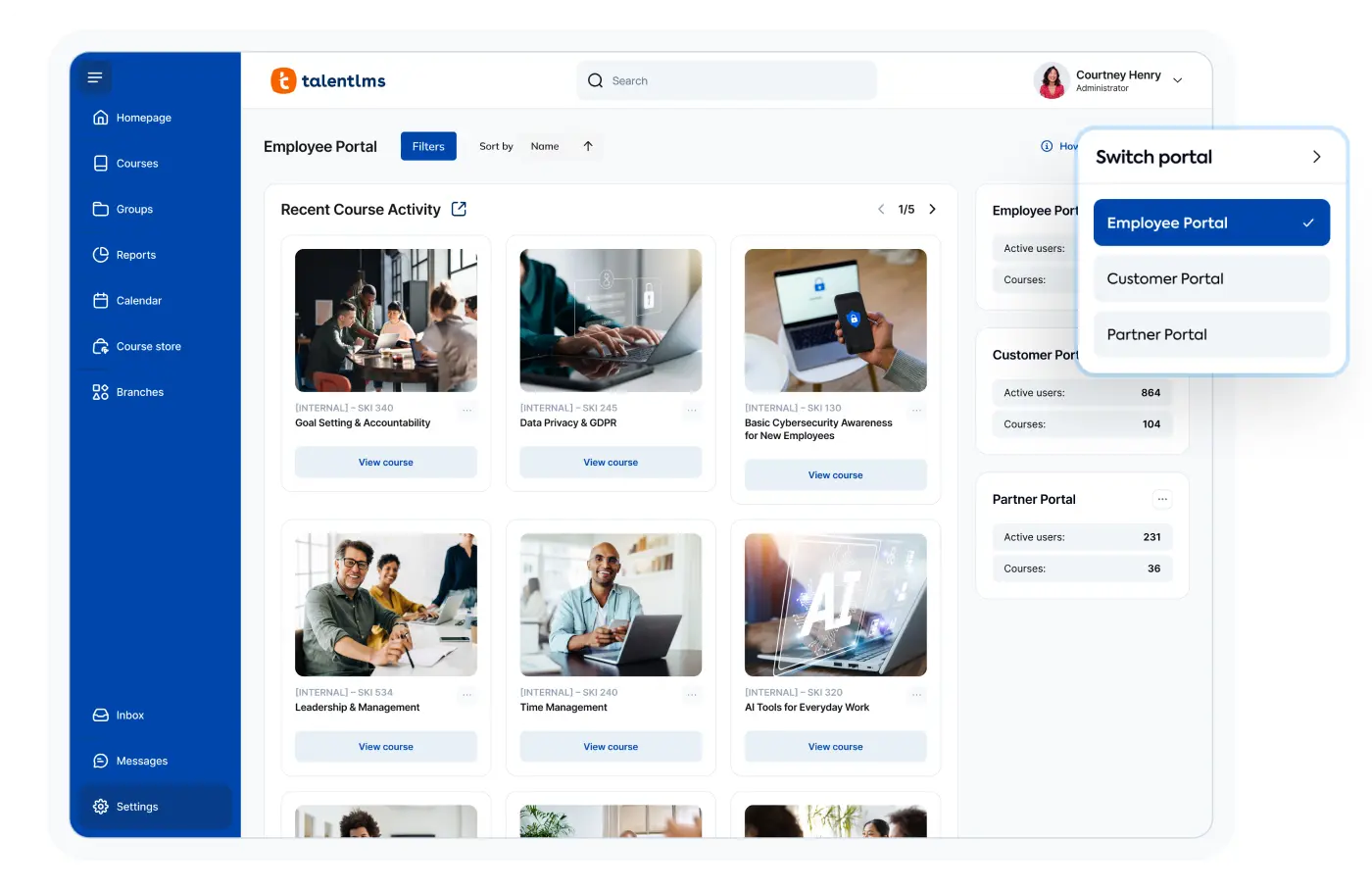
TalentLMS targets small and medium-sized businesses with corporate training needs, and has recently made significant AI investments.
AI capabilities
TalentLMS now offers an AI Coach that provides real-time, personalized support to learners across courses—essentially a virtual tutor, AI-powered course creation tools to generate content and quizzes quickly, Skills (AI) for creating and managing competency frameworks with auto-generated skill descriptions and assessments, and automatic question generation from course units for testing.
Their roadmap includes interactive video features and advanced AI customization for tone and learning goals.
Corporate training focus
TalentLMS is designed for internal employee training, with features supporting onboarding programs, compliance training, skills development initiatives, and integration with HR systems and workflows.
For companies rolling out AI readiness training to employees, TalentLMS provides accessible, cost-effective tools.
Comparison with Disco
TalentLMS is a solid choice for straightforward corporate AI training. However, for AI readiness programs that benefit from social learning and community engagement, Disco offers distinct advantages:
Community and social learning: TalentLMS is primarily individual-focused LMS functionality. Disco's community features—discussions, cohort spaces, peer connections—create the collaborative environment where AI readiness training thrives.
Training business model: TalentLMS is built for companies training their own employees. Disco serves both internal L&D and training businesses selling programs externally, with monetization tools and client management features.
Cohort flexibility: Disco's program-and-cohort structure makes it easy to run the same AI readiness program repeatedly with different groups. TalentLMS requires more manual configuration for cohort-based delivery.
Best use case
TalentLMS works well for SMBs needing affordable employee training with AI support. Disco is better for AI readiness programs emphasizing peer learning, accountability, and community—and for training businesses monetizing their expertise.
4. 360Learning – Collaborative learning for internal teams

360Learning takes a different approach by emphasizing collaborative learning and social knowledge sharing, positioning itself between traditional LMS platforms and community tools.
Social learning emphasis
Unlike many LMS platforms, 360Learning was built around the idea that the best learning happens through collaboration. Features include collaborative course authoring (subject matter experts create and improve content together), peer learning and discussion integrated into courses, social features for knowledge sharing and questions, and reactions, comments, and upvoting of helpful content.
This social learning philosophy aligns well with AI readiness training, where peer sharing of AI experiments and use cases accelerates learning.
Corporate and internal focus
360Learning primarily targets internal L&D teams for employee onboarding and training, upskilling and reskilling initiatives, customer education programs, and knowledge management across distributed teams.
AI and automation
While 360Learning doesn't position AI as aggressively as some competitors, it offers AI-assisted content creation, recommendations for relevant learning, analytics identifying skills gaps, and collaborative tools that help organizations capture and distribute tacit knowledge.
How Disco compares
Both 360Learning and Disco emphasize social learning, but with different primary audiences:
Target audience: 360Learning focuses on corporate internal learning. Disco serves both internal L&D and training businesses selling externally.
Community depth: Disco provides richer community features—spaces, events, profiles, feeds—creating a more engaging learning environment. 360Learning's social features are tightly integrated with course delivery but less community-centric.
AI scope: Disco's AI is more comprehensive for the training lifecycle: curriculum generation, learner Q&A, content summarization, and operational automation. 360Learning's strengths lie more in collaborative workflows.
Cohort management: Disco's cohort model is more flexible for running repeated AI readiness programs. 360Learning requires more setup for each new cohort.
When to choose 360Learning
360Learning excels for large organizations with internal L&D teams focused on employee development and knowledge capture. If you're building an internal AI readiness program and value collaborative content creation by subject matter experts, 360Learning merits strong consideration.
Choose Disco when you want the benefits of social learning combined with more comprehensive community features, AI-powered operations, and flexibility to serve both internal and external audiences.
5. Docebo – Enterprise AI LMS with advanced features
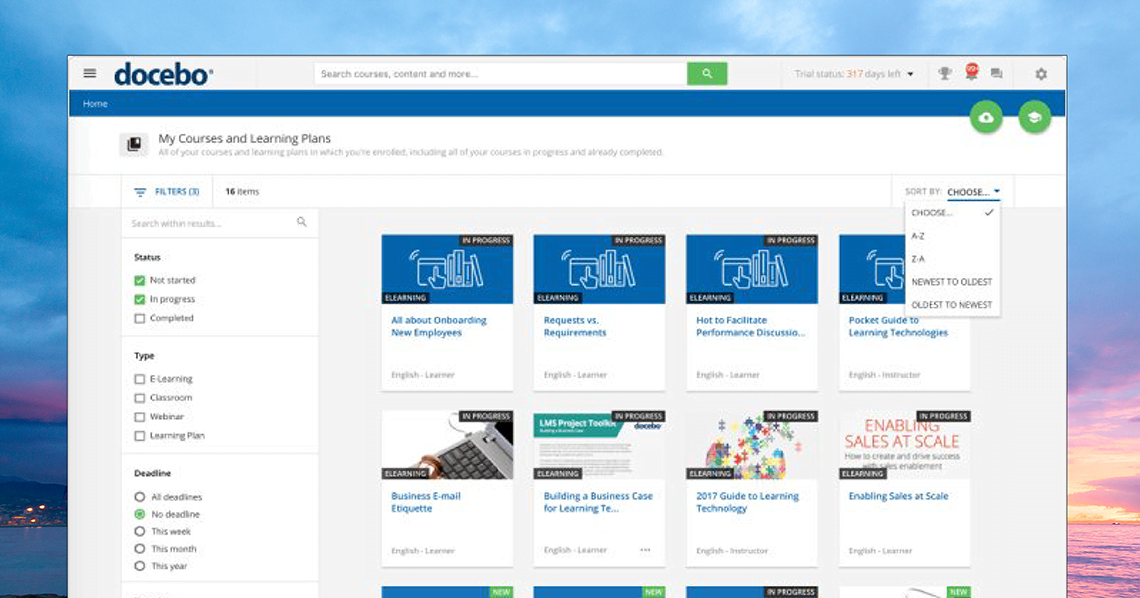
Docebo represents the enterprise tier of AI-powered learning management systems, with sophisticated features for large organizations.
Comprehensive AI capabilities
Docebo has invested heavily in AI across the platform: AI-powered content recommendations personalized to each learner, automated content authoring and course creation, advanced analytics identifying learning patterns and predicting outcomes, skills mapping and competency frameworks, and integrations with major enterprise systems (HRIS, HCM, CRM).
For AI readiness training at enterprise scale, Docebo provides robust infrastructure.
Extended enterprise capabilities
Docebo's "extended enterprise" features support customer training, partner enablement, and multi-tenant deployment—valuable for companies using AI readiness training for customers or partners alongside employees.
Enterprise positioning
With SOC 2, GDPR compliance, and other certifications, Docebo targets large enterprises and heavily regulated industries requiring stringent security and compliance.
Disco vs Docebo for AI readiness training
Docebo and Disco serve different segments of the market:
Implementation and complexity: Docebo is an enterprise platform requiring significant implementation resources and technical expertise. Disco can be deployed rapidly with minimal IT involvement.
Pricing and scale: Docebo typically requires $25,000+ annual minimums. Disco serves training businesses and mid-market organizations at more accessible price points.
Community focus: Docebo's community features exist as premium add-ons. Disco was built with community at its core.
AI philosophy: Both platforms emphasize AI, but differently. Docebo uses AI primarily for personalization, analytics, and automation of administrative tasks. Disco uses AI throughout the learning experience—generating curricula, answering learner questions, and facilitating the training process itself.
User experience: Reviews consistently note Docebo's complexity and learning curve. Disco emphasizes intuitive, modern UX that both administrators and learners appreciate.
Best fit for Docebo
Docebo makes sense for large enterprises (1,000+ employees) with complex HR technology stacks, significant compliance requirements, dedicated L&D teams to manage the platform, and budget for enterprise software.
For training businesses, mid-market companies, and L&D teams wanting rapid deployment of AI readiness programs with strong community engagement, Disco provides a more accessible, purpose-built solution.
6. Canvas LMS – Education-rooted enterprise learning
Canvas LMS (by Instructure) dominates higher education with over 200 million users globally, and now offers Canvas LMS for Business and Government for corporate training.
Enterprise learning features
Canvas brings education-proven capabilities to corporate training: IgniteAI for personalized learning paths aligned to workforce skills, accelerated content creation using AI, real-time skill and ROI tracking, integrations with 1,000+ tools and systems, and open ecosystem for customization.
Strengths for AI readiness training
For large enterprises with learning operations teams and technical resources, Canvas provides a comprehensive platform for workforce development, including AI readiness initiatives. The skills-based approach aligns well with mapping AI competencies across an organization.
Considerations for AI readiness programs
Canvas brings enterprise-grade capabilities but faces challenges for modern training programs:
Community limitations: Canvas's community features feel dated compared to modern platforms. Discussions are text-heavy and forum-style rather than engaging social spaces. For AI readiness training where peer learning and sharing experiments matter, this affects engagement.
Complexity: Canvas requires significant training for administrators and often technical expertise to configure effectively. This overhead may not justify the investment for focused AI readiness programs.
User experience: With a 1.8/5 rating on Trustpilot, Canvas is known for clunky interfaces and dated design. While functional, it doesn't match the modern UX that learners expect.
AI readiness: Despite OpenAI partnerships and AI messaging, Canvas's AI features are relatively nascent compared to platforms built more recently with AI-native architectures.
Disco's approach
Disco offers modern alternatives to Canvas's traditional LMS approach:
Built for engagement: Disco's interface resembles Notion or modern collaboration tools—intuitive, visually appealing, easy to navigate. This matters for AI readiness training where you want learners focused on content, not struggling with the platform.
Community-native: Rather than forums bolted onto an LMS, Disco's community architecture creates genuine connection and peer learning.
Rapid deployment: Launch an AI readiness program in days, not months. No implementation team required.
Training-business friendly: Canvas is built for institutions. Disco serves training businesses selling programs externally as well as internal L&D.
When Canvas makes sense
Canvas works for large enterprises already invested in the platform for other training, organizations with dedicated learning technology teams to manage complexity, and situations where integration with existing Canvas deployments provides value.
For most AI readiness initiatives—especially those run by training businesses or forward-looking L&D teams—Disco delivers better engagement, faster time-to-value, and purpose-built AI tools.
Making the right choice for your AI readiness program
The platform you choose for AI readiness training should align with your specific situation, goals, and resources.
Choose Disco if:
- You're a training business selling AI readiness programs to corporate clients
- You're an L&D team wanting to launch company-wide AI upskilling with strong engagement
- Social learning and peer accountability are central to your training philosophy
- You want AI-powered curriculum creation and learner support, not just administrative automation
- You need to run repeated cohorts of the same program efficiently
- You value modern UX and rapid deployment over extensive enterprise features
- You want one platform for community, courses, cohorts, and operations
Choose LearnWorlds if:
- You need powerful LMS capabilities with strong course authoring tools
- Customer education is a primary use case alongside employee training
- You have resources to manage a more complex platform
- Interactive video and advanced content types are priorities
- Community is supplementary to structured course delivery
Choose TalentLMS if:
- You're an SMB with straightforward internal employee training needs
- Budget is a primary constraint
- You need basic AI support without extensive community features
- Skills frameworks and competency tracking are important
Choose 360Learning if:
- You're a corporate L&D team focused exclusively on internal employees
- Collaborative content creation by subject matter experts is valuable
- Social learning integrated tightly with courses is the priority
- You're comfortable with less community-centric features than Disco
Choose Docebo if:
- You're a large enterprise (1,000+ employees) with complex requirements
- Significant budget ($25K+ annually) is available
- You have dedicated learning technology teams
- Extensive HRIS/HCM integrations and compliance are critical
- Extended enterprise (customer/partner training) is important
Choose Canvas if:
- You're already invested in Canvas for other education/training needs
- You have IT and learning technology resources to manage complexity
- Open ecosystem and extensive integrations outweigh UX concerns
- Large-scale workforce development programs justify the investment
Why training businesses and L&D teams choose Disco for AI readiness
Across hundreds of virtual academies, training businesses, and corporate learning programs, Disco has become the platform of choice for organizations taking AI readiness seriously. Here's why:
AI that powers the entire training lifecycle, not just operations
Circle's AI helps community managers draft posts, moderate discussions, and answer FAQs—valuable operational support. Disco's AI goes further: it helps design your AI readiness curriculum, answers learner questions about the content you're teaching, summarizes complex live sessions, and automates program operations. For teaching AI, having AI deeply integrated into the learning experience creates coherence between message and medium.
Social learning without sacrificing structure
AI readiness training works best when learners share experiments, troubleshoot together, and learn from peers. But it also needs clear progression, assessments, and outcomes. Disco balances both: robust community features that make learning social and engaging, plus program structure, assignments, and tracking that training businesses and L&D teams require.
Community-first platforms like Circle often lack assessment rigor. Traditional LMS platforms include assessments but weak community. Disco delivers both.
Cohort-based design that scales effortlessly
Many organizations need to roll out AI readiness training in waves—different departments, multiple client companies, or continuous enrollment. Disco's cohort model makes this simple: design your program once, clone it for each new cohort with a few clicks, and automatically manage group transitions, schedules, and spaces. This efficiency allows training businesses to scale from dozens to thousands of learners without proportionally increasing operational burden.
Modern experience that learners actually want to use
AI readiness training competes for attention with every other priority learners face. An engaging, intuitive platform increases participation and completion. Disco's Notion-inspired navigation, clean mobile experience, and social features create an environment learners enjoy—reflected in consistently high engagement rates versus traditional LMS platforms.
Flexibility for both B2B and internal training
Whether you're selling AI readiness programs to corporate clients or rolling out internal employee training, Disco handles both. White-label branding, client-specific cohorts, monetization tools, and flexible authentication support various business models. This versatility matters for training businesses and multi-use L&D teams. Explore Disco's use cases for virtual academies and bootcamps.
Conclusion: Building AI-native learning communities
AI readiness training represents more than teaching people to use ChatGPT or Midjourney. It's about developing organizational capabilities—critical thinking about AI applications, ethical frameworks for deployment, collaborative experimentation, and continuous adaptation as the technology evolves.
This kind of transformational learning requires platforms that combine:
- Structured curricula with clear progression and outcomes
- Social environments where learners connect and learn together
- AI tools that enhance both teaching and learning
- Operational efficiency that allows small teams to serve many learners
- Measurement capabilities proving training impact
Circle built an excellent community platform and added courses and AI. For open-ended communities and lightweight learning, it works well. But AI readiness programs demand platforms purpose-built for learning—where community, curriculum, and AI work together seamlessly.
Disco was built specifically for this intersection: AI-powered social learning platforms for serious training programs. Hundreds of training businesses and forward-looking L&D teams use Disco to deliver AI readiness training that combines engagement with outcomes, scale with personalization, and modern technology with human connection.
If you're planning AI readiness training that goes beyond discussion forums and static courses—programs that actually transform how people and organizations work with AI—exploring Disco's AI-powered learning platform is worth the investment.
The future of work is AI-augmented. The future of learning should be too.


