


Why All-in-One Platforms Beat Piecing Together Tools
TL;DR
- Fragmented stacks cost 7 hours/week in overhead and cause low retention (baseline 4-27%).
- Unified platforms with cohort architecture drive 90%+ completion and premium experiences.
- Disco's AI and native integrations boost engagement by 45% with a quick 4-6 week migration.
If you’re profitable as a new learning business, you've built something real. Your learning program has traction. Students are enrolling, community discussions are happening, revenue is flowing. But underneath, does something feel broken?
Like many growing learning businesses, you might be managing a patchwork of five different platforms. Your LMS hosts courses. Slack holds community conversations. Zoom handles live sessions. ConvertKit manages emails. Stripe processes payments. And somehow, you're supposed to stitch this together into a seamless experience while actually teaching.
The bad news is that the operational drag is real. Your team spends 7 hours per week switching between tools and troubleshooting integration failures. That's 18 weeks per year on pure overhead.
And your students feel it. They log into three different platforms to complete one module. They ask questions in Slack that you miss. Their completed assignments don't sync properly, creating frustrating access issues that erode trust.
This is the fragmentation tax. And it's costing more than you realize.
The hidden cost of piecing together your learning stack
Most learning businesses don't choose fragmentation intentionally. It accumulates. Each decision makes sense alone. Collectively, they create silent organizational drain.
The data nightmare: When student data lives across five disconnected systems, you can't see the complete picture. Attendance in Zoom. Course progress in your LMS. Community engagement in Discord. Payments in Stripe. IDC research found that data silos cost the global economy $3.1 trillion annually in lost productivity and misaligned decision making.
For learning businesses, this means delayed insights, missed intervention opportunities, and inability to personalize at scale.
The member experience problem: Your students don't care about your tech stack. They want learning to feel effortless. But when they remember four different login credentials, navigate three different interfaces, and wait for data to sync between systems, friction builds. And friction kills retention.
Consider this: A student completes Module 3 in your LMS, but the community platform doesn't register it because the integration failed. They can't access the exclusive discussion group. They reach out to support. You manually verify and override. The student feels frustrated. You feel embarrassed.
There is a better way.
What premium learning experiences actually require
Learning businesses charging $2,000 per cohort instead of $200, achieving 40% retention instead of 10%, have figured something out: premium pricing requires premium experience. And premium experience requires infrastructure that makes learning feel effortless, social, and transformational.
This infrastructure needs:
Unified student profiles: When learners enroll in courses, join study groups, attend live sessions, and participate in community discussions, the system should capture all of it in one data model. No syncing delays. No missing interactions. Real-time visibility.
Cohort-based architecture: The highest-performing learning programs use cohort models because peer accountability drives completion. Self-paced online courses have completion rates around 25% or lower. Cohort-based courses achieve 90%+ completion rates.
The difference isn't the content. It's the community. But cohorts require infrastructure: enrollment tied to course access, peer visibility, urgent discussion spaces, progress transparency.
Intelligent automation: Premium programs adapt to each learner. That requires systems that trigger personalized nudges when students fall behind, surface relevant discussions based on curriculum position, and automatically route questions to the right instructor.

The retention revolution that changes everything
EdTech baseline retention rates hover between 4% and 27% depending on platform type. Cohort-based community-driven programs achieve retention 2 to 3 times higher. If your baseline retention is 15%, community architecture can drive you to 30% to 45%.
This compounds dramatically. At 15% retention, you're replacing lost customers monthly just to maintain revenue. At 40% retention, you're investing in growth. Your unit economics shift. Customer lifetime value increases.
Research consistently shows that learners in community-oriented environments are more engaged and motivated, leading to higher program completion rates. But this only works when the platform makes peer interaction effortless.
Real results: Organizations consolidating their learning tech stacks report 45% increases in engagement alongside 30% reductions in training costs. The Royal Bank of Canada generated $5.5 million in annual savings through a unified platform by eliminating redundant platform management.
Why Disco is the most AI-scalable option for premium learning communities
The all-in-one platform market has consolidated around distinct positioning:
Kajabi excels at sales and marketing but offers less depth in learning-specific features and community engagement.
Teachable and Thinkific prioritize course delivery but lack sophisticated community features and automation for scaling.
Circle builds strong communities but lacks integrated learning management, forcing users to add a separate LMS.
Disco stands apart as the most AI-scalable premium option purpose-built for transformational learning. Unlike platforms that bolt on AI features as afterthoughts, Disco integrates intelligent automation throughout the entire experience: cohort-based learning, community connection, and AI-powered personalization in one system.
Disco's AI advantage: scale without losing premium quality
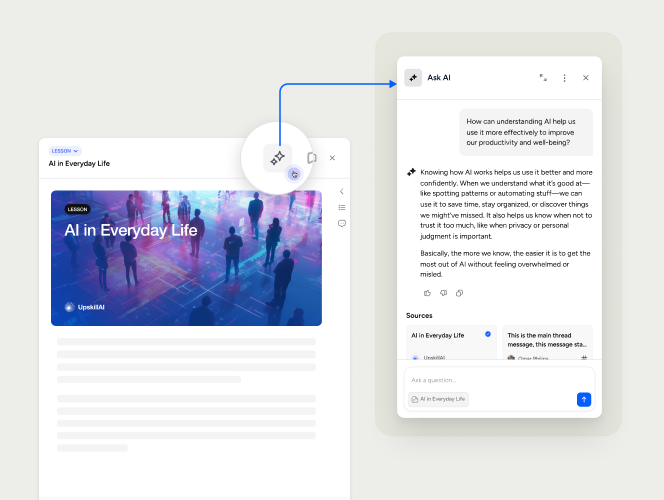
AI-powered student support: Disco's Ask AI automatically answers common questions using your course content and community discussions. This isn't generic chatbot responses. It's contextual support trained on your specific program. D2D Experts achieved 75% time savings on learner Q&A, allowing their team to focus on high-value interactions.
Intelligent content generation: Creating course materials used to take hours. Disco's AI content tools generate initial drafts, outline structures, and learning paths in minutes. You maintain full editorial control while accelerating production velocity.
Automated personalization: As your community scales from 100 to 10,000 members, manual personalization becomes impossible. Disco's AI surfaces relevant peer connections, recommends content based on learning patterns, and triggers nudges when students show disengagement signals.
This AI infrastructure means you maintain the premium, personalized experience that commands premium pricing while serving significantly more students without proportionally increasing headcount.
Deep native integrations eliminate switching costs
One of the biggest barriers to migrating from fragmented stacks is integration complexity. You've spent months building connections between your current tools. Rebuilding feels overwhelming.
Disco eliminates this barrier through deep native integrations built directly into the platform:
Zoom integration: Live sessions sync automatically. Students see upcoming sessions in their course dashboard and join with one click. Attendance data flows back to Disco automatically.
Zapier connectivity: Connect Disco to 5,000+ applications without custom development. Trigger workflows in your CRM when students complete courses. Sync enrollment data to email platforms. The integrations you've built can transfer without starting from scratch.
Payment processing: Stripe and PayPal integrate natively. Accept payments, manage subscriptions, and process refunds without leaving the platform.
Calendar sync: Two-way calendar integration with Google Calendar and Outlook means students add live sessions to personal calendars while you manage everything from one interface.
These are deep integrations maintained by Disco, tested continuously, and designed to feel native.
The migration reality: Because these integrations exist out of the box, migrating to Disco means activating connections rather than building them. Most organizations complete technical setup in days, not months.
Built for migration: Disco makes switching simple
Disco's architecture specifically reduces switching costs:
Data import tools: Bulk import student profiles, course content, and historical data through CSV uploads and structured workflows. No technical expertise needed.
Content migration support: Disco's customer success team provides dedicated migration assistance. They help you audit your current stack, design your new structure, and execute the transition. This is hands-on support from people who've guided hundreds of migrations.
Parallel operation: Run Disco alongside your existing stack during transition. Test with pilot cohorts. Gather feedback. Refine your setup. Only commit to full migration once you're confident.
Typical migration timeline: 4 to 6 weeks from decision to full launch. Compare this to the 18 weeks per year you're currently spending on fragmented stack overhead. The migration pays for itself in operational efficiency within the first quarter.

The competitive advantage: organic growth through unified platforms
Organic search drives 50% of all web traffic. The top 5 organic search results capture 67.6% of all clicks. And organic search delivers 5 times more value than paid advertising in cost-per-acquisition.
Unified platforms have structural SEO advantages:
Better site architecture: Integrated course pages, community showcases, testimonials, and public member discussions create a richer indexable surface than fragmented stacks where elements live on separate domains.
Content velocity: When your platform generates user-generated content (member discussions, peer reviews, project showcases) alongside owned content, search engines see more fresh, unique content signaling relevance.
Authority concentration: Backlinks and internal link equity concentrate on a single domain. If you're using Circle plus Teachable, authority splits across two domains, diluting ranking potential.
Platforms designed for public community spaces allow discussions to be indexed, turning member success stories into discoverable assets that drive organic traffic back to your program.
AI-powered analytics: unified insights that drive decisions
One of the most powerful advantages of Disco's unified architecture is how AI transforms data into actionable insights:
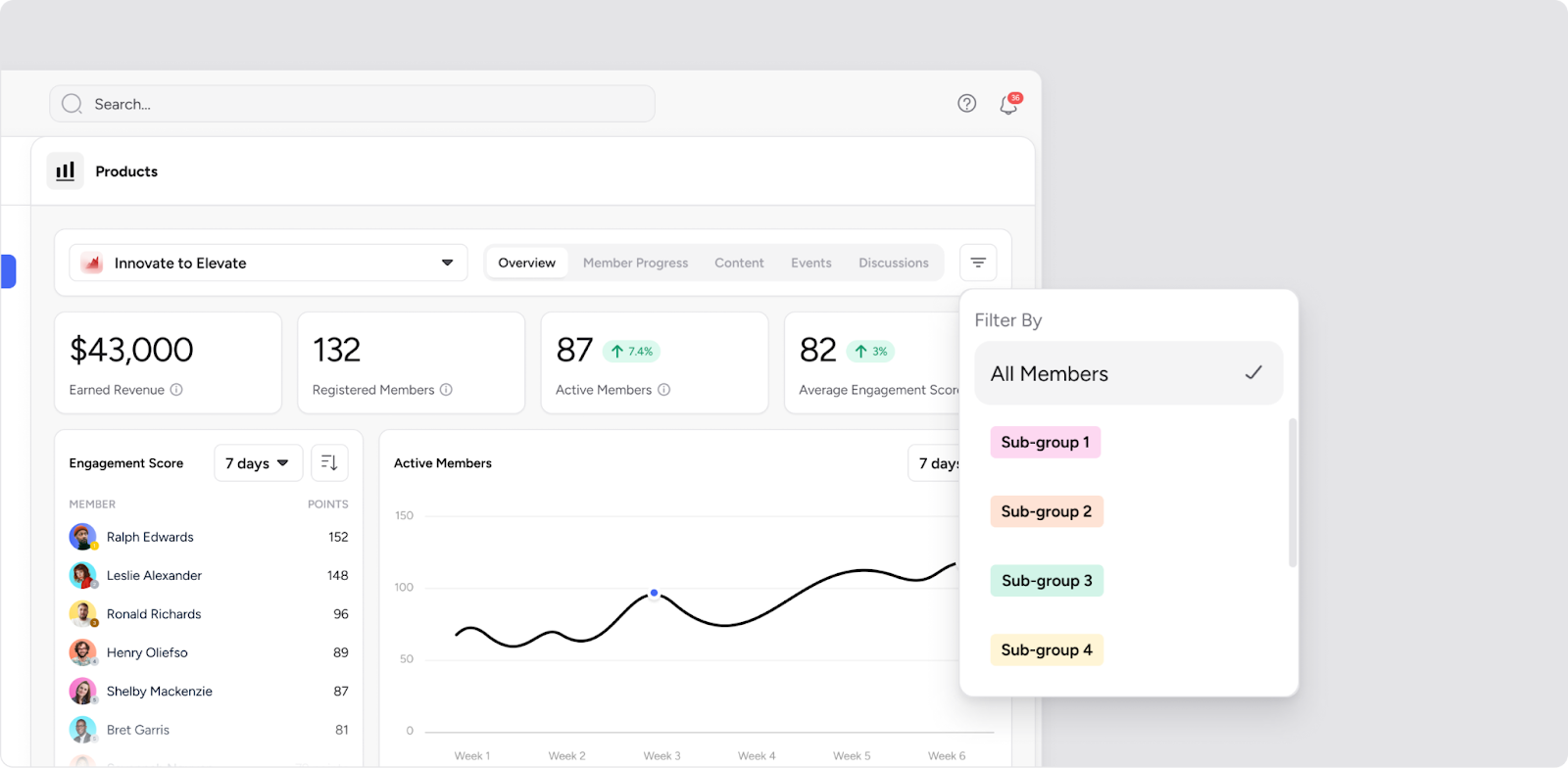
Predictive engagement scoring: Disco's AI analyzes patterns across course progress, community participation, and live session attendance to identify students at risk before they churn. You receive proactive alerts with recommended interventions.
Content performance analysis: See which modules drive highest completion, which discussions generate most engagement, which peer connections strengthen retention. AI surfaces patterns you'd miss in manual analysis.
Revenue attribution: Connect student behavior to revenue outcomes. See which engagement patterns predict renewals. Understand which content justifies premium pricing.
Automated reporting: Generate comprehensive reports without manual data compilation. AI assembles relevant metrics, highlights key trends, and presents insights in clear visualizations. Hours of work become minutes.
This intelligence only works when all your data lives in one unified system.
The decision: stop paying the fragmentation tax
Every learning business faces this choice: build on infrastructure that compounds value over time, or accept infrastructure that creates ongoing drag.
Fragmented stacks create drag. Each integration is a potential failure point. Each new tool adds complexity. Each student touchpoint across multiple platforms introduces friction. And the operational overhead (7 hours per week, 18 weeks per year) never goes away.
Unified platforms create compounding advantages. Better data enables better personalization. Better experiences drive higher retention. Higher retention enables premium pricing. Premium pricing funds better content and features.
For learning businesses ready to scale beyond duct-taped solutions, Disco offers the most AI-scalable, migration-friendly path forward:
- Deep native integrations eliminate switching costs
- AI-powered automation maintains premium quality at scale
- Cohort-based architecture and community features work together seamlessly
- 4 to 6 week migrations with dedicated support
- Unified data enabling intelligent personalization impossible on fragmented stacks
Your students deserve seamless learning experiences. Your team deserves operational clarity. Your business deserves infrastructure that compounds value instead of creating drag.
The fragmentation tax is optional. Stop paying it.


