


Canvas vs Disco: AI-Native Learning Platforms Compared
.png)
TL;DR
Canvas LMS offers AI features like Smart Search and discussion summaries that help instructors manage courses more efficiently. However, Disco is purpose-built as an AI-native learning platform that embeds artificial intelligence across every aspect of the learning experience—from instant program generation and AI-powered learner support to community engagement copilots and operational automation. For training businesses, corporate academies, and L&D teams running cohort-based programs, Disco delivers a complete AI-powered learning and community operating system rather than AI tools bolted onto a traditional academic LMS.
The phrase "AI-powered learning platform" has become ubiquitous in 2026, but not all AI implementations are created equal. Canvas LMS has added AI capabilities to its mature academic platform, while Disco was architected from the ground up as an AI-native learning ecosystem. This distinction matters tremendously for corporate L&D teams and training businesses deciding where to invest.
Canvas remains a robust choice for institutions extending their academic programs into workforce development. Disco, however, represents a fundamentally different approach: learning designed for social connection, community engagement, and transformational outcomes—with AI woven into every interaction rather than layered on top of existing infrastructure.
What "AI-native" actually means
An AI-enabled platform adds artificial intelligence features to existing architecture. An AI-native platform is designed around AI from its foundation, treating machine learning as core infrastructure rather than optional enhancement.
Canvas has integrated AI thoughtfully into its instructor-facing workflows. Disco built its entire platform assuming AI would power content creation, learner support, community engagement, and operational automation simultaneously. This architectural difference shapes everything from implementation speed to learner experience.
AI for content creation: instructor assist vs complete generation
Canvas approach
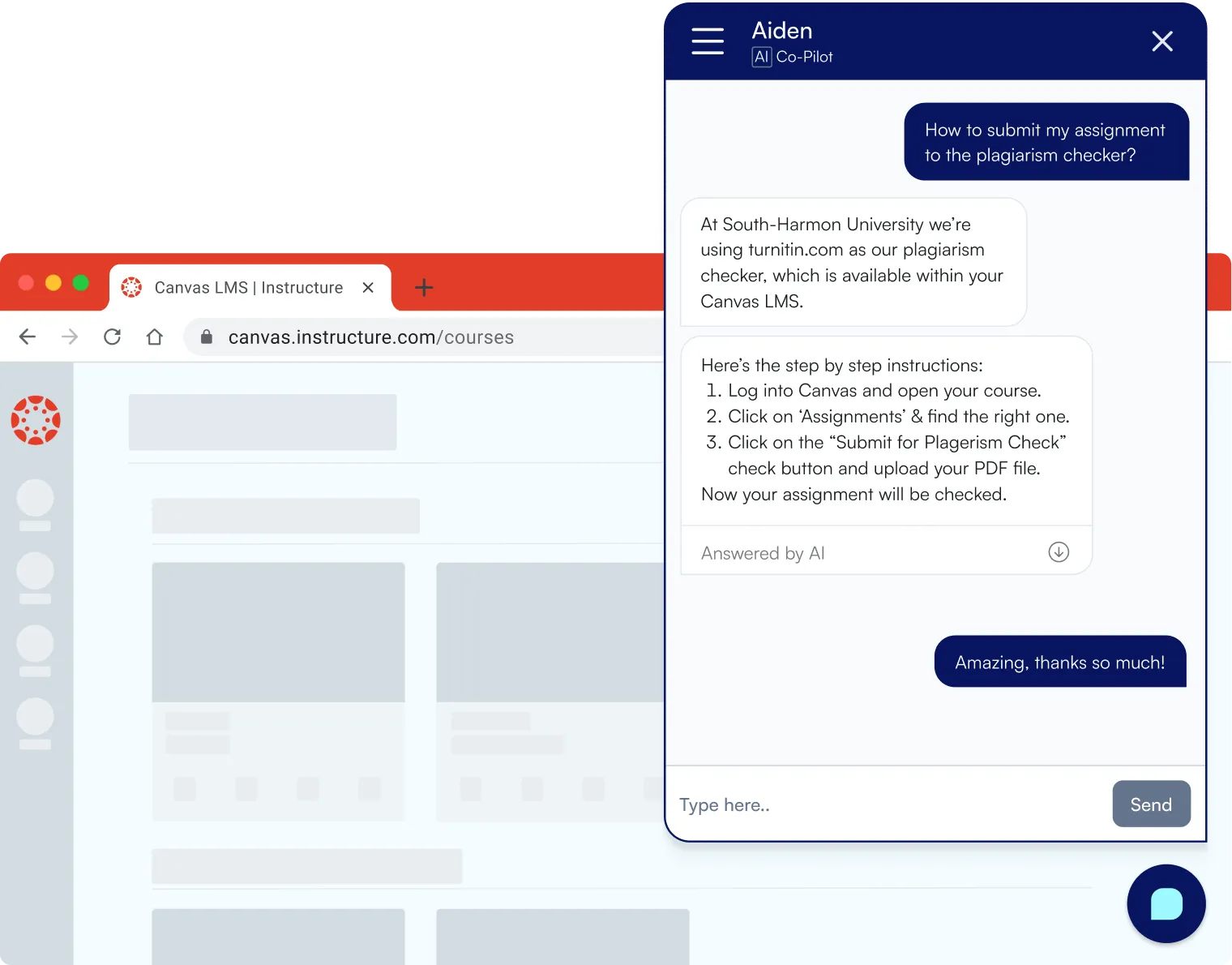
Canvas has rolled out several AI tools focused on reducing instructor workload. The platform's AI rubric generator helps educators create assessment criteria from existing content. Smart Search uses contextual understanding to surface relevant course materials across pages, announcements, and discussions. The upcoming "Super SmartGrader" promises first-pass scoring on assignments using AI evaluation against rubrics.
For institutions with dedicated instructional design teams and substantial course development time, these tools meaningfully accelerate existing workflows. Canvas AI helps instructors work faster within familiar course authoring patterns.
Disco approach
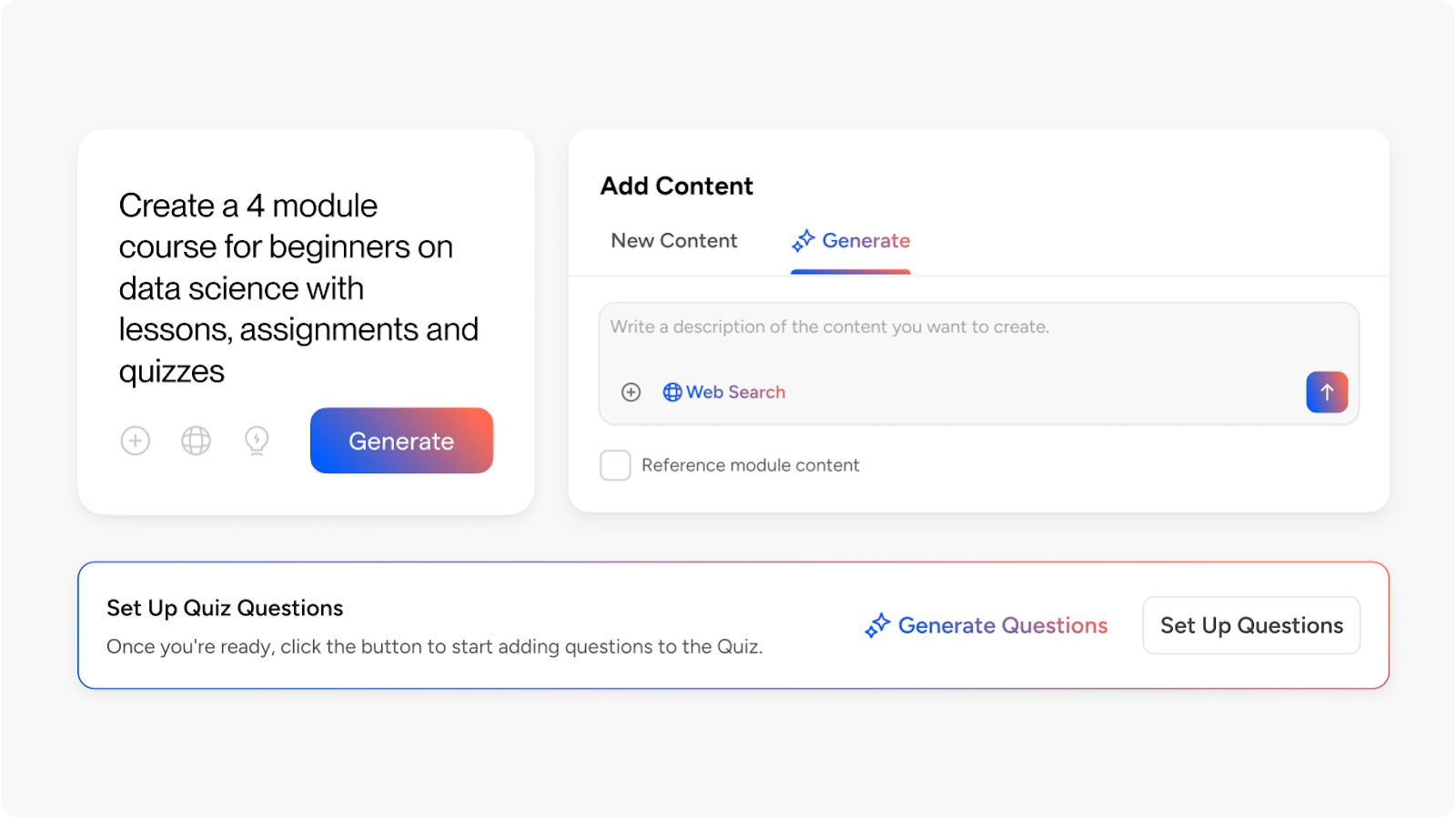
Disco's AI Canvas generates complete learning programs in minutes from prompts or existing content. The platform's AI capabilities include:
- Program generation: Build full curricula with learning objectives, content suggestions, and assessment frameworks from a single prompt
- Quiz generator: Automatically create assessments aligned with learning outcomes
- Write with AI: Generate lesson content, facilitator guides, and learner materials
- Image generation: Create custom visuals for programs without external design tools
- AI video enhancement: Upload videos to receive automatic transcripts, chapter markers, and content summaries
- Time estimates: AI calculates expected completion duration for lessons and modules
[Insert screenshot: Disco AI Canvas generating a complete program structure]
For training businesses launching new offerings or corporate academies scaling quickly, Disco's generative approach transforms weeks of curriculum development into days. A training business using Disco can move from concept to live program faster than competitors can outline their syllabus in Canvas.
AI for learner support: behind-the-scenes vs in-the-moment
Canvas learner experience
Canvas AI primarily enhances the instructor and administrator experience. Smart Search helps learners find content across courses, and some institutions embed custom LLM assistants using the Smart Search API for additional support. The platform's AI generates discussion summaries that help instructors identify key themes, but learners don't directly interact with AI during their learning journey.
This approach maintains Canvas's traditional course structure while using AI to surface information more effectively. For learners, the experience remains fundamentally unchanged—they navigate courses, complete assignments, and participate in discussions much as they would without AI.
Disco learner experience
Disco's Ask AI functions as a contextual learning assistant trained on your academy's entire content library. Learners can:
- Ask questions about course material and receive instant, source-backed answers
- Explore generative questions embedded directly within lessons to deepen understanding
- Get personalized guidance without waiting for instructor response
- Access 24/7 support that scales infinitely without additional staffing
[Insert screenshot: Disco Ask AI interface showing learner question and contextualized response]
This transforms learning from content consumption into active dialogue. A learner stuck on a concept at 11pm doesn't bookmark their question for office hours—they get immediate, accurate support that keeps momentum alive.
AI for community engagement: analytics vs active participation
Canvas community capabilities
Canvas provides discussion forums that can be threaded, graded, and organized by groups or sections. The platform's AI generates summaries of these discussions for instructors, helping them understand conversation themes without reading every post. Canvas discussions work well for structured, course-bound exchanges.
However, Canvas community features remain tied to individual courses and terms. There's no native social feed spanning programs, no AI layer suggesting conversation starters or matching learners with similar interests, and no broader network model that maintains connections beyond course completion.
Disco community capabilities
Disco treats community as central infrastructure, not an add-on feature. The platform's AI Community Engagement tools include:
- Suggested prompts and posts: AI generates conversation starters based on program content and member activity
- Smart reply suggestions: Contextual response recommendations that maintain discussion quality
- Automated nudges: Intelligent reminders triggered by engagement patterns to re-activate quiet members
- AI Insights: Predictive analytics with suggested actions to improve engagement before problems emerge
[Insert screenshot: Disco community feed showing AI-generated engagement prompts and member interactions]
Training businesses using Disco maintain vibrant member communities with minimal manual moderation. The AI doesn't just report on engagement—it actively fosters it, creating the social learning environment that drives completion rates 4x higher than traditional platforms.
AI for operations and automation: reporting vs proactive management
Canvas operational AI
Canvas offers Intelligent Insights for administrators and analytics dashboards through Canvas for Business and Government. The Smart Search API allows institutions to connect their own large language models and integrate AI into existing workflows. For organizations with technical resources, Canvas provides extensibility to build custom AI-enhanced operations.
The platform excels at reporting and visibility. Administrators can see learner progress, identify at-risk students, and track completion metrics. However, acting on these insights typically requires manual intervention—Canvas shows you the data; you build the workflows.
Disco operational AI
Disco automates operational workflows that typically consume 20+ hours per week of admin time:
- Automated onboarding sequences: New members receive personalized welcome experiences based on their role, program, or cohort
- Smart certification and badging: Automatic credential issuance upon completion with customizable criteria
- Engagement workflows: Triggered reminders, milestone celebrations, and re-engagement campaigns
- AI-powered reporting: Not just dashboards showing what happened, but recommended actions to improve outcomes
- API and webhooks: Connect Disco to your existing tech stack with thousands of integrations
The platform's automation templates mean training businesses can deliver personalized, high-touch experiences at scale without scaling headcount proportionally. A team of three can manage programs serving thousands of learners with operational excellence that would require a dozen people in a traditional LMS.
Data strategy and AI transparency
Canvas approach
Canvas has implemented "AI nutrition facts" labeling to describe which AI models and data policies apply to each tool and LTI integration. This transparency helps institutions make informed decisions about AI adoption while maintaining data governance standards. The Smart Search API allows organizations to bring their own LLM and maintain control over how course content is vectorized and processed.
For enterprises with strict data residency requirements or regulatory constraints, Canvas's approach to AI extensibility and transparency provides necessary flexibility.
Disco approach
Disco's Ask AI can be trained on your organization's proprietary content and knowledge base, keeping answers on-brand and accurate to your specific context. The platform's API and webhooks enable integration with existing systems while maintaining data security. Disco treats AI as infrastructure that should work within your policies, not require you to adapt to its constraints.
The fundamental difference: course delivery vs learning community
The deepest distinction between Canvas and Disco isn't feature count—it's architectural philosophy.
Canvas began as, and remains, a course-centric LMS. Its AI enhancements make course creation faster, grading easier, and content discovery better. But the fundamental model stays the same: instructors create courses, learners consume them, and discussions happen within course boundaries.
Disco treats learning as inherently social and ongoing. Programs exist within communities, not the other way around. Learners maintain connections across cohorts and continue engaging long after completing specific courses. AI doesn't just make content creation efficient—it keeps conversations alive, surfaces relevant connections, and turns one-time learners into lifelong members.
[Insert screenshot: Disco community dashboard showing member activity across multiple programs and cohorts]
This matters profoundly for training businesses building sustainable academies and corporate L&D teams creating cultures of continuous learning. Canvas optimizes for course completion. Disco optimizes for transformation and retention.
Implementation and total cost of ownership
Canvas deployment
Canvas pricing requires sales conversations and typically follows institutional or enterprise licensing models. Organizations report:
- Implementation timelines measured in weeks or months depending on complexity
- Need for technical resources to configure integrations and customize functionality
- Ongoing IT involvement for maintenance and user support
- Best fit for organizations with dedicated learning technology teams
Canvas shines when organizations have the resources to fully leverage its extensive feature set and can invest in proper implementation.
Disco deployment
Disco offers transparent SaaS pricing starting at $399 per month with clear plan structures designed for training businesses and corporate teams. Organizations report:
- Academies live and accepting learners within days, not months
- Minimal technical requirements beyond basic web literacy
- AI-powered automation reducing ongoing administrative burden
- Best fit for lean teams that need to move quickly without sacrificing quality
Disco's implementation speed makes it practical for organizations that can't dedicate months to LMS deployment or maintain large internal learning operations teams.
When Disco makes sense
Disco is purpose-built for:
- Training businesses and bootcamps selling cohort-based programs
- Corporate academies and customer education teams building branded learning experiences
- L&D organizations prioritizing engagement, completion, and community over compliance tracking
- Teams that need to launch quickly and scale efficiently without expanding headcount
- Organizations wanting AI woven throughout the learning experience, not just the authoring experience
Disco serves hundreds of learning organizations globally that need more than a traditional LMS can provide—even a traditional LMS with AI features added.
Conclusion
Canvas has added AI capabilities to its established academic LMS platform, helping instructors work more efficiently and administrators gain better visibility. These are meaningful improvements to a mature product for some users.
Disco represents a different category entirely: an AI-native learning and community operating system built specifically for modern training businesses and corporate academies. Every aspect of the platform—from program design to learner support to community engagement to operational workflows—assumes AI as foundational infrastructure rather than optional enhancement.
For organizations evaluating "AI-powered learning platforms," the question isn't whether Canvas or Disco uses artificial intelligence. Both do. The question is whether you need AI that makes traditional course delivery more efficient, or AI that enables fundamentally different approaches to learning: social, community-driven, and designed for transformation rather than completion.
If you're a training business, customer education team, or corporate L&D leader looking to create learning experiences people actually want to return to, Disco offers the AI-native alternative Canvas was never designed to be.
Ready to see how AI-native learning actually works? Explore Disco's AI-powered features or speak with our team about building your academy on a platform designed for the future of learning.


