


Monetizing Your Learning Community Without Complex Tech Stacks
.png)
TL;DR
- All-in-one platforms drive 4x higher engagement.
- Launch revenue-generating academies in days, not months.
- Reduce admin overhead by 75% with unified analytics.
How enterprise learning businesses are launching revenue-generating academies in days—not months—with all-in-one platforms that eliminate switching costs and deliver 4x engagement.
The hidden cost of fragmented learning tech
Your enterprise learning business doesn't need another integration project. Yet most training organizations are drowning in them.
Legacy LMS platforms. Separate payment processors. Standalone community tools. Video hosting services. Email automation. Analytics dashboards.
Each connection creates friction. Each update risks breaking something. Each vendor negotiation drains resources that should go toward learners.
The result? Weeks or months to launch, delayed revenue, and training teams spending more time managing tech than building programs.
Why traditional enterprise LMS platforms block monetization
50% of membership-based learning businesses grew revenue last year, many reaching six and seven figures. But most used purpose-built platforms, not retrofitted LMS systems.
Traditional enterprise learning stacks weren't designed for revenue generation. They were built for compliance tracking and course completion metrics—not subscriptions, digital products, or community engagement.
Three barriers keep legacy platforms from monetizing effectively:
- Bolted-on payments. Third-party integrations add complexity, fees, and security concerns. Transaction failures become support nightmares.
- Scaling requires developers. Adding new revenue streams means custom builds, API connections, and ongoing maintenance costs.
- Engagement remains low. Traditional LMS platforms average 20% engagement, leaving most learners inactive and unlikely to renew or upgrade.
For enterprise learning businesses targeting customer academies or extended enterprise training, these limitations kill scalability before it starts.
The all-in-one advantage: Revenue from day one
Leading enterprise learning businesses are switching to platforms built for monetization and scale. The difference shows immediately.
Native payments, zero platform fees
Platforms with built-in Stripe integration let you sell courses, memberships, and certifications without payment processor overhead. Keep 100% of revenue with 0% platform fees, using discount codes and referral systems to drive viral growth.
This matters for extended enterprise programs, where selling training partnerships and certifications can reduce support costs by 16% while creating new revenue streams.
Seamless integrations with your existing tools
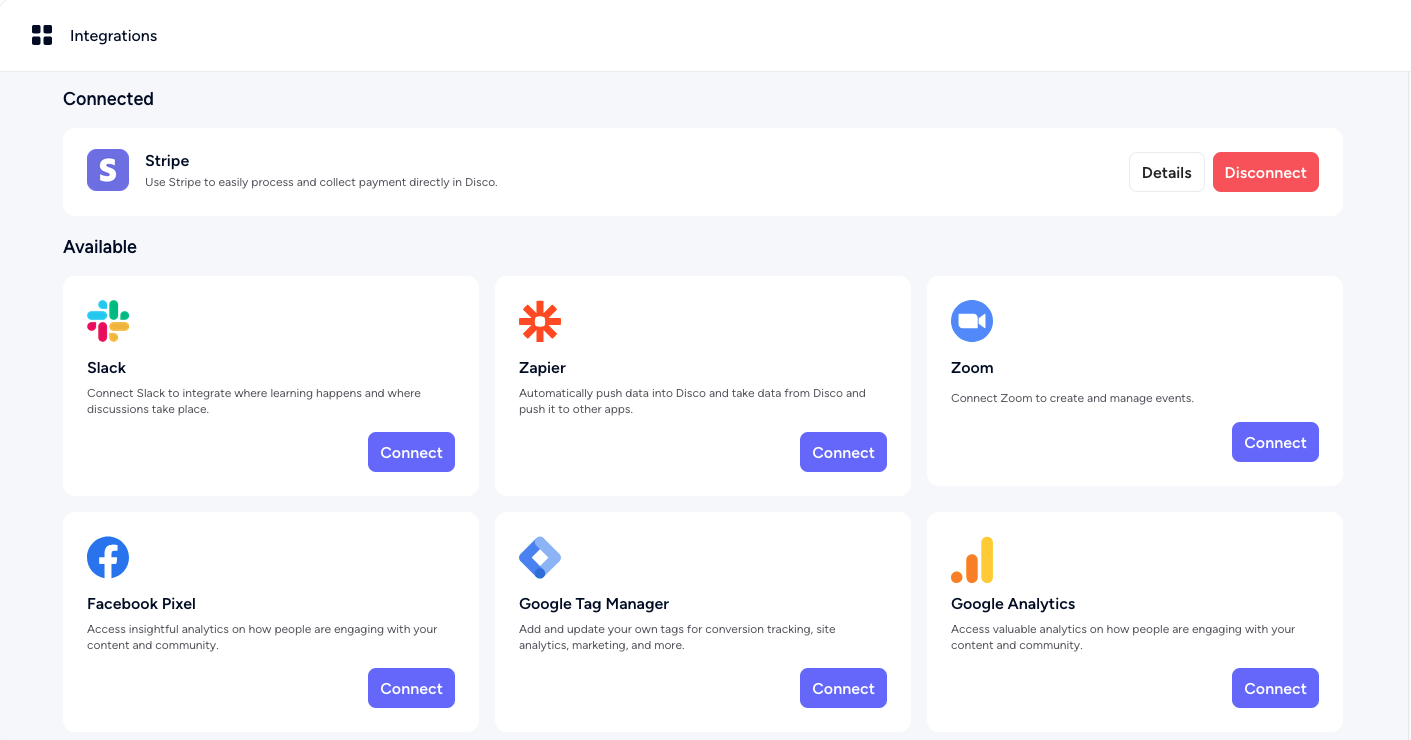
Modern platforms connect directly with the tools you already use—Zoom for live sessions, Zapier for workflow automation, your CRM for learner data. These aren't fragile API connections requiring developer maintenance. They're purpose-built integrations designed to work together from day one.
You keep the tools that work while eliminating the complexity of managing disconnected systems.
Launch in days, not months
Pre-built templates and guided workflows eliminate the $10,000 to $100,000 custom build costs of traditional implementations. Launch branded learning academies in days with production-ready frameworks for subscriptions, cohorts, and events.
Enterprise learning businesses report 50% faster onboarding and immediate revenue generation versus legacy platform migrations that take quarters to complete.
Unified analytics without integration chaos
When payments, engagement, and learning data live in one dashboard, you see what drives revenue. No Zapier workflows needed for basic operations. No data exports. No reconciling reports across five systems.
Organizations using all-in-one platforms achieve 75% reductions in administrative overhead, freeing teams to focus on program quality instead of technical troubleshooting.
Proven revenue models for enterprise learning businesses
Digital learning products grew 70% in transactions from 2022 to 2024, with enterprise training businesses leading adoption. Three models dominate:
Tiered membership subscriptions
Offer basic, professional, and enterprise access levels with different content libraries, live events, and certification paths. Recurring revenue from subscriptions creates predictable income while paid members show higher engagement and renewal rates.
On-demand courses and certifications
Create once, sell infinitely. Digital courses scale without marginal delivery costs, while certifications command premium pricing from professionals seeking credentials.
Hybrid programs combining access and events
Mix self-paced content with live cohorts, workshops, and networking events. This model supports both B2C individual learners and B2B enterprise contracts.
Multi-tenant platforms let you reuse content across audiences, customizing monetization without recreating assets for each customer segment.
The switching cost myth
"We've invested too much in our current stack to switch now."
This objection assumes switching means starting over. It doesn't.
Plus, modern platforms integrate with your existing tools—your CRM, communication systems, and content libraries connect through purpose-built integrations, not custom code.
The real switching cost isn't migration—it's the revenue you lose every month staying on platforms that weren't built for growth.
Enterprise learning businesses winning with unified platforms
- Kids & Company scaled training for 3,000+ employees while cutting administrative tasks in half.
- Monitor Deloitte and Kaplan switched from fragmented stacks spanning 17+ platforms to achieve superior engagement and faster program launches.
Training businesses across industries now monetize communities profitably through passive income from courses and events, with SEO-optimized portals driving organic learner discovery.
The pattern is consistent: enterprises save $200 per employee by eliminating infrastructure overhead while simultaneously creating new revenue streams from digital products.
From cost center to profit center
The shift from enterprise learning as expense to enterprise learning as revenue generator requires infrastructure purpose-built for monetization.
Your next learning program should generate income, not just completion certificates. Your community should drive renewals, not just house content. Your platform should accelerate launches, not delay them.
Practical implementation:
Choose platforms with native payment processing and zero platform fees. Transaction revenue belongs to your business, not your software vendor.
Launch with templates optimized for your business model. Whether selling to individuals or enterprises, start generating revenue in days instead of months.
Use unified analytics to optimize conversion. When engagement and payment data connect, you see exactly which content drives subscriptions and renewals.
Scale through multi-tenancy, not duplication. Reuse successful programs across customer segments with customized branding and pricing.
Leverage purpose-built integrations. Connect your existing tools without developer overhead or fragile custom code.
The competitive window is closing
As more enterprise learning businesses discover the revenue potential of modern platforms, early movers capture market share. Late adopters spend years catching up while competitors build engaged, paying communities.
The question isn't whether to monetize your learning community. With 50% of membership programs already growing revenue and digital products scaling infinitely post-creation, the question is how quickly you'll switch to infrastructure that supports it.
Complex tech stacks are optional. Revenue generation isn't.
Ready to turn your training programs into revenue engines? Disco's all-in-one enterprise learning platform delivers 4x engagement, 75% admin reduction, and built-in monetization with 0% platform fees. Launch your first revenue-generating academy in days, not months. Start transforming your learning business today.


