


The AI Bet That Actually Pays: Investing in How People Learn
.png)
TL;DR
95% of enterprise AI pilots fail to deliver ROI. While most projects struggle to show returns, a specific category keeps delivering: learning and upskilling.
MIT's July 2025 study sent shockwaves through the business world: 95% of generative AI pilots fail to deliver measurable financial returns. Across $30 to $40 billion in enterprise AI spending, only 5% of projects showed meaningful P&L impact.
The MIT researchers identified the core problem behind failing AI pilots: generic tools excel for individuals, but stall in enterprise use because they operate in a vacuum, failing to learn from or adapt to specific organizational workflows.
Yet a specific category of AI investment keeps beating those odds, in-house learning and upskilling.
Learning platforms solve the core issue by design. Instead of asking employees to leave their work to "chat" with a bot, they integrate AI directly into the environment where context already lives: courses, discussions, and the proprietary knowledge base.
While the broader market struggles with ROI, a clear divide has appeared. Companies that use AI not to replace people, but to empower them through structured education, are seeing the returns the rest of the market is missing.
Companies with formalized training see 218% higher income per employee and 17% greater productivity. Bell Canada's cloud training boosted sales by 67%. source
This success isn't limited to the Fortune 500; it is a repeatable blueprint for any training-first organization:
- D2D Experts cut learner support time by 75% by using AI to handle repetitive inquiries.
- Coding Temple doubled their learner retention and lifted NPS by 61% through AI-powered personalization.
- The Toronto Board of Trade halved their administrative workload, shifting their focus from logistics to high-value community interaction.
AI built into learning experiences delivers three compounding advantages: dramatically improved outcomes, reclaimed administrative time, and engagement that scales without proportional headcount.
Learners achieve 54% higher outcomes with integrated AI
A 2025 randomized controlled trial at Harvard found that students using an AI tutor achieved learning gains more than double those of in-class active learning, with effect sizes ranging from d = 0.63 to 1.3. The study also found that 83% of students rated AI explanations as good or better than human instructors. Personalized AI instruction improves outcomes by 30% versus conventional approaches. Adaptive learning systems show a 62% increase in test scores.
These results represent the central tendency across multiple studies and implementations.
The mechanism explains why learning AI succeeds where other enterprise AI fails. MIT found that generic tools like ChatGPT stall in enterprise use because they operate in a stateless vacuum with no awareness of organizational context. When a learner pauses to query an external tool, they face exactly this problem: the model has no knowledge of their curriculum, recent discussions, or company methodology. It provides plausible but often irrelevant answers.
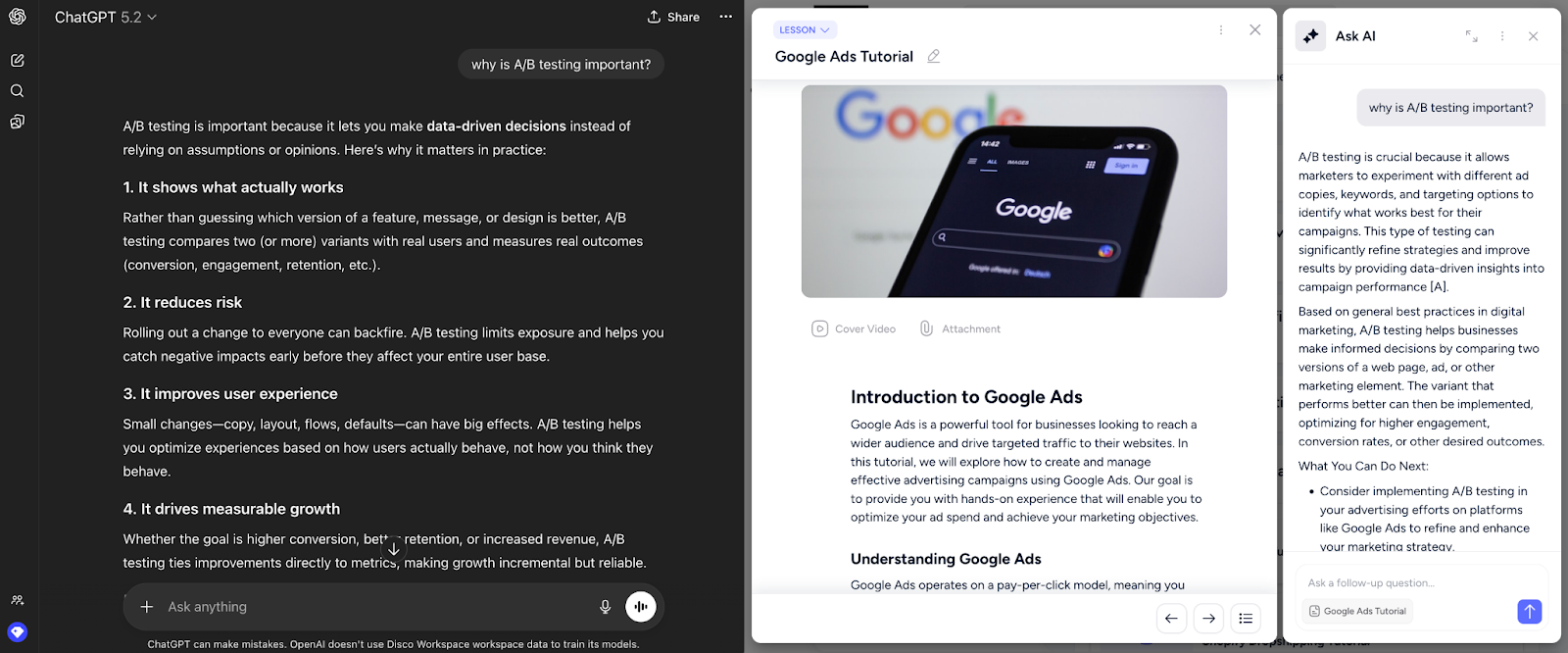
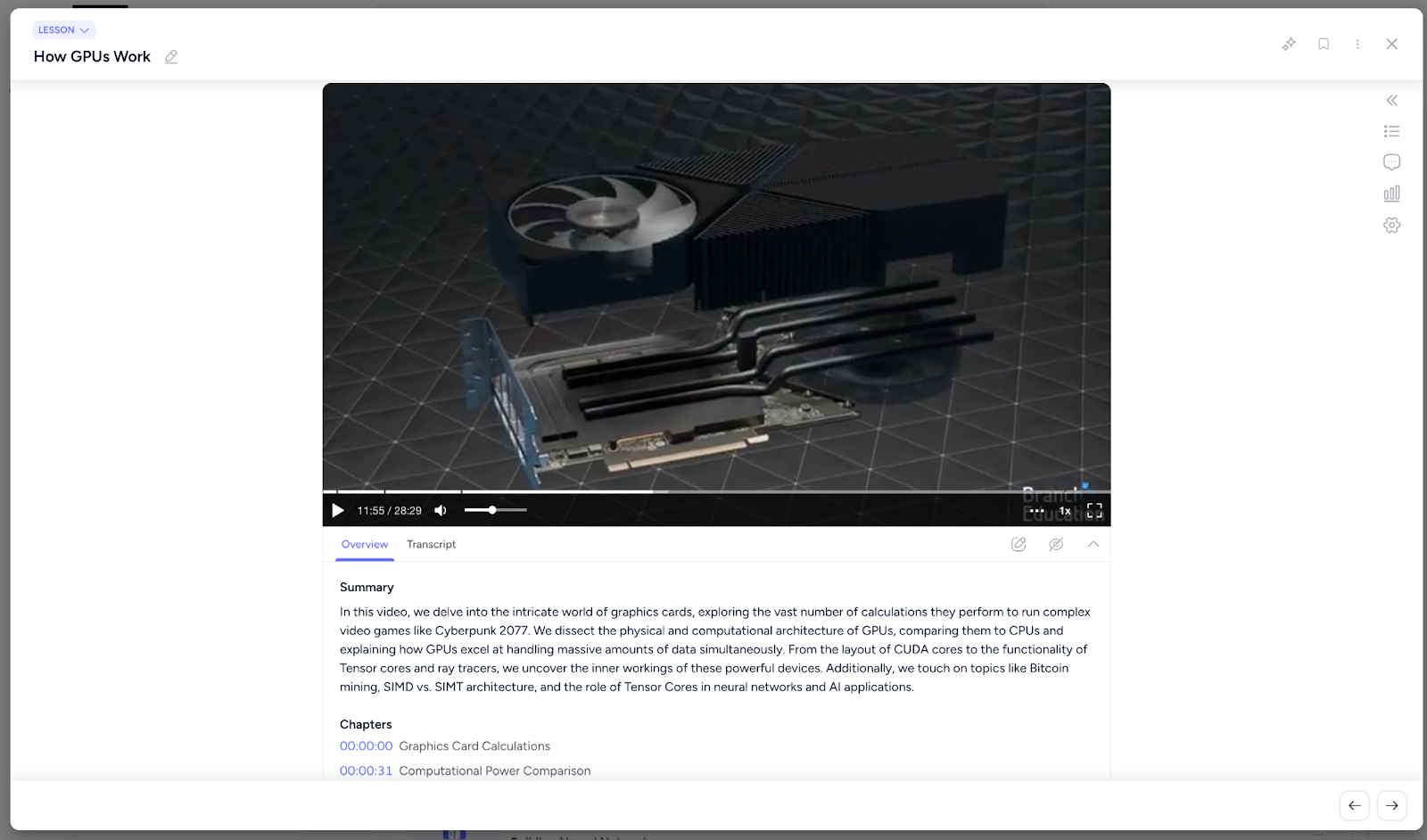
Integrated AI solves the context problem that kills most enterprise pilots. Using Retrieval-Augmented Generation (RAG), it grounds responses in the organization's actual knowledge base: courses, documents, video transcripts, and community discussions. The learner gets instant, context-aware answers with citations to source material. Hallucination risk drops. Trust builds.
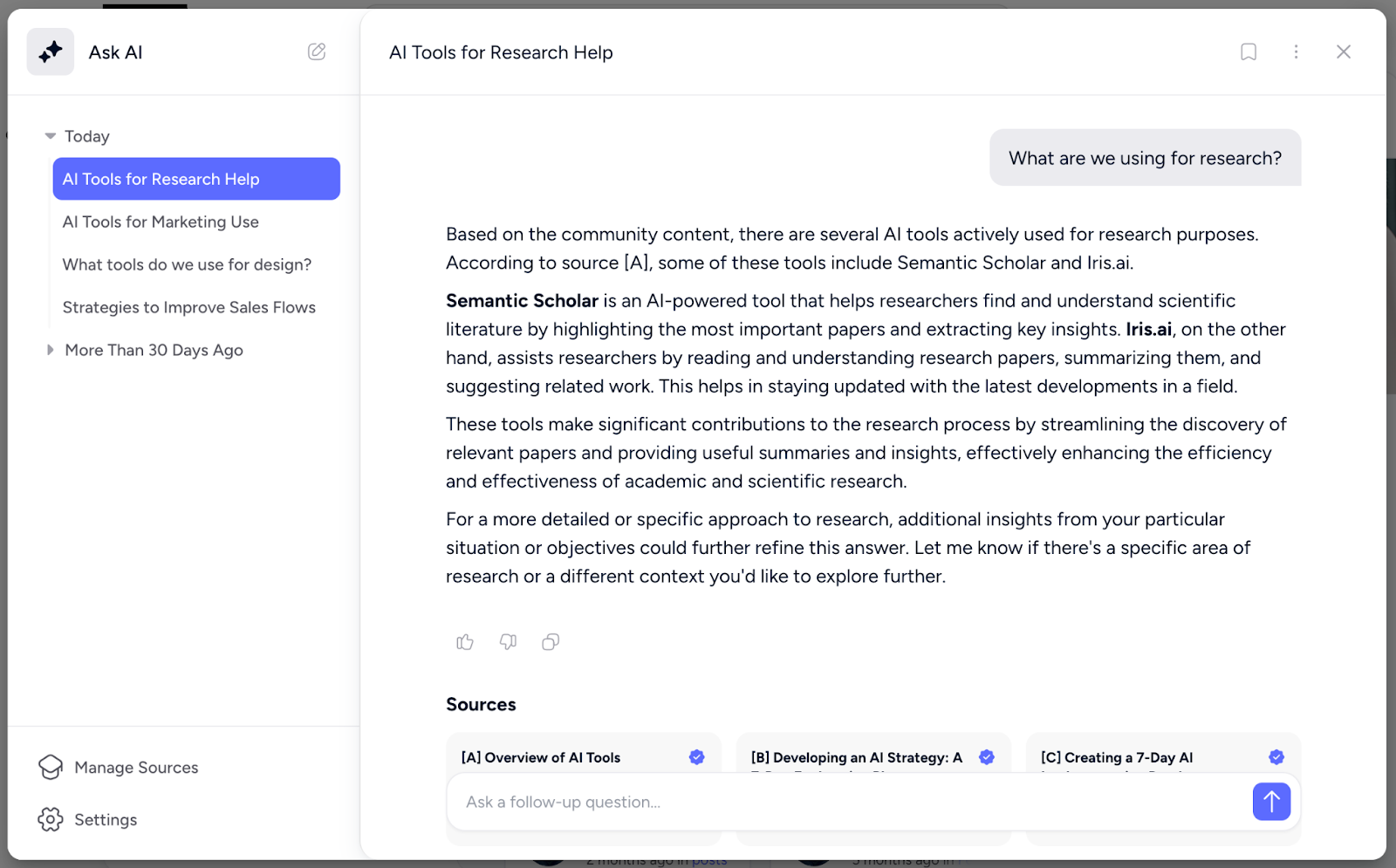
Coding Temple utilized AI-powered personalization to double their learner retention rates and achieve a 61% increase in their Net Promoter Score. By matching learners with relevant materials based on role and skill level, the platform reduced time-to-competency and improved overall satisfaction.
The cognitive science supports this. Sweller's Cognitive Load Theory defines learning as selecting, organizing, and integrating information into long-term memory. This process is constrained by working memory limits. When learners must constantly swap between content and external tools, extraneous cognitive load becomes prohibitive. Research indicates that task switching can consume up to 40% of productive time.
Integrated AI allows cognitive offloading without the overhead of managing separate tools. The result: 70% to 80% knowledge retention at 30 days versus 20% to 30% in fragmented workflows.
Administrators reclaim 40% of their time
The MIT study found that back-office automation produces the highest returns for enterprise AI, outperforming the sales and marketing tools where most budgets go. Learning administration is precisely this kind of back-office function: repetitive, process-heavy, and ripe for automation.
Teachers currently spend 40% of their time on administrative tasks. This creates a fundamental constraint on student engagement and strategic instruction.
AI addresses this directly. According to a Gallup survey, 60% of teachers used AI this year and saved nearly six hours of work per week. That translates to roughly 312 hours annually per educator, time that can be redirected toward high-value teaching.
In corporate training, the efficiency gains compound. Automation reduces administrative overhead by 40%. Organizations implementing AI-powered microlearning report up to 50% reduction in training time, with one leading retail chain cutting onboarding time in half while improving knowledge retention. Content creation time drops by 50% for learning design.
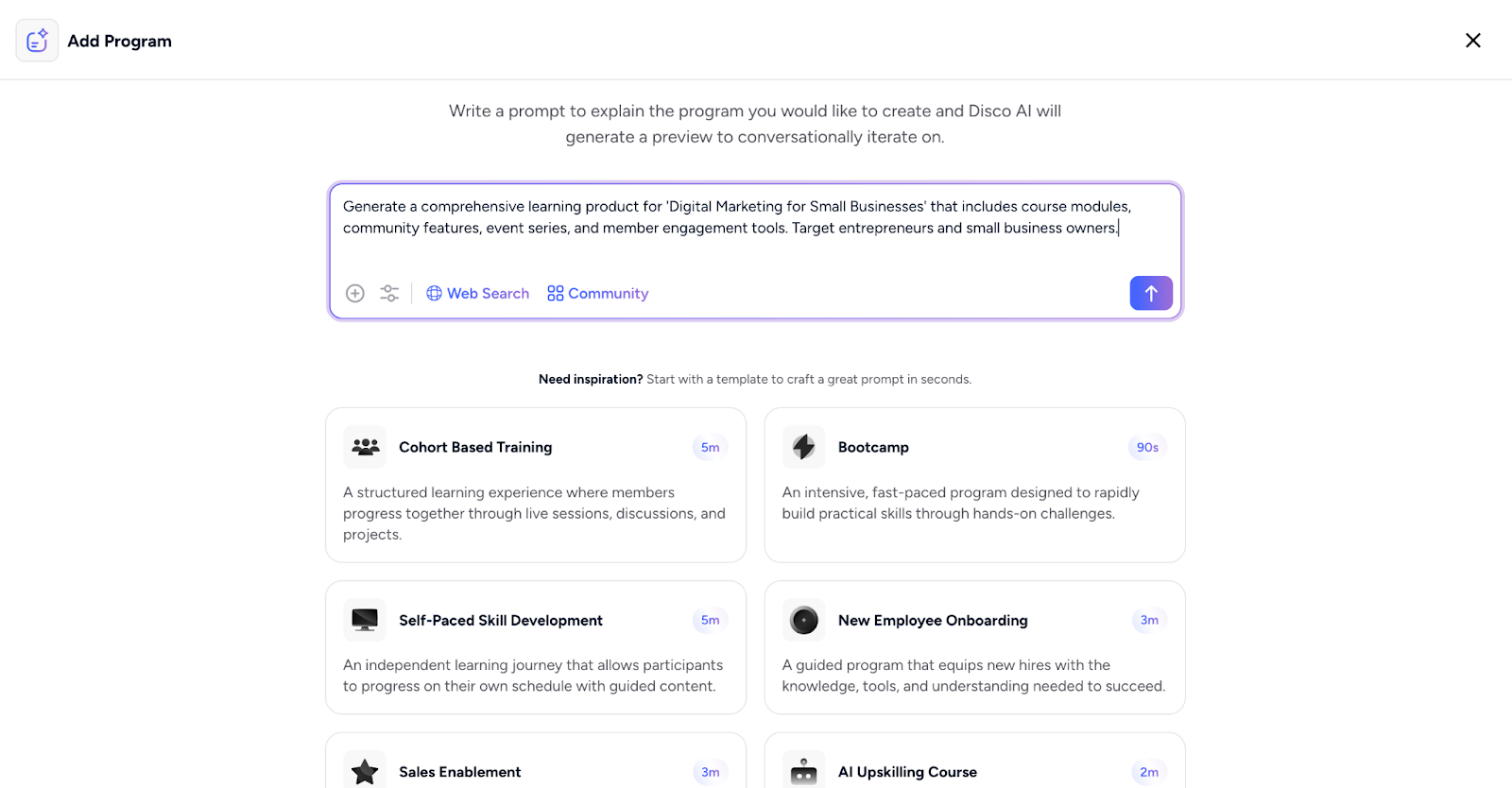
D2D Experts, a sales training firm, previously operated with a patchwork of tools including Google Drive, Slack, and Zoom. Tracking progress and providing consistent support was nearly impossible. By centralizing their training communities on Disco, they achieved:
- 75% reduction in learner Q&A time (AI handled repetitive inquiries using company SOPs)
- 50% reduction in onboarding time
- 10% faster ramp time for sales reps
- Operational savings equivalent to one to two additional full-time employees
The Toronto Board of Trade faced similar administrative burdens managing their social learning programs. After implementing AI and automation features, they reported a 50% reduction in administrative tasks. The Chairman described it as a "transformative force" that shifted focus from logistics to high-engagement community interactions.
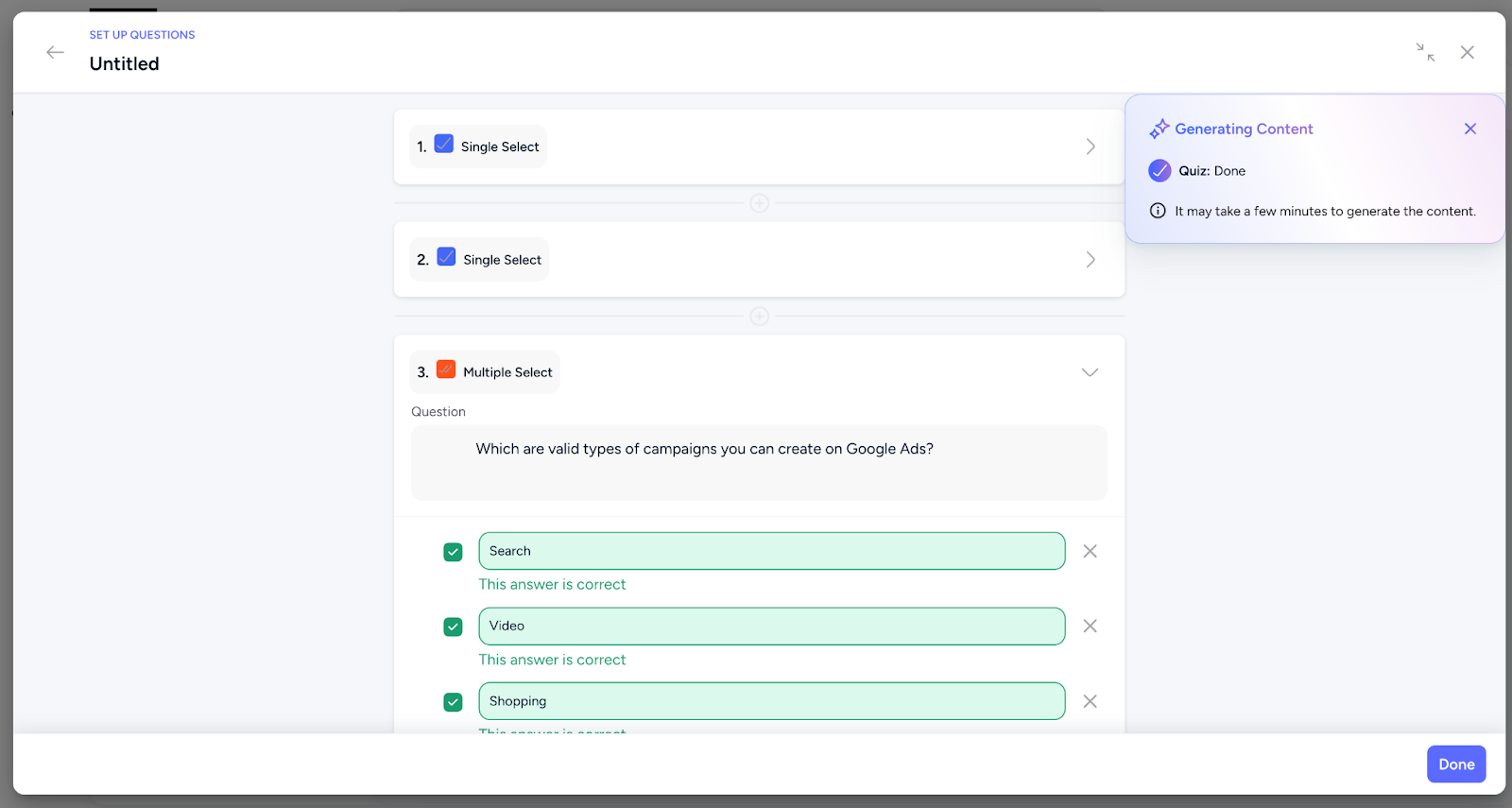
For content development, AI-driven authoring tools turn unstructured ideas into structured courses. Curriculum generators and content generators produce modules, lessons, and assignments from a single prompt. Quiz generators automatically build assessments aligned with specific objectives.
This remodels the educator's role, shifting focus from rough drafting to narrative synthesis and strategic review.
Engagement scales without proportional headcount
Research from the Harvard AI tutoring study found that students in the AI-tutored group reported significantly higher engagement (mean 4.1 vs. 3.6 on a 5-point scale, p < 0.0001) compared to in-class active learning. Additional studies show AI-enhanced training can generate substantially more engagement than passive methods. Practically, this translates to 70% better course completion rates and a 12% increase in attendance.
The challenge for most learning organizations is scale. As programs grow, maintaining engagement requires proportionally more staff. AI breaks this constraint.
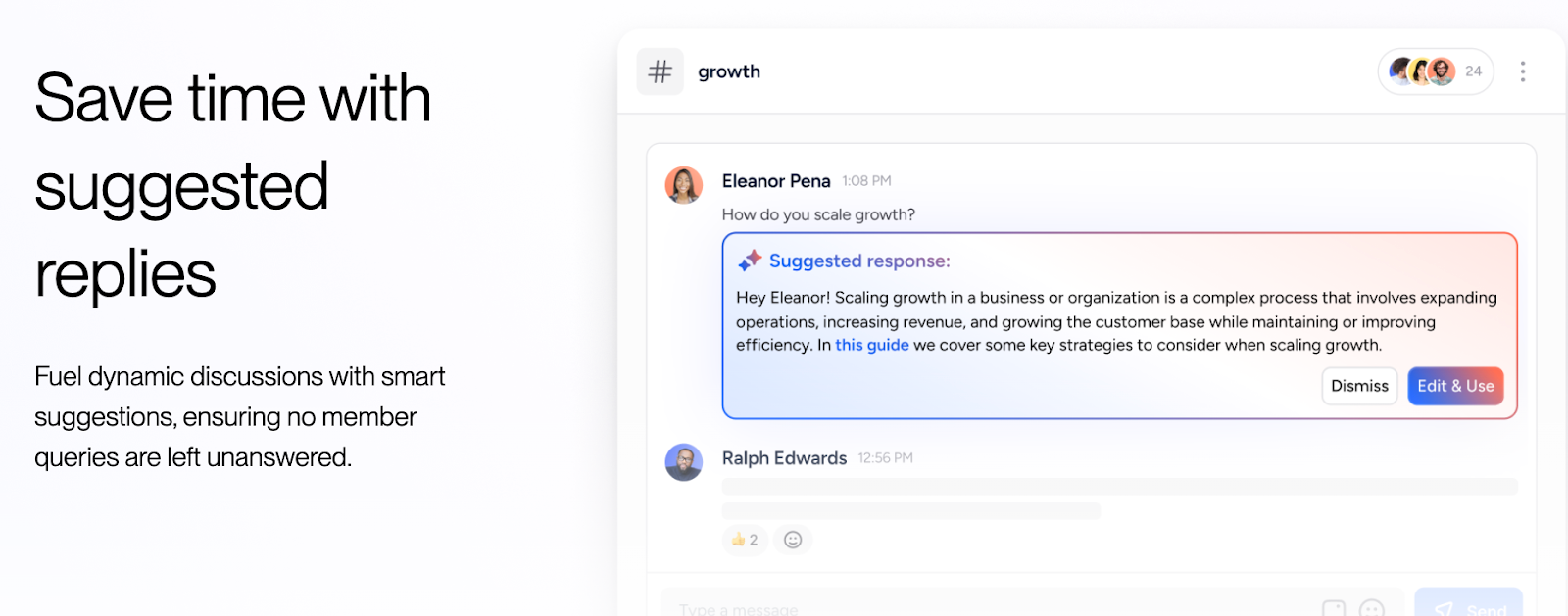
When AI is embedded directly into collaboration tools, employees do not need to log into separate platforms. This integration boosts productivity by more than 40%. On-demand coaching reinforces knowledge precisely when it matters.
The retention improvements are striking. AI learning agents focused on conversational interfaces and knowledge retrieval double retention rates compared to conventional courses. Notably, studies show no significant correlation between AI-generated content alone and improved learner performance. The value lies in context-aware navigation.
Organizations adopting AI for training save an average of $1.3 million annually.
The financial ROI is clear. Coca-Cola leveraged learning analytics to identify skill gaps and design targeted training programs for its sales team, resulting in a 20% increase in sales. Deloitte used similar approaches to personalize onboarding, achieving higher completion rates and faster time-to-productivity.
Compare this to the MIT findings: most enterprise AI pilots show zero measurable P&L impact even after months of investment. Learning-integrated AI consistently delivers returns because it addresses the exact failure points MIT identified: workflow integration, contextual adaptation, and back-office efficiency.
Organizations report 50-70% reductions in content creation time, 45% productivity gains and 72% better knowledge retention. Learner satisfaction reaches 90% with 50% reduction in training time.
The broader implications extend to accessibility. AI-powered transcription provides essential bridges for learners who are Deaf or hard of hearing. Text-to-audio features enhance understanding and retention for auditory learners, with research indicating a 30% improvement in academic performance. These tools benefit all learners.
Why learning AI succeeds where other AI fails
The MIT study offers a framework for understanding why 95% of AI pilots stall. The researchers found that success depends on three factors: tight workflow integration, contextual learning capability, and focus on back-office efficiency.
Learning platforms check all three boxes by default.
- Workflow integration. Learning AI operates inside the platform where work already happens. Learners query AI while studying, not in a separate tab. Administrators generate content and assessments within their existing workflow. The integration is native, not bolted on.
- Contextual learning. Unlike generic chatbots, learning AI is grounded in proprietary data: course materials, community discussions, organizational documentation. It learns from and adapts to the specific context of each organization.
- Back-office efficiency. Learning administration is exactly the kind of repetitive, process-heavy work where MIT found AI delivers the strongest returns. Grading, scheduling, Q&A support, content generation: these tasks compress dramatically with integrated AI.
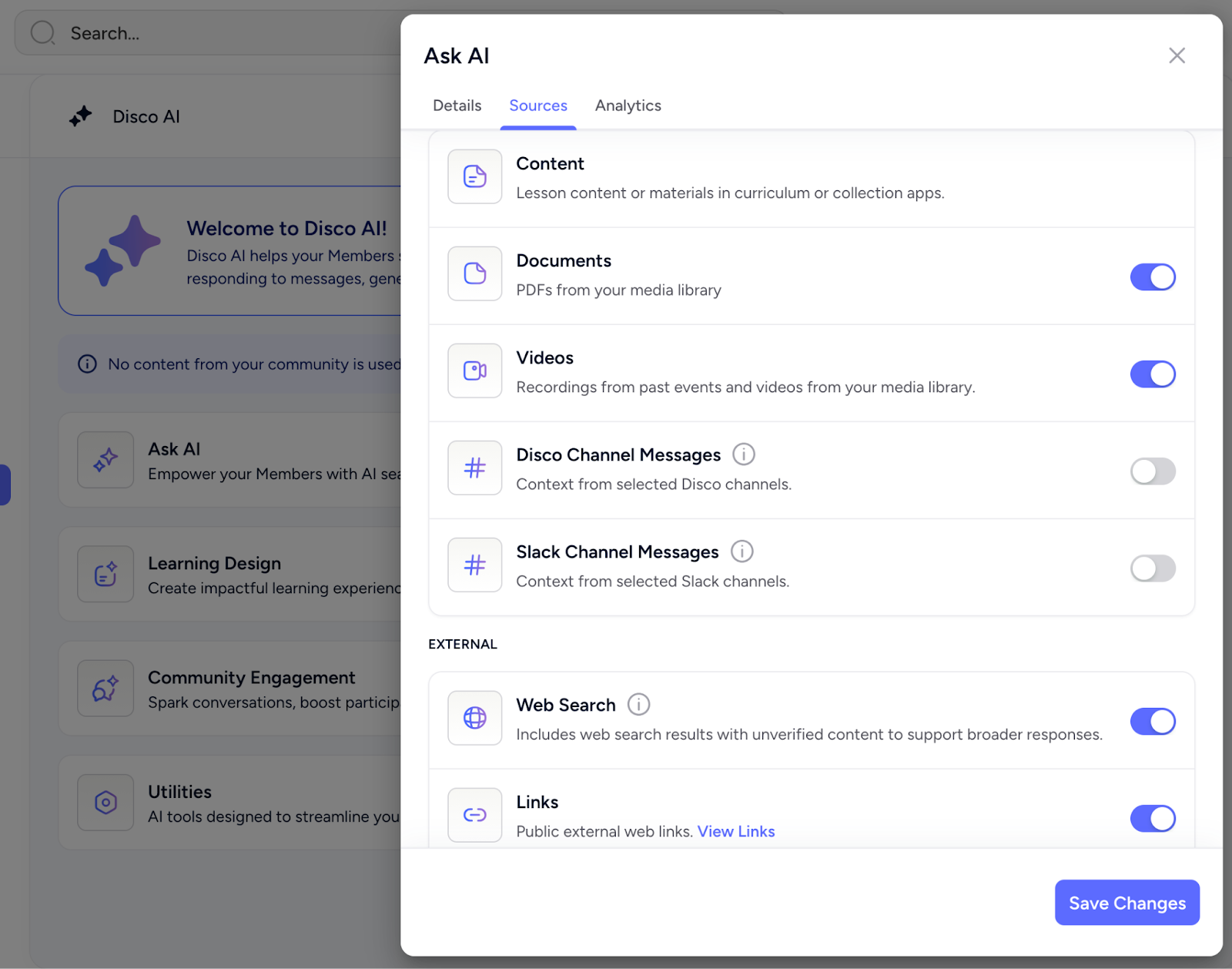
In an era where general AI is becoming a commodity, proprietary context creates defensibility. Trillion-parameter models can master quantum physics but fail basic questions about your organization's internal processes unless connected to that specific information. Building AI into the learning platform creates a universal context layer. Your intellectual property becomes searchable and actionable. Generic tools cannot replicate this without high-friction manual data entry
Invest in the 5% that actually works
Most AI spending will not pay off. MIT's research confirms what executives suspected: the gap between AI hype and AI value is real.
The projects that deliver returns share common traits. They embed AI into existing workflows. They automate back-office tasks rather than chase visibility. They build on proprietary context.
Learning programs check every box. D2D Experts, Coding Temple, and the Toronto Board of Trade found returns because they applied AI where it works: inside the platform, grounded in their content, focused on making people better at their jobs.
The recommendation is simple: if you need AI investments that deliver measurable ROI, start with your training and education programs. The data supports it. The case studies prove it. And unlike most enterprise AI, the results compound as your team gets better.
Ready to see how AI-powered learning can transform your organization? Start with Disco and build your first program in minutes.


