


Circle alternatives for training businesses

TL;DR
If you run a training business and need more than a community platform, Disco is the strongest Circle alternative. Disco combines AI-powered curriculum design, cohort-based program management, and social learning features into one platform built specifically for training businesses, bootcamps, and professional academies. While Circle excels at community engagement for creators and memberships, Disco delivers the learning-first architecture, assignment tracking, and AI tools that training businesses need to create measurable outcomes and scale revenue without scaling headcount. For organizations serious about transformational learning programs, Disco eliminates the gap between community platforms and traditional LMS tools.
Why training businesses are searching for Circle alternatives
Circle has become the default choice for creators, membership sites, and community-led businesses. Its modern interface, flexible spaces, and native event features make it an attractive option for anyone building an engaged audience. The platform has also invested heavily in AI capabilities, including content co-pilots, AI agents for member support, and workflow automation.
For training businesses, however, the calculus is different. When your core product is education, you need more than community engagement tools. You need structured curriculum, assessment capabilities, progress tracking, and the ability to run repeated cohorts efficiently. You need a platform where learning outcomes are the primary organizing principle, not an add-on to community features.
This distinction matters because training businesses face unique challenges. Course completion rates across the industry hover around 15% for self-paced content. This engagement crisis is precisely why AI-powered LMS platforms are becoming essential for training businesses focused on measurable outcomes. Engagement drops off dramatically after the first week. And as you scale from dozens to thousands of learners, the operational complexity of running cohort-based programs multiplies.
The platforms in this guide address these challenges with different approaches. Some lean heavily into community with learning as a secondary feature. Others prioritize course delivery with community bolted on. The strongest alternatives combine both, with AI capabilities that speed up content creation and personalize the learning experience.
What training businesses actually need from a platform
Before evaluating specific alternatives, it helps to understand what separates a platform built for training businesses from one built for general community building. Training businesses typically require capabilities across five key areas.
Learning architecture and curriculum design form the foundation. This includes structured course builders with modules, lessons, and logical sequencing. It means support for multiple content types including video, documents, live sessions, and assignments. Cohort-based program structures allow you to run the same curriculum repeatedly with different groups, while drip content and prerequisite logic create guided learning paths rather than overwhelming learners with everything at once.
Assessment and progress tracking enable you to measure learning outcomes, not just engagement. Quizzes and knowledge checks verify comprehension. Assignment submissions with feedback loops allow for applied learning. Completion tracking and certificates provide documentation, while analytics that connect to learning outcomes rather than just activity metrics help you understand what's working.
Social learning and community features drive engagement and peer accountability. Discussion spaces tied to specific courses or cohorts keep conversations contextual. Live events and workshops create synchronous touchpoints. Peer interaction, group projects, and mentor matching leverage the power of learning with others.
Operational efficiency at scale becomes critical as you grow. Course cloning for repeated cohorts saves hours of setup time. Automated workflows handle repetitive tasks like sending reminders or transitioning alumni. Integrations with payment processors, CRMs, and other business tools keep your tech stack connected.
AI-powered capabilities increasingly differentiate platforms. AI tools for creating training materials transform how L&D teams develop content. AI curriculum generation speeds up course creation. AI teaching assistants answer learner questions at scale. Content recommendations personalize the experience, and automated summaries of live sessions capture knowledge for those who missed them.
How the top Circle alternatives compare
The following table provides a quick comparison of the platforms covered in this guide. Each has strengths in different areas, and the right choice depends on your specific priorities.
1. Disco: Best for AI-powered training academies

Disco sits at the intersection that training businesses need most: the engagement of a modern community platform combined with the curriculum depth of an LMS, powered by AI that accelerates both content creation and learner support. The platform was built specifically for virtual academies, bootcamps, customer education programs, and corporate training teams.
What sets Disco apart for training businesses is its learning-first architecture. While community platforms treat courses as a feature within their community structure, Disco organizes everything around programs and cohorts. This means spaces, events, and discussions all tie back to specific learning experiences rather than existing as separate community elements.
The AI capabilities go beyond operational efficiency into actual learning design. The AI curriculum builder generates course outlines and content from prompts or source materials you upload, turning existing expertise into structured learning experiences. The Q&A bot trains on your program materials to answer learner questions at any hour, functioning as an AI teaching assistant. Event summaries automatically capture key takeaways from live sessions for learners who missed them or want to review.
For training businesses running repeated programs, the cohort management capabilities matter enormously. You can clone entire courses, update content across all versions or target specific cohorts, and automate workflows for alumni transitions. This makes Disco particularly effective for AI cohort-based course platforms where repeated programs need efficient management. The platform handles the operational complexity of scaling from one cohort to dozens without requiring proportional increases in admin time.
Training business fit
Disco works particularly well for training businesses that sell premium, cohort-based programs where community and peer learning drive outcomes. Leadership development, professional certifications, bootcamp-style training, and customer education academies align with its strengths. Organizations with established training IP who want to scale without sacrificing the human element will find the platform matches their needs.
Considerations
Disco's pricing positions it for serious training operations rather than hobbyist course creators. If your training business is primarily self-paced content with minimal community interaction, a simpler course platform may suffice. The platform's power comes from combining structured learning with social elements, so businesses that only need one or the other might find it more than they require.
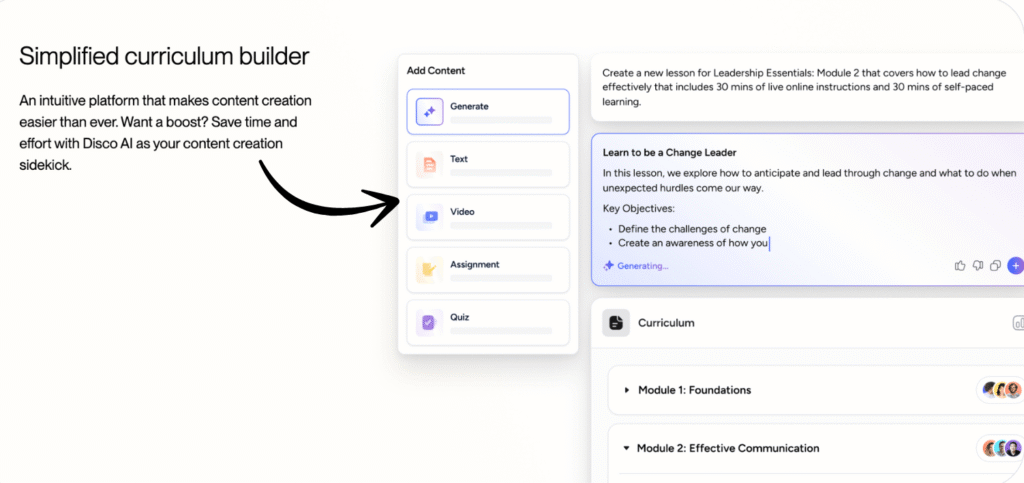
2. LearnWorlds: Best for course-first training businesses
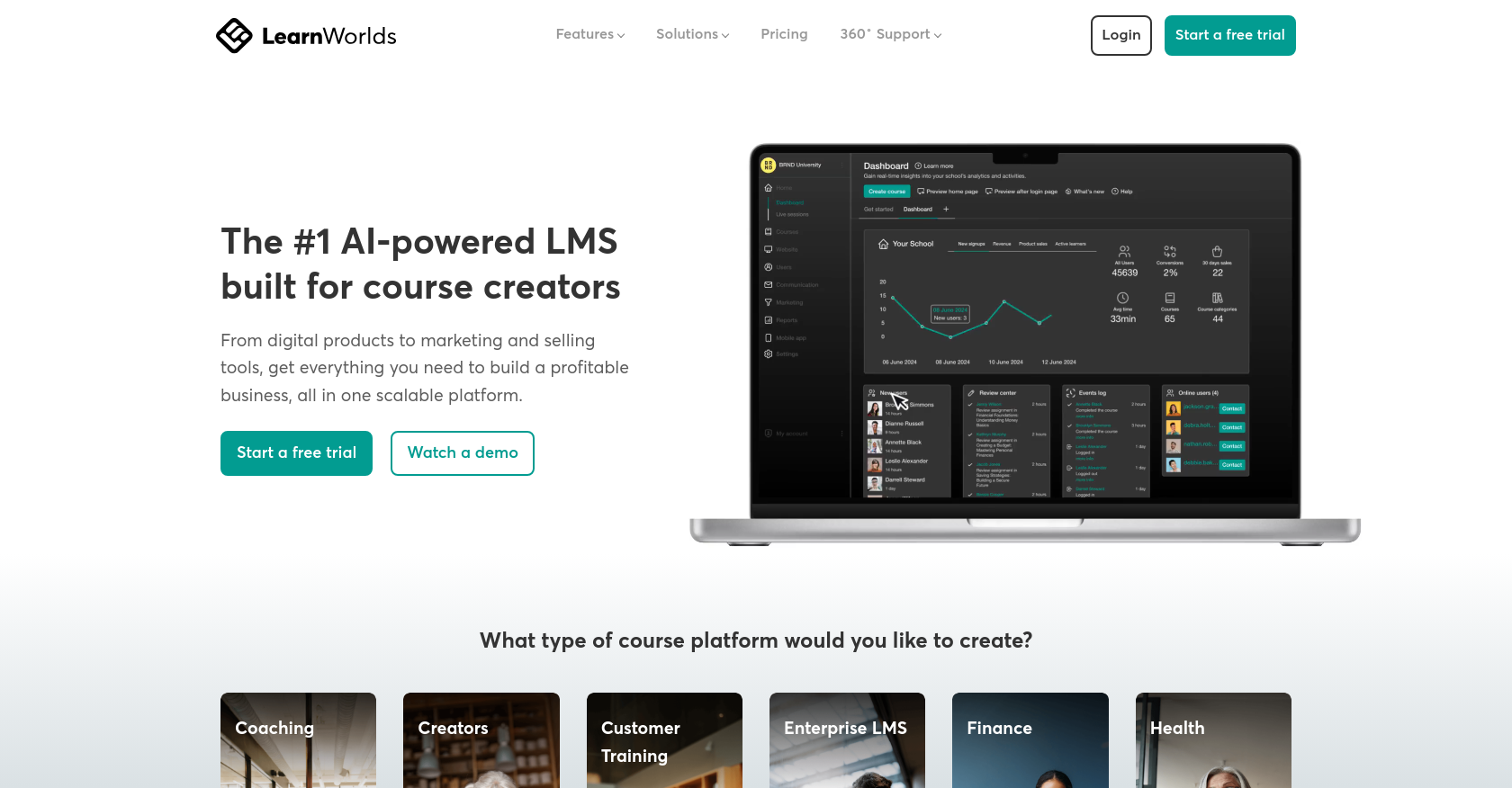
LearnWorlds has positioned itself aggressively in the AI-powered LMS space, with particular strength in corporate training and customer education. The platform combines interactive video capabilities, assessment tools, and increasingly sophisticated AI features in a package designed for serious course businesses.
Learning capabilities represent LearnWorlds' core strength. Interactive video allows you to embed quizzes, clickable elements, and branching scenarios directly into video content. SCORM support means you can import existing e-learning modules. The assessment tools include sophisticated quiz types, automatic grading, and the ability to provide AI-enhanced feedback on learner responses.
The AI features focus heavily on course creation efficiency. The AI course planner helps structure content, while AI assessment design speeds up quiz and evaluation creation. Content editing, email generation, and ebook creation tools reduce production time across the training development workflow.
Training business fit
LearnWorlds excels for training businesses where course content is the primary product and community is supplementary. Customer education programs that need to scale self-paced learning, corporate training with compliance requirements, and businesses selling primarily video-based courses align well with the platform's strengths. Organizations evaluating platforms for customer education can explore more options in our guide to best community platforms for online training.
Considerations
While LearnWorlds has added community features, they function more as discussion forums attached to courses than as rich learning communities. If peer learning, cohort accountability, and social connection drive your training outcomes, you may find the community experience less compelling than platforms built with social learning at their core. The platform's strength is content delivery rather than community cultivation.
3. Kajabi: Best for marketing-driven course businesses
Kajabi built its reputation as the all-in-one platform for digital entrepreneurs, combining courses, memberships, email marketing, and sales funnels in a single system. For training businesses where marketing sophistication matters as much as course delivery, Kajabi offers capabilities few learning platforms match.
The marketing engine distinguishes Kajabi from pure learning platforms. Built-in email sequences, landing page builders, checkout optimization, and sales funnel tools mean you can run sophisticated marketing campaigns without external software. The AI Content Assistant generates course outlines, lesson content, landing page copy, email sequences, and video scripts from prompts, accelerating the entire content production pipeline.
Course features provide solid foundations for training delivery. The course builder supports video, text, downloads, and quizzes. Membership tiers and access controls enable various pricing models. The community feature allows discussion and engagement, though it functions as a module rather than a central organizing principle.
Training business fit
Kajabi works well for training businesses that prioritize marketing and sales capabilities alongside course delivery. Solo trainers building their audience, course creators who want integrated funnel management, and businesses where lead generation and conversion matter as much as learning outcomes will appreciate the unified approach.
Considerations
The platform's focus on marketing means the learning experience takes a back seat to the sales experience. Assessment capabilities are basic compared to dedicated LMS tools. Community features lack the depth of community-first platforms. For training businesses where learning outcomes, cohort management, and social learning drive value, other platforms may deliver better educational experiences.
4. Thinkific: Best for self-paced course businesses
Thinkific has evolved from a straightforward course platform into a more comprehensive solution with community, memberships, and expanding AI capabilities. Its strength lies in course creation and delivery, with features that support professional training operations including SCORM compliance and certification programs.
Course infrastructure forms Thinkific's foundation. The platform supports various content types, bundled courses, and structured learning paths. SCORM support allows importing corporate e-learning content. Completion certificates and assignment features serve businesses with formal training requirements. Thinkific Plus offers enterprise features for larger training operations.
The AI roadmap shows significant investment in learning-focused AI features. AI-assisted course creation helps structure content. The planned Thinker AI teaching assistant aims to provide AI-based support integrated into the learning experience. Community AI features for moderation and engagement are also in development.
Training business fit
Thinkific suits training businesses centered on self-paced course delivery with some community elements. Professional certification programs, structured e-learning with corporate clients, and businesses that need SCORM compliance find the platform's capabilities well-matched to their requirements.
Considerations
Community features, while improved, still feel secondary to the course experience. If your training model depends heavily on peer interaction, live cohort experiences, and social accountability, you may find the community tools less robust than platforms designed around social learning. The AI features, while promising, remain in development compared to platforms with more mature AI implementations.
5. Mighty Networks: Best for community-led programs
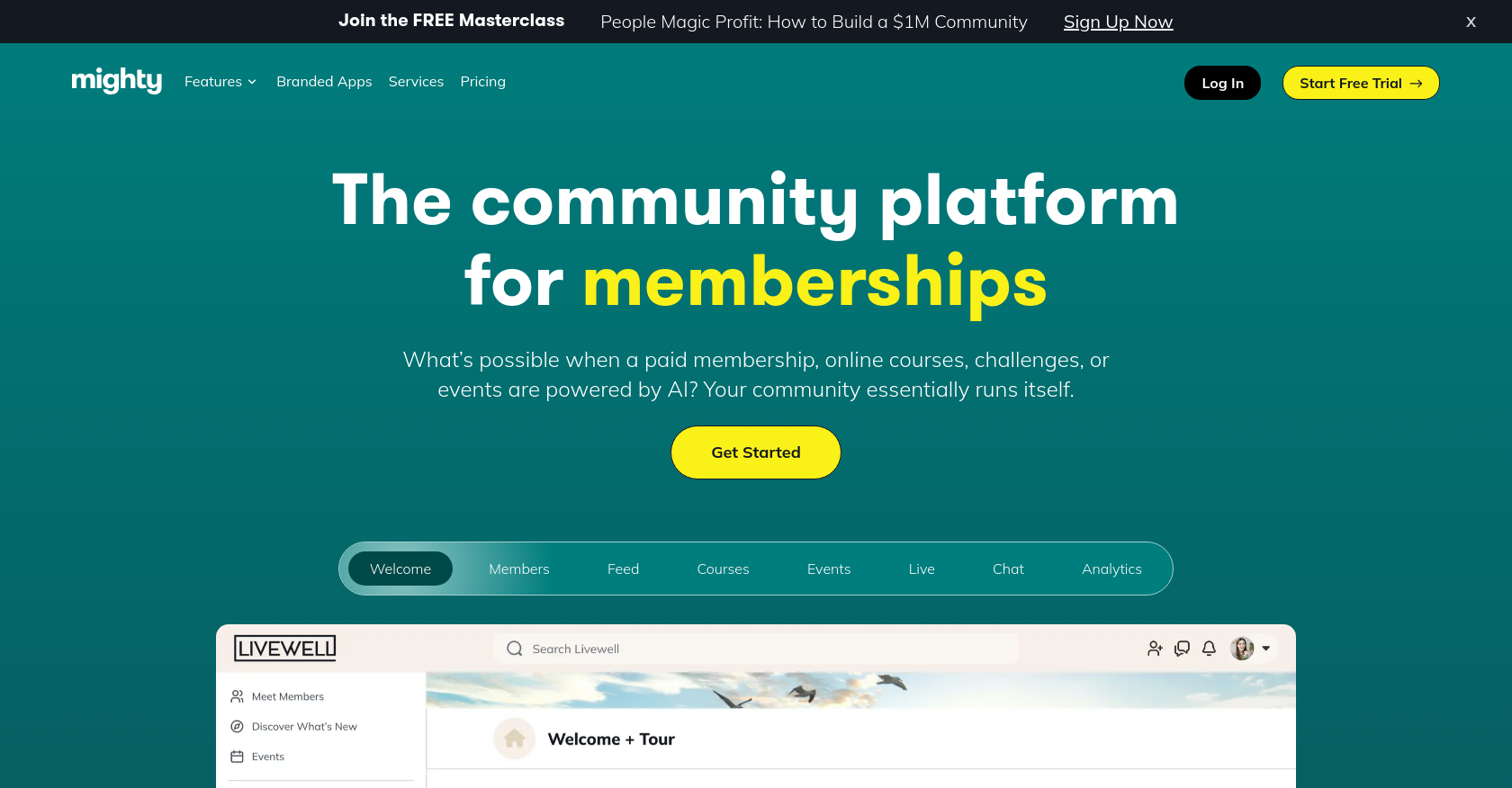
Mighty Networks represents the community-first approach at its strongest, with courses, events, and memberships woven into a community-centric platform. The platform has invested heavily in AI through its Mighty Co-Host capabilities, positioning itself as an AI-powered community builder.
AI for community engagement defines Mighty Networks' approach. The Co-Host AI can generate community concepts, propose course outlines, and help with content creation. The Make It Better feature improves posts, articles, and communications with tone and clarity adjustments. Profile assistance and similarity detection help members connect. Engagement tools include infinite question generators and re-engagement workflows for inactive members.
Courses and learning features exist within the community framework. Space-based courses integrate with community discussions. Events, live sessions, and workshops support blended learning. Gamification elements like points and levels drive participation, though they focus on community activity rather than learning progress specifically.
Training business fit
Mighty Networks excels for training programs where community is the primary value and structured learning supports that community experience. Membership-based training, coaching programs with strong peer components, and programs where ongoing engagement matters more than completing specific curricula align with the platform's design.
Considerations
The course and assessment tools are more limited than dedicated LMS platforms. For training businesses with complex curricula, certification requirements, or detailed learning analytics needs, the platform may not provide sufficient depth. The AI focuses on community and host workflows rather than curriculum design or learner support, making it less suitable for programs where AI-enhanced learning experiences are priorities.
How to choose the right platform for your training business
Selecting the right Circle alternative depends on understanding where your training business creates the most value and where platform capabilities need to align with that value creation.
Choose Disco if your training business delivers cohort-based programs where peer learning, community connection, and structured curriculum must work together. If you're scaling an academy, running leadership development, or building customer education programs that require both engagement and measurable outcomes, Disco's learning-first, AI-powered approach provides the most complete solution. For a deeper comparison of how Disco stacks up against corporate training alternatives, see our analysis of AI corporate training software alternatives. The platform particularly suits organizations with established training IP looking to scale without losing the human element that makes their programs transformational.
Choose LearnWorlds if course content is your primary product and community is supplementary. If you need interactive video capabilities, SCORM compliance for corporate clients, or sophisticated assessment tools, LearnWorlds delivers strong learning infrastructure with growing AI capabilities.
Choose Kajabi if marketing and sales sophistication matter as much as course delivery. If you need integrated funnels, email automation, and landing page builders alongside your courses, Kajabi's all-in-one approach eliminates the need for multiple marketing tools.
Choose Thinkific if you run a self-paced course business with formal training requirements. If SCORM compliance, certification management, and structured e-learning serve your clients' needs, Thinkific provides mature course infrastructure.
Choose Mighty Networks if community drives your training value and courses support that community experience. If ongoing membership engagement matters more than completing specific programs, the platform's community-first design aligns with that priority.
Making the switch: migration considerations
Moving from Circle to any alternative platform requires planning around several key areas. Content migration, member communication, and feature mapping all need attention to ensure a smooth transition.
Most platforms offer import tools for common content formats like video files, PDFs, and structured course content. Historical discussion data and community posts typically require more manual migration or may not transfer completely. Plan for a period where both platforms run simultaneously to allow members to transition gradually.
Member communication matters significantly during transitions. Clear explanation of why the move benefits them, step-by-step migration guides, and support during the transition period help maintain engagement. Many training businesses use the migration as an opportunity to re-engage lapsed members or launch updated program versions on the new platform.
Feature mapping ensures you don't lose critical capabilities in the transition. Document your current workflow in Circle, identify equivalent features in the new platform, and note any gaps that require workarounds or workflow changes. Training businesses migrating from Circle should also consider how their platform choice supports cohort-based learning at scale, particularly if running repeated programs is central to your business model. Most modern platforms offer trial periods or sandbox environments where you can test your migration before committing.
The future of training platforms
The training platform landscape continues evolving rapidly, with AI capabilities becoming increasingly central to both operations and learning experiences. The platforms winning in this market combine three elements: modern community UX that drives engagement, structured learning architecture that enables outcomes, and AI that accelerates both content creation and learner support.
For training businesses evaluating Circle alternatives, the key question is where your value creation happens. If community engagement is the product, community-first platforms serve well. If course content is the product, course-first platforms deliver. If transformational learning through the combination of curriculum, community, and AI is the product, platforms built specifically for that intersection provide the strongest foundation.
Disco represents the clearest example of a platform purpose-built for training businesses seeking that combination. By starting with learning as the organizing principle and adding community and AI as amplifiers of that learning, the platform addresses challenges that training businesses face in ways that community-first or course-first alternatives struggle to match.
Whatever platform you choose, the decision should align with how your training business creates value and where you expect that value creation to evolve. The right platform becomes a strategic asset that enables scale while maintaining the quality and outcomes that make your training programs worth choosing.


