


Best AI tools for change management training in 2026

TL;DR
Most change initiatives fail because training can't keep pace with the speed of change. The right AI tools help L&D teams build personalized, role-based programs that drive real adoption. Here's how to pick them, how to build your stack, and which tools actually deliver in 2026.
Seventy percent of organizational change initiatives fail. The most common culprit isn't strategy or budget. It's adoption. Teams don't use new tools, workflows don't stick, and training programs weren't built to handle the speed of change.
AI is accelerating that problem and solving it at the same time. The pace of change has never been faster, but the tools available to L&D and change management teams are genuinely powerful now. The right AI change management stack helps you build role-based training programs that scale, personalize content to each team member, and give you the measurement data to know whether adoption is actually happening.
This guide breaks down the best AI tools for change management training in 2026, how to evaluate them, and how to build a program that sticks.
Why change management training is failing
The old playbook for change management training looks like this: build a one-size-fits-all eLearning module, send it to everyone, measure completion, and call it done. Self-paced learning achieves just 15% completion rates on average. Completion tells you nothing about whether people actually changed how they work.
AI change management works differently because it treats training as a continuous, personalized process rather than a one-time event. The best programs combine role-based learning pathways, in-app guidance at the moment of need, and reinforcement loops that keep new behaviors from fading. McKinsey's guidance on gen AI adoption is consistent here: sustainable change requires workflow redesign, role modeling, and clear measurement tied to business outcomes rather than course completions.
The tools below are the ones that make this possible.
The best AI tools for change management training in 2026
Disco
Best for: Modern cohort-based learning programs that actually drive change adoption
Disco is the best AI-native learning platform for change management training, whether you're running programs internally or delivering them as a consulting firm. Where most learning tools treat AI as a feature layer bolted onto an aging LMS, Disco was built from the ground up with purpose-built AI at every layer: program generation, personalization, member experience, and learning design. The result is a platform that makes social, cohort-based learning as easy to run at scale as a self-paced module but dramatically more effective.
For change management, that distinction matters. Cohort-based programs create accountability, peer reinforcement, and shared context that isolated eLearning never can. When teams learn together through a structured change initiative, they come out with shared language, shared habits, and the social proof that new behaviors are the norm. Disco makes it possible to run those programs at enterprise scale without a full instructional design team behind every rollout.
The AI Program Generator turns your internal IP, process documentation, and subject matter expert knowledge into structured programs in hours. Members get personalized learning paths that reflect their actual role and workflow context. And everything lives in a branded academy your organization owns. Disco customers see a 76% average engagement rate and an 84 NPS, compared to the 15% typical of self-paced eLearning. It integrates with Slack, HubSpot, Zoom, and the tools your teams already use.
WalkMe
Best for: In-app guidance during digital tool rollouts
WalkMe is the go-to tool when you need to reduce friction at the exact moment someone opens a new piece of software. It overlays contextual guidance, tooltips, and step-by-step walkthroughs directly inside the applications your teams are adopting. This is change management training that happens in the flow of work rather than before it.
For change managers running ERP, CRM, or productivity tool rollouts, WalkMe reduces support ticket volume and shortens time-to-competency. Its analytics show exactly where people drop off in a workflow so you can target training to real pain points.
Standout AI feature: AI-powered content suggestions and predictive guidance based on user behavior patterns.
Prosci and Kaiya
Best for: Change practitioners who need a methodology-aligned AI assistant
Prosci is the most widely used change management methodology in the world, and Kaiya is its AI assistant. For certified change practitioners, Kaiya acts as a real-time advisor: describe your change initiative, and it helps you apply the ADKAR model, draft stakeholder communications, and plan interventions at each stage.
Prosci has also expanded its certification programs to include AI-specific change management tracks, which is useful if you're building a change capability team and want formal credentials to anchor it.
Standout AI feature: Methodology-native AI guidance aligned to ADKAR frameworks and Prosci's change management toolkit.
Axonify
Best for: Frontline employee reinforcement and microlearning
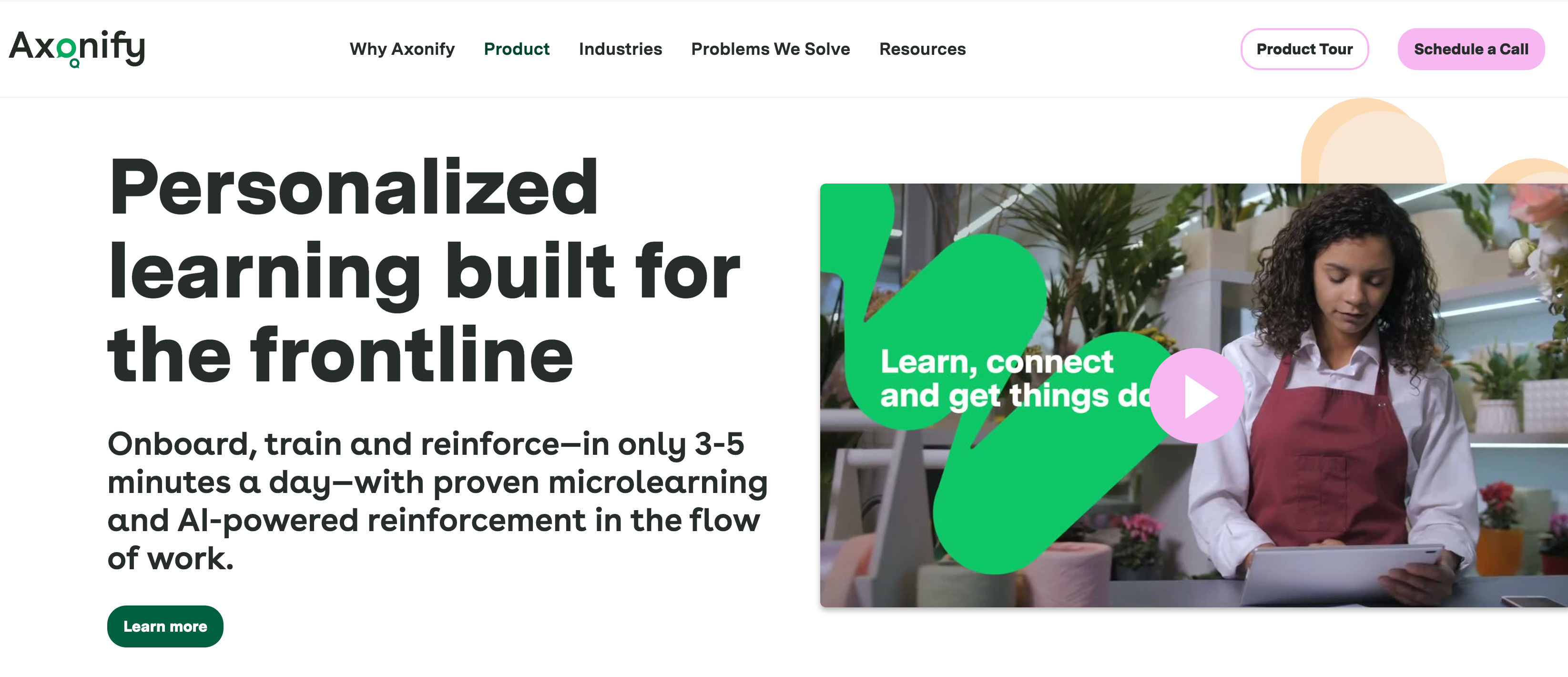
Axonify is built for high-frequency, low-friction reinforcement. It delivers three-to-five-minute microlearning bursts on a scheduled cadence, using AI to prioritize topics based on what each employee most needs to review. For frontline workforces going through change, it fits naturally into a shift start or team huddle.
The platform's algorithm identifies knowledge gaps over time and fills them with targeted content. If you're training a retail team on a new POS system or a warehouse team on updated safety procedures, Axonify keeps knowledge fresh long after the initial rollout.
Standout AI feature: Adaptive reinforcement algorithm that personalizes content frequency and difficulty per learner.
Go1
Best for: Enterprise content libraries and role-based course assignment
Go1 aggregates content from hundreds of training providers into a single platform, with AI-powered recommendations that match content to roles, goals, and skill gaps. For change management programs, it's useful when you need a broad library of off-the-shelf content to complement custom programs, or when you're building role-specific learning pathways at scale.
It integrates with most major LMS and HRIS platforms, which makes it easy to layer into an existing stack without replacing what you already have.
Standout AI feature: AI-driven content recommendations that match library resources to individual roles and learning gaps.
ChangePlan
Best for: Change portfolio management and training-to-outcome alignment
ChangePlan is a dedicated change management platform that helps teams plan, track, and measure change initiatives from a portfolio perspective. It's the project layer that ties all your training activities to business outcomes. You can map change impacts by role, track adoption milestones, and produce stakeholder reports that connect training to actual KPIs.
For change managers who need to demonstrate program impact to leadership, ChangePlan provides the measurement infrastructure that most training platforms lack.
Standout AI feature: AI-assisted impact assessment and change readiness scoring across stakeholder groups.
Quick comparison
How to build a training program for AI change management
A tool list is only as useful as the program it sits inside. Here's how to build one that actually drives adoption.
Start with role mapping, not content. Before you build a single module, document how each role's workflow actually changes. A sales rep using a new CRM has different training needs than an operations manager using the same tool. Role-specific pathways reduce noise and increase relevance.
Run a pilot before you scale. McKinsey consistently recommends phased rollouts for AI adoption. Pick a high-visibility, willing team, run a six-to-eight-week pilot, and measure adoption at multiple checkpoints. A sample pilot stack: Disco for the learning program layer, WalkMe for in-app guidance, and Axonify for weekly reinforcement. Measure against baseline workflow KPIs, not just completion rates.
Build a champions network. Peer-to-peer influence is more effective than top-down mandates for sustained behavior change. Identify early adopters in each team, give them early access and a voice in shaping the program, and let them model new behaviors for their colleagues.
Measure what matters. Completion rates are a proxy metric, not an outcome. Define the behaviors you want to see post-training and track those directly. Time-to-competency, error rates, workflow adoption rates, and self-reported confidence scores all tell you more than whether someone clicked through a module.
Build reinforcement in from day one. Most training programs treat reinforcement as an afterthought. Space out knowledge checks, use brief refreshers at the 30- and 60-day mark, and make it easy for managers to see where their teams need support.
Certifications and upskilling options
If you're building a change capability practice, formal credentials add credibility and structure. A few worth knowing:
- Prosci Change Management Certification: The most widely recognized credential in the field. Prosci now offers AI-specific modules for practitioners managing AI adoption initiatives.
- Microsoft AI Transformation Leader: A vendor-backed credential for leaders managing AI change at scale. Covers governance, workflow redesign, and stakeholder management.
- AI Change Impact Lab: An applied certification from Change Management Review that focuses on practical AI change tools and real-world initiative design.
- ACMP Certified Change Management Professional (CCMP): A broader credential that covers change methodology fundamentals and is respected across industries.
For L&D leaders building internal capability, these certifications work well as anchor credentials for a champions program or a Center of Excellence.
The bottom line
There's no single AI change management tool that does everything. The strongest programs treat the stack as a set of complementary layers: a learning platform for program delivery, an in-app guidance tool for workflow adoption, a reinforcement engine for knowledge retention, and a measurement layer to track what's actually changing.
Disco sits at the top of that stack because it's the only modern, cohort-based learning platform with purpose-built AI designed specifically for the way people actually learn and change. L&D teams get the ability to build personalized, social, and scalable programs from their own organizational knowledge, without the bloat of a legacy LMS or the limitations of AI that was added after the fact. Pair it with the right adoption and reinforcement tools, and you have a change management training program that goes well beyond checkbox compliance.
Want to see how Disco can support your next change initiative? Book a demo and we'll walk you through it.


