


Disco vs. Claude: which tool do you actually need to run a learning program?
TL;DR
Claude is one of the best AI tools available for drafting course content: outlines, lessons, quizzes, and scripts. But Claude can't enroll learners, manage cohorts, track completion, issue certifications, or lock its answers to your curriculum. If you need to actually run a learning program, you need a platform built for that. This article explains exactly where Claude stops and where Disco picks up, and why most teams use both.
You've probably already opened Claude and typed something like "write me a 6-module course on AI fundamentals for managers." And it delivered. The outline was solid, the objectives made sense, and within a few minutes you had something that looked like the bones of a real program.
So the obvious next question: do you actually need a dedicated learning platform, or can you just run this out of Claude?
The honest answer is that Claude and Disco solve different problems. Claude is a generalist AI assistant built for writing, research, design support, and coding. Disco is an AI-native learning platform built to deliver, manage, and scale structured learning programs. They're not really competing. Most teams that get the most out of Disco use Claude to help draft content and then bring it into Disco to actually run it.
But if you're evaluating your options before committing, this article walks through exactly where each tool fits, where each one stops, and how to think about the right setup for what you're trying to build.
What Claude is genuinely great at
Claude is one of the most capable AI writing and reasoning tools available. For learning and development work, that translates to a few specific use cases where it's genuinely excellent.
It can produce a complete curriculum outline in a single prompt. Give it your topic, target audience, and learning goals, and it returns a structured breakdown of modules, learning objectives, and suggested activities. That's real work, done in seconds.
It's also strong at content drafting. Lesson scripts, quiz questions, case study writeups, discussion prompts, facilitator guides: Claude handles all of these with high quality output. If you know what you want to teach, Claude helps you write it faster than almost any other tool.
With Claude Projects, you can attach reference documents and source materials that persist within that project context. That means you can upload your company's existing training materials, brand guidelines, or subject matter expert notes, and Claude will draw on them when generating content. Reviewers have described this as "the closest thing to chatting with your own knowledge base."
For individual contributors and small teams exploring a new training topic, Claude is a fast, low-cost starting point. The content it produces is genuinely good.
Where Claude reaches its limit
The gap between drafting content and running a learning program is significant. Here's where Claude structurally stops.
No persistent shared memory across a cohort
Claude's memory is per-user and limited. Auto-generated memory has a documented recency bias, meaning older context fades. User-directed memory has hard caps. There is no shared state across multiple learners. If you have 25 members going through the same program, Claude has no awareness of the group, what they've already covered, or where they're getting stuck. Each conversation is essentially isolated.
No enrollment, cohort management, or scheduling
Claude can't enroll anyone in anything. There's no concept of a roster, a cohort start date, a program schedule, or automated reminders. Running a program means managing people through a defined experience over time. That requires infrastructure Claude doesn't have.
No progress tracking or completion data
There are no analytics on what learners have done, how far they've progressed, or where they've dropped off. If you're accountable for learning outcomes, you need visibility into what's actually happening. Claude doesn't surface any of it.
No community or peer learning layer
Research consistently shows that learners who engage with peers complete at higher rates and retain more. Claude has no discussion feeds, channels, group spaces, member directories, or live event infrastructure. Every interaction is one-on-one with the AI.
No certifications or credentials
Claude can't issue a certificate of completion, generate a credential, or track who has finished what. For training businesses and enterprise L&D teams where credentials matter, this is a hard gap.
No controlled content sources
This is arguably the most important gap for enterprise teams. Claude draws on its broad training data by default. You can't lock it to answer only from your approved curriculum. That creates two problems: it may reference information outside your materials, and it may occasionally produce plausible-sounding but inaccurate answers about your specific content domain.
For regulated industries, compliance training, or any context where accuracy to your organization's specific policies matters, this is a significant risk.
No payments, branding, or delivery infrastructure
If you're a training business selling programs, Claude offers no checkout, no enrollment flow, no branded environment, and no white-label option. You're still relying on a generic chat interface with no connection to your business model.
What Disco does that Claude can't
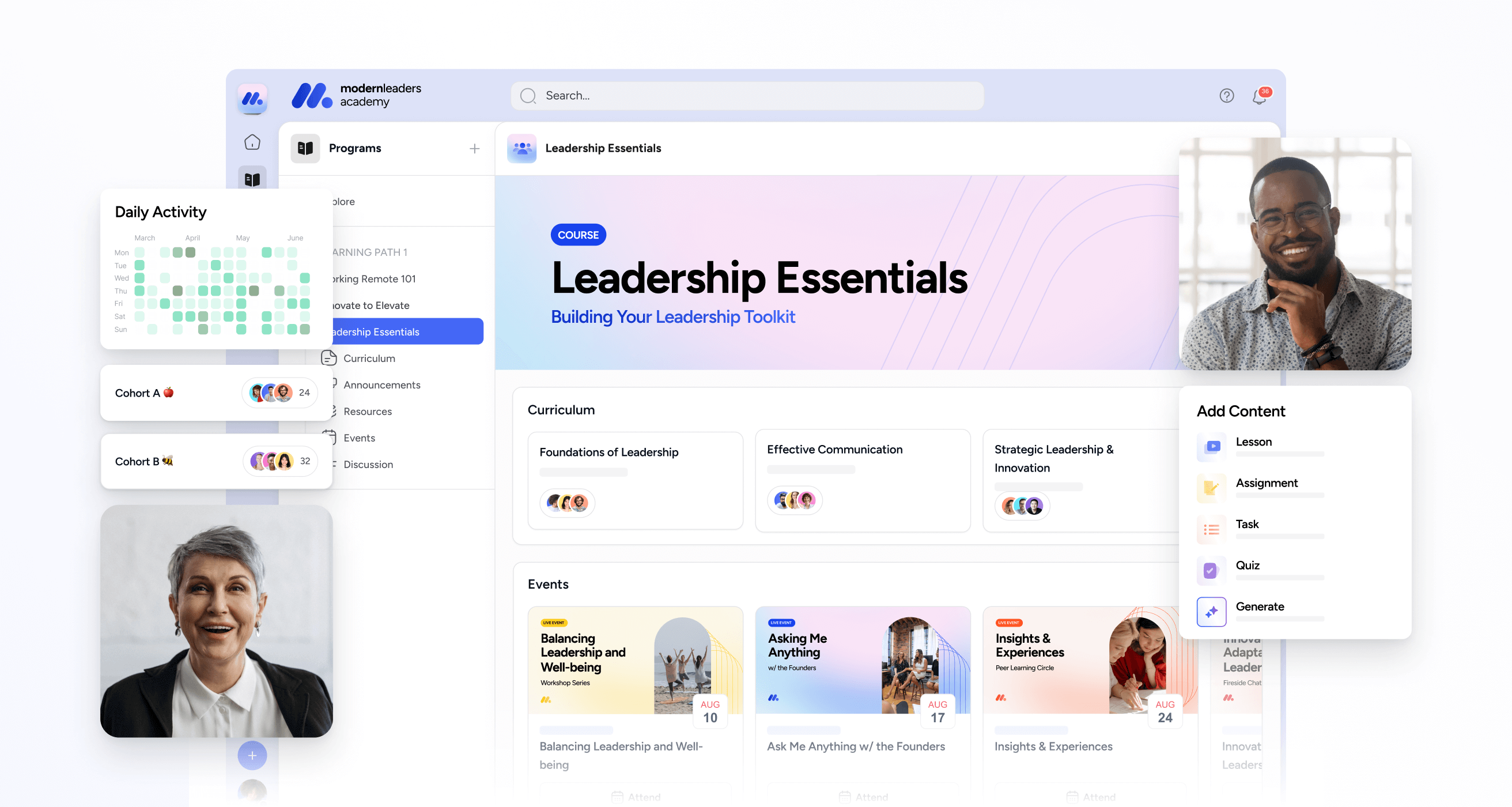
Disco is purpose-built for the layer that comes after content creation: delivery, community, tracking, and scale.
AI Program Generator
Disco's AI Program Generator takes your existing knowledge, documents, or outline and builds a complete structured program in minutes. Think of it as the Claude-for-drafting experience, but native to the platform where you'll actually run the program. The output is a fully structured learning experience with modules, activities, and a live learning environment, not just a document.
AskAI with controlled sources
This is Disco's sharpest enterprise differentiator. AskAI is an AI assistant built directly into the learning environment, but it answers only from the content you've uploaded. Your curriculum, your resources, your materials. Learners can ask questions and get accurate, source-grounded answers without the AI pulling from the broader internet or making things up.
For enterprise teams, this kills the AI safety objection that comes up in nearly every procurement conversation.
Cohort-based delivery
Disco is built around cohorts: groups of learners moving through a program together over a defined time period. This is the model that drives Disco's 76% average engagement rate versus the 15% completion rate typical of self-paced courses. When learners are accountable to each other and to a shared schedule, they complete.
Learning plus community in one platform
Discussion channels, live events, member directories, peer groups, mentorship matching: all of it lives inside the same platform as the course content. Learners don't have to context-switch between a Slack workspace and a separate LMS. The social layer is embedded in the learning experience.
Progress tracking and analytics
Disco surfaces real-time data on member progress, completion rates, engagement by module, and at-risk learners. Program managers and L&D leaders get the visibility they need to actually manage outcomes, not just hope people finish.
Certifications and credentials
Automated certificates on completion, custom credential design, and the ability to tie completion to specific assessments. For training businesses and professional development programs, this is table stakes that Disco delivers natively.
White-label and branded environments
Your academy looks like your brand. Custom domain, logo, colors, and a branded mobile app. Learners don't see Disco's logo. This is critical for training businesses selling premium programs and enterprise teams building internal academies that reflect their organization.
A side-by-side look at the key differences
How Disco and Anthropic both think about learning
Anthropic, the company behind Claude, has developed what they call a 4D learning framework: a model for how humans actually retain and apply new knowledge. Candice Faktor, co-CEO of Disco, spoke about this framework and how it aligns with the way Disco approaches learning design. It's worth watching because it gets at exactly why purpose-built learning platforms exist alongside general AI tools.
The core insight is that generating content and delivering a transformative learning experience are two different problems. Anthropic builds tools that make generating content faster and better. Disco builds the infrastructure that turns that content into structured, social, outcome-driven programs that people actually complete.
That's not a competition. It's a handoff.
The "70% go unfinished" problem
70% of online courses go unfinished. Self-paced learning achieves just 15% average completion rates across the industry. This isn't a content quality problem. Most of those abandoned courses have decent material. The problem is isolation: learners moving through content alone, on their own schedule, with no accountability to anyone.
Disco's model is built around the evidence that people learn better together. Cohort-based programs with peer discussion, live sessions, and shared milestones consistently outperform self-paced equivalents. Disco's 76% average engagement rate across its customer base reflects this. Structured social learning with AI support produces completion rates that self-paced AI-generated content doesn't come close to.
Claude can't solve the isolation problem because it has no group model. Every learner's relationship with Claude is individual. There's no cohort, no peer, no shared space.
Who should use which tool
Here's a practical breakdown based on what you're actually trying to do.
Use Claude when: You're an individual exploring a topic, a subject matter expert drafting course materials, a writer looking to generate quizzes or discussion prompts, or anyone in the early content creation phase. Claude is excellent at the work of building learning material. It's fast, capable, and available without any platform setup.
Use Disco when: You need to deliver a program to a real group of learners. You're running a training business and need enrollment, payment, branding, and a scalable delivery system. You lead L&D at an organization and need progress visibility, certifications, and enterprise-safe AI. You want learners to actually complete what you've built. You're building a customer education academy and need controlled-source AI that won't answer outside your content.
Use both when: This is the approach a lot of Disco customers take. Draft curriculum and lesson content in Claude, then bring it into Disco's AI Program Generator to structure and launch it as a full program. The AI Program Generator can ingest your existing materials and instantly scaffold them into a structured learning experience. Claude is the ideation and writing layer. Disco is the delivery and scale layer.
A note on enterprise and compliance contexts
If you work in a regulated industry, handle sensitive internal policies, or run compliance training, the controlled-source question isn't just a nice-to-have. It's a requirement.
Claude is a general-purpose assistant. Its answers draw from a broad base of training data. You can attach documents in a Project and it will prioritize them, but you can't guarantee it only answers from your materials. In a compliance training context, that's a meaningful risk.
Disco's AskAI is scoped to your content. Learners ask questions, the AI answers from your uploaded materials, and the answers stay accurate to what you've actually taught. That's the design. It's one of the reasons enterprise teams evaluating learning platforms consistently flag it as a differentiator.
The bottom line
Claude is an exceptional general-purpose AI. For writing, ideation, research, coding support, and content drafting, it's one of the best tools available. That includes drafting learning content: outlines, lessons, quizzes, scripts.
Disco is a learning platform. Its job is to take that content and make it into a program that real people can enroll in, learn from together, complete, and get certified for. The AI built into Disco, including the Program Generator, AskAI, and the personalization layer, is purpose-built for learning delivery, not general conversation.
They're genuinely complementary. The teams building the highest-quality programs tend to use both: Claude for speed and flexibility in content creation, Disco for the structure, community, and accountability that drive completion.
If you're ready to see what a structured AI-native learning program looks like in practice, book a demo with Disco or start a free trial and bring your content in.


