


How Do You Design a Training Program That Actually Changes Behavior?
TL;DR
Quick Summary: Designing Training for Behavior Change
Behavior-change training design is the upstream process of defining a specific, observable on-the-job behavior and building every program element to transfer it into daily work. Research by Blume et al. (2010) shows only 10–15% of training is still applied a year later, which makes transfer, not completion, the core design problem.
5 Core Design Steps:
- Outcome-First Design: Apply Kirkpatrick's four-level model in reverse, starting from Level 4 business results and defining the specific behavior that drives them.
- Transfer of Training: Apply Baldwin and Ford's identical-elements principle through realistic role-plays, low-stakes practice, and explicit implementation intentions.
- Social & Spaced Learning: Counter the Ebbinghaus forgetting curve with cohort-based peer practice and distributed practice, which outperforms massed practice by 10–30% on retention.
- Manager Enablement: Equip managers with coaching prompts before launch, since pairing training with manager coaching lifts performance by an average of 41%, versus 15–20% from training alone.
- Behavior Measurement: Evaluate at Kirkpatrick Levels 3 and 4 using 60–90 day observed behavior, CRM data, quota attainment, and time to competency, not completion or satisfaction scores.
Only 10 to 15 percent of what gets taught in the average training program is still being used on the job a year later. That number comes from Blume and colleagues' 2010 meta-analysis of transfer of training research, and it lines up with decades of earlier work from Baldwin and Ford. Put another way: if your organization spent $100,000 on a training initiative this year, roughly $85,000 to $90,000 of it evaporated the moment people walked back to their desks.
Meanwhile, spending keeps climbing. US training expenditures hit $102.8 billion in 2025, up 4.9 percent from the year before, according to Training Magazine's 2025 Training Industry Report. ATD's 2025 State of the Industry report puts average direct learning expenditure at $1,254 per employee. Organizations are paying more for training that produces less durable change than ever, and formal learning hours per employee have declined every year since 2020.
This is the gap that matters when you're learning how to design a training program: not the gap between content and completion, but the gap between completion and changed behavior. A member finishing a course and a member actually doing their job differently six weeks later are two very different outcomes, and most training program design only optimizes for the first one.
This guide walks through how to design a training program that closes that gap, with the specific mechanisms (not vague principles) that the research says actually move behavior, plus the metrics that tell you whether it worked.
It's worth being precise about what training program design actually means here, because the term gets used loosely. Designing a training program isn't the same task as writing a curriculum, building slides, or picking a delivery format. It's the upstream decision-making that determines whether everything downstream, the content, the schedule, the assessment, and the manager conversations, is actually built to move a specific behavior. Get the design wrong and the best content in the world won't save the program. Get it right and even a modest content budget can produce durable change.
Why most training programs don't change behavior
Before getting into training program design, it helps to understand why the default approach fails so consistently. Three forces work against you from the moment a session ends.
The forgetting curve is faster than you think. Ebbinghaus's original research, replicated many times since, shows people forget roughly 50 to 70 percent of new information within a day if there's no reinforcement. Cepeda and colleagues' 2006 meta-analysis of 254 studies confirmed that distributed practice beats massed practice (cramming) by 10 to 30 percent on retention. A single workshop, no matter how well designed, is fighting a memory system built to discard anything it doesn't need again soon.
Managers are the strongest predictor of transfer, and most are left out. Baldwin and Ford's foundational transfer model identifies three factors: trainee characteristics, training design, and work environment. Of the three, work environment (and specifically manager support) is consistently the strongest predictor. LSA Global's study of 121 professionals found that members who received manager coaching scored nearly 20 percent higher on skill proficiency than a control group who didn't. Wilson Learning's review of nine studies found that pairing manager coaching with the same content training the team received can lift performance outcomes by an average of 41 percent, compared to just 15 to 20 percent from training alone. Most training program design treats managers as a distribution channel for a calendar invite instead of the single highest-leverage lever available.
Training gets designed as an event, not a system. A one-time session, no matter how strong its content, has no mechanism to survive contact with a busy calendar. This is the exact failure mode Disco has written about in why an AI training program can finish while workflows never change: the training completed successfully by every traditional measure, and the organization's actual behavior didn't move at all.
Step 1: start from the behavior, not the content
The single biggest training program design mistake is starting with what needs to be taught instead of what needs to change. Work backward from Kirkpatrick's fourth level.
Donald Kirkpatrick's four-level evaluation model, first published in 1959 and still the industry standard, breaks training impact into reaction, learning, behavior, and results. Jim and Wendy Kirkpatrick's New World update to the model made an important addition: plan from level four backward, not from level one forward. Before you write a single slide, answer three questions.
- What business result needs to change (retention, cycle time, error rate, quota attainment)?
- What specific, observable behavior would move that result?
- What does someone doing that behavior look like in the flow of their actual job, not in a classroom?
If you can't describe the target behavior in a single concrete sentence ("Reps confirm budget authority before scheduling a demo," not "Reps understand the sales process better"), the training program design isn't ready yet. Disco's guide to measuring training ROI covers how to connect these outcomes to a defensible number your finance team will accept, which is worth doing at the design stage, not after launch.
Step 2: design for transfer, not just for learning
Once the target behavior is defined, training program design has to account for the gap between "learned it" and "does it." Three specific tactics move that needle, all backed by transfer of training research rather than instinct.
Use identical elements. Baldwin and Ford's transfer model calls for training environments that physically and psychologically resemble the real job. Role-plays should use the actual objections reps hear, actual tools reps use, and actual pace reps work at. Generic scenarios don't transfer; specific ones do.
Build in practice before the stakes are real. Members need low-risk repetition on the exact behavior before they're expected to perform it under pressure. This is different from "covering the material." It means structured practice with feedback, not a slide explaining the concept once.
Make the intention explicit. Huczynski and Lewis's classic 1980 research found that 48 percent of members who successfully applied new skills on the job had discussed the training with their supervisor before attending. The simple act of naming, out loud, what someone plans to do differently increases the odds they'll do it. Build that conversation into the program instead of hoping it happens informally.
Disco's 7 P's of transformational learning goes deeper on the science behind why most learning programs stop at knowledge transfer and never reach behavior change, and it's a useful companion to this section if you want the full framework.
These three tactics also happen to be some of the clearest corporate training best practices that separate programs built for genuine capability from programs built to check a box. None of them require a bigger budget. They require sequencing decisions made at the design stage: what gets practiced, in what order, against what real-world scenario, and with whose explicit commitment attached to it. A program can have excellent production values and still skip every one of these, and a program can have a modest slide deck and hit all three. The tactics, not the polish, are what predict transfer.
Step 3: make it social, not solitary
Completion rate data is one of the clearest signals in learning and development, and it points in one direction. Self-paced, asynchronous programs average around 15 percent completion. Cohort-based programs, where members move through content together on a shared schedule with peer accountability, land at 85 to 96 percent. That gap alone should reshape how you think about training program design.
The mechanism isn't mysterious. Social commitment and peer visibility create the same accountability that a gym workout partner creates: you show up because someone else is expecting you to. Disco's breakdown of how cohort-based learning works covers the operational details of running one, from cohort sizing to facilitator cadence.
This matters even more once you connect it back to behavior change specifically. A member who completes a course alone has demonstrated they can finish content. A member who works through a cohort, discusses application with peers, and gets feedback on attempts has demonstrated something closer to the actual target behavior. Community isn't a nice-to-have layer on top of training content. For programs built to change behavior, it's part of the mechanism.
There's also a practical reason cohorts outperform solitary content libraries specifically on behavior change rather than just completion. Discussing application with peers forces members to articulate what they plan to do differently, which echoes the same intention-setting effect that Huczynski and Lewis found with supervisors. A cohort multiplies that effect across every member in the group instead of relying on a single manager conversation. It also surfaces obstacles early. When five people hit the same blocker applying a new skill, that's a signal the program or the surrounding workflow needs adjustment, and a cohort format makes that visible in week two instead of in a disappointing level four metric six months later.
Step 4: space the practice over time
Given how fast the forgetting curve moves, a training program built around a single event is working against basic cognitive science. Spacing practice over weeks instead of compressing it into a day or two produces meaningfully better retention, and the same spacing principle applies to skill application, not just fact recall.
Practically, this means:
- Replacing one eight-hour workshop with four two-hour sessions spread across a month
- Building in short recall checkpoints between sessions rather than a single test at the end
- Scheduling a 30, 60, and 90-day follow-up touchpoint tied to the specific behavior, not a generic survey
This is also where in-context AI support earns its place in a program. A member who can ask a question against the actual lesson content right as they're about to apply a skill gets reinforcement exactly when they need it, instead of having to dig back through a slide deck from three weeks ago. Disco's guide to building an AI-powered employee training program covers how to layer this kind of reinforcement into a program without adding headcount.
Step 5: equip managers before you launch
Given how strongly manager behavior predicts transfer, this step deserves its own line item in your project plan, not an afterthought email.
At minimum, before launch, managers need:
- A short briefing on the specific behavior the program targets, in the same language used with their team
- Two or three coaching prompts they can use in existing one-on-ones (not a new meeting)
- Visibility into who on their team has applied the behavior, so reinforcement isn't guesswork
Trainingmag's reporting on manager accountability found that when managers prepared members before training, reinforced skills afterward, and tied the behavior to performance goals, first-call resolution and satisfaction metrics moved significantly within three months. A separate study from ESI International, surveying more than 3,000 government and commercial training-related managers, found manager support was one of the two biggest factors separating programs where learning stuck from programs where it didn't, ahead of nearly every other variable studied. Disco's piece on why your sales manager is your training program's biggest risk walks through what happens when this step gets skipped, and it applies just as directly to onboarding, compliance, or leadership programs as it does to sales.
None of this requires turning managers into full-time facilitators. It requires giving them a short, specific script and a reason to use it, which is a design decision, not a training delivery decision. If a program launches without this step built in, expect the transfer rate to track closer to the 10 to 15 percent baseline than to anything better.
Step 6: measure behavior and results, not just completion
Most organizations measure level one (did they like it) and stop. Analysis of the Kirkpatrick model's limitations notes that levels three and four, the ones that actually matter for proving impact, are the ones least often collected because they're harder to instrument.
A training program design built for behavior change needs a measurement plan from day one, mapped to the four levels:
This is also where training effectiveness metrics tie back to ROI conversations with finance and leadership. If a program can show movement on a level four metric, the budget conversation changes entirely. Disco's analysis of organizations with mature AI upskilling programs found they were roughly twice as likely to report significant ROI, largely because they were measuring the right things from the start rather than retrofitting metrics after launch.
Common training program design mistakes to avoid
A few patterns show up repeatedly in programs that fail to change behavior, even when the content itself is strong.
Treating training as a compliance checkbox. Content areas like mandatory and compliance training remain among the most common types of formal training, according to ATD's 2025 data, but checkbox framing signals to members that the goal is completion, not application. Disco's modern L&D playbook covers how to shift compliance-driven programs toward genuine culture and capability building.
Skipping the onboarding-specific version of this problem. New hire ramp is one of the highest-stakes moments for training program design, and poor onboarding compounds fast. Failed hires cost organizations between $7,500 and $28,000 each, according to data Disco compiled in the $1.5M problem. The same behavior-first design principles in this guide apply directly to onboarding programs.
Confusing content volume with capability. A library of 200 courses says nothing about whether anyone can do their job better. More modules is not a training program design strategy; a smaller set of programs mapped tightly to specific behaviors, reinforced and measured well, consistently outperforms a large content library measured only by completion.
Ignoring AI power users versus everyone else. Where AI skills training is involved specifically, there's a documented six-fold productivity gap between employees who've genuinely adopted new workflows and those who've only completed the training. Closing that gap takes workflow redesign alongside training, not more content on top of the same workflows.
Frequently asked questions
What are the basic steps in how to create a training program for employees?
Start by defining the business result and the specific observable behavior that would move it. From there, design the content and delivery format around that behavior (not the reverse), build in spaced practice and manager reinforcement, and set up measurement at Kirkpatrick's behavior and results levels before launch, not after.
How long should a training program design process take?
It depends on scope, but the design phase (defining behavior, mapping the transfer plan, briefing managers, and setting up measurement) typically deserves as much time as content production itself. Programs that skip straight to slide-building tend to need expensive rework once it becomes clear the content doesn't map to a measurable behavior.
What's the difference between training program design and instructional design?
Instructional design typically focuses on how content is structured and delivered for learning. Training program design is the broader discipline that also includes the business result, the transfer mechanisms, manager involvement, and the measurement plan. A program can be instructionally excellent and still fail to change behavior if the surrounding design is missing.
How do you measure whether a training program changed behavior, not just completed?
Track a level three metric (an observable, specific behavior, such as CRM field completion, manager-reported frequency, or error rate) at 30, 60, and 90 days after training, not just a level one satisfaction score at the end of a session. Pair it with a level four business metric wherever possible to make the ROI case.
Putting it together
Designing a training program that drives real behavior change comes down to five shifts from how most organizations currently approach training program design:
None of this requires abandoning existing content. It requires redesigning how that content gets delivered, reinforced, and measured. Organizations spending an average of $1,254 per employee on training deserve to know whether that investment is producing behavior change or just producing completions.
Where Disco fits into this
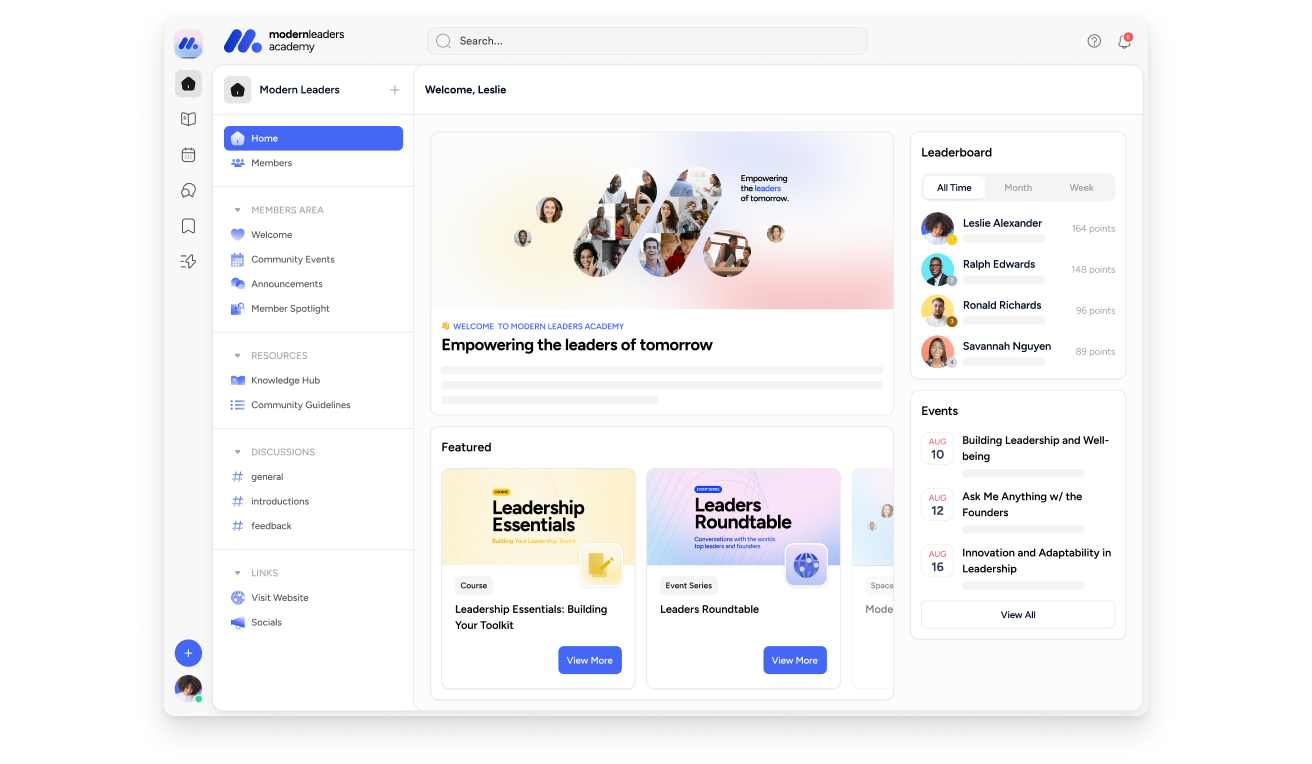
Every step above is a design decision, not a feature. But the platform a program runs on either makes those decisions easy to execute or turns each one into a workaround. Here's where Disco supports the specific steps in this guide, without overstating what's a native capability today versus what would need custom work.
Social, cohort-based structure is native, not bolted on. Programs and Groups are core building blocks in Disco, which means the design decision in step three, running members through a shared cohort instead of a solitary content library, doesn't require custom development to set up. Members move through a Program together, discuss it in channels, and see each other's progress by default.
AskAI supports the in-context reinforcement described in step four. Disco's AskAI lives in a global drawer accessible from any page and in a side panel inside every lesson, on web, mobile web, and the app. It's permission-aware, so a member only gets answers drawn from content they actually have access to, and it indexes course content, uploaded documents, and connected Slack channels automatically. That means a member applying a skill weeks after a session can ask a specific question against the actual program content rather than digging through old slides, which is a direct, shipped answer to the spacing problem in step four.
Engagement data is there for the level three and four metrics in step six. Disco's webhook system fires on the specific behaviors that matter for measurement: quiz and video completion, curriculum module completion, channel messages, reactions, and session attendance, among others. The engagement.list API endpoint returns engagement metrics for members over a date range. That's the raw material for the 30, 60, and 90-day behavior checkpoints this guide recommends, without needing a separate reporting tool bolted on afterward.
Slack sync supports the manager visibility step five calls for. Slack is a native, bidirectional integration (not just an embed), so channel activity and notifications can flow into tools managers already check, lowering the friction on the "visibility into who's applied the behavior" requirement from step five.
Custom branding supports a program members recognize as theirs. Colors, logos, a custom domain, and a fully white-labeled academy experience are standard, which matters more than it sounds for adoption. Members engage differently with a program that looks and feels like it belongs to their own organization rather than a generic third-party tool.
Where a program's requirements go beyond what's native today, such as indexing a paywalled third-party content library or injecting fully custom UI components, those are real constraints worth knowing before committing to a specific design, and Disco's team can walk through what's native, what needs the Google Tag Manager workaround, and what's genuinely out of scope before a program launches.
Disco is built as an AI native learning platform for human transformation specifically because the gap this guide describes, between finishing content and changing behavior, is the gap Disco's own product decisions are made against. If your current training program design is optimized for completion rather than behavior change, that's a solvable problem, and it starts with the six steps above.


