


When every AI can reach your knowledge, your IP becomes the advantage
TL;DR
Quick Summary: MCP and Proprietary IP in Learning
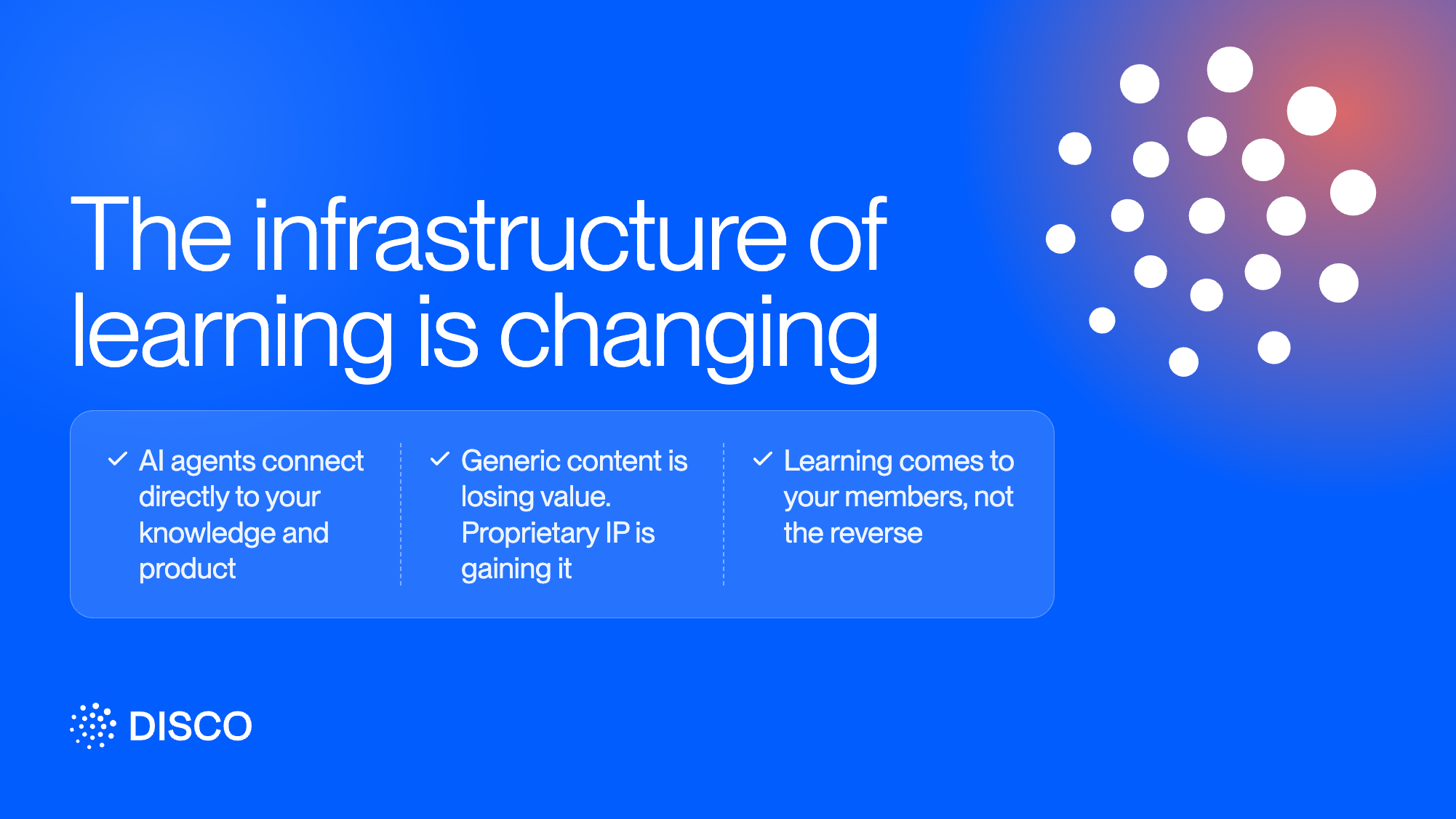
Model Context Protocol (MCP) is an open standard, introduced by Anthropic in late 2024, that connects AI agents to the documents, products, and data a business runs on. For training organizations and customer education platforms, it commoditizes generic content and makes proprietary IP, measurable outcomes, and human connection the primary competitive advantage.
5 Key Takeaways:
- Context Infrastructure: MCP acts as a universal port for AI agents, and its 2026 specifications add enterprise authorization, security, and managed access controls.
- Learning in the Flow of Work: MCP-connected learning platforms let operators enroll cohorts, check engagement, and nudge members from inside Slack, a CRM, or other workflow tools.
- Content Commoditization: Generic courses lose value as AI generates comparable explanations on demand, compounding a market where 70% of online courses go unfinished and self-paced completion averages 15%.
- Customer Education Impact: Product-usage context lets customer education programs adapt to real behavior, tying learning to activation, adoption, and expansion revenue.
- Human-First Strategy: L&D leaders should structure IP to feed AI experiences, measure behavior change over completion, and invest in the community and mentorship that AI cannot replicate.
What MCP actually is, in plain terms
Anthropic introduced MCP in late 2024 as an open standard for connecting AI models to the systems where work happens. Think of it as a universal port. Instead of building a custom integration for every tool, an AI agent speaks one protocol and can reach your documents, your product, your knowledge base, and your data. In 2026 it moved from novelty to infrastructure. The industry now treats it as the default way agents access context, and the latest specifications added the enterprise pieces, authorization, security, and managed access, that make companies comfortable turning it on.
The one-line version: MCP is how AI gets context. And context is everything in learning.
Context is king, and MCP is a context protocol
We've said for years that context is king. A learning experience is only as good as how well it reflects your world, your IP, and your members' real roles and goals. MCP makes that principle operational. When your proprietary knowledge can flow to an AI agent through a standard protocol, learning stops being a static library someone has to visit. It becomes an agent that meets members where they work, personalized to what they're actually doing.
For a training business, that's a profound change. Your differentiated expertise, the thing people pay you for, becomes something an AI can deliver in the flow of work, adapting to each member instead of serving everyone the same program.
Your academy comes to you, not the other way around
The bigger operational shift is direction. For decades, running a learning program meant everyone had to go to the learning platform. You logged into a separate system to build, launch, and manage it. Members logged into another one to take it. MCP flips that. Your learning management comes to you, right inside the workflow tools you already live in.
Imagine spinning up a program, enrolling a cohort, checking engagement, and nudging a stuck member without leaving Slack, your CRM, or wherever your team already works. That's a 10x drop in the friction of operating and running learning programs. The platform stops being a destination you visit and becomes a capability that meets you where you are.
Generic content gets commoditized fast
Here's the uncomfortable part. When any AI can generate a passable explanation of a common topic, generic content stops being valuable. Programs that teach what a model already knows will struggle. Seventy percent of online courses already go unfinished, and self-paced content averages just 15% completion. MCP accelerates the pressure on that model, and it's a big reason AI in learning and development is getting board-level attention this year.
The organizations that win will be the ones sitting on proprietary IP, real practitioner insight, community, and measurable outcomes. Those are the things a generic model can't fabricate, and MCP is exactly how you make them accessible without giving them away.
Customer education platforms feel this shift first, and most positively
Customer education has always fought a hard problem: connecting what someone learns to what they do in your product. MCP closes that gap. A customer education platform connected through MCP can draw on how a customer actually uses the product, then adapt the learning to their real usage and outcomes. Learning becomes tied to activation, adoption, and expansion, so your academy drives revenue instead of just tracking completions.
That's the future we're building toward at Disco: programs that are personalized and adaptive to outcomes, powered by your product context and your IP.
Human-first is still the whole point
AI handling context, retrieval, and personalization frees people to do what only people can: mentor, challenge, connect, and inspire. That's not a consolation prize, it's the actual point. Social, feedback-rich learning consistently outperforms passive content, and it's why Disco academies see 76% engagement and an 84 NPS.
MCP amplifies human potential. The human stays at the center of every real transformation. Our job is to make sure the agentic era makes learning more human, not less.
Frequently asked questions
What is an MCP in the context of a learning platform?
An MCP, or Model Context Protocol, is an open standard that connects an AI assistant to the tools and data it acts on. Applied to a learning platform, it lets an operator manage members, enrollment, content, and reporting by describing what they want to an AI assistant, instead of navigating an admin interface.
Who benefits most from an AI connection to their learning programs?
The people who run programs day to day. That includes training organizations managing cohorts and certifications, and customer education teams driving product adoption across many accounts. Both spend significant time on small administrative actions that an AI connection can handle in the flow of a conversation.
How is this different from an admin dashboard?
A dashboard shows a fixed view and expects the operator to filter and interpret it. An AI connection answers the specific question being asked and takes the specific action requested, in plain language, without the operator leaving the conversation they are already in.
Does an AI connection replace the people running programs?
It does the opposite. It removes the administrative friction so operators spend more of their time on the human parts of the work: the teaching, the mentorship, and the relationships that make a program worth joining.


