


Best AI tools for learning and development teams in 2026
TL;DR
61% of organizations have adopted or are testing AI in their L&D strategy. Only 11% feel confident about where their skills-building is headed. This guide breaks down the best AI tools for learning and development teams in 2026, from cohort-based academies with purpose-built AI to authoring tools, skills platforms, and LMS options, so you can match the right tool to your actual program needs.
Most organizations are already using some form of AI in their learning programs. The problem is that many are using it as a shortcut — auto-generating generic content, pasting it into an aging LMS, and calling it a strategy.
The result is predictable. 70% of online courses go unfinished. Self-paced learning averages just 15% completion. And according to a 2026 L&D trends report from Together (Absorb Software), only 11% of teams feel extremely confident in their future skills-building plans — even as AI adoption in L&D hits 61%.
The tools aren't the problem. The wrong tools for the wrong use case are. This guide breaks down the best AI tools for learning and development in 2026 by category so you can pick what actually fits your programs.
What AI is doing in learning and development in 2026
AI in learning and development has moved well past basic quiz generation. Modern platforms use AI for adaptive learning paths, just-in-time answers, skills gap analysis, automated enrollment and reminders, and real-time analytics that surface what's actually working.
The most forward-thinking teams are using AI for what researchers call "learning in the flow of work": autonomous agents that diagnose skill needs, recommend content, nudge learners, and track impact without anyone having to file a request with an L&D team.
That's the direction the market is moving. The tools below reflect where things actually are in 2026, not where vendors hope to be.
Types of AI tools for learning and development
Before jumping to the list, it helps to understand the categories. Different tools solve different problems, and conflating them is how teams end up paying for six platforms that overlap.
AI-native cohort and academy platforms
These platforms are built for organizations running structured, social, and cohort-based programs. They combine AI program generation, community features, live events, and personalized learning in one place. Best fit for training businesses, customer education teams, and enterprise academies that want high engagement and completion.
AI-enhanced LMS and LXP platforms
Traditional learning management systems with AI layered on top. They recommend content, automate enrollments, and generate analytics. Best fit for large organizations managing compliance, onboarding, and internal training at scale.
AI authoring and content creation tools
Platforms that generate course outlines, modules, quizzes, narration, and SCORM-compliant packages from documents, decks, or prompts. Best fit for L&D teams with large existing content libraries that need to move faster.
Skills intelligence and career-pathing tools
These platforms map employee skills, surface gaps, and link learning recommendations to career moves and workforce planning. Best fit for HR and talent teams connecting L&D to retention and succession strategy.
AI assessment and coaching tools
Tools for skills gap checks, readiness simulations, and conversational coaching. Best fit for teams that need to assess before and after a learning intervention, or support scenario-based practice like leadership or sales conversations.
Learning operations platforms
Project and capacity management tooling for L&D teams. AI helps prioritize intake requests and align projects with business priorities. Best fit for mature L&D functions running many programs in parallel.
Best AI tools for learning and development teams in 2026
1. Disco — best AI-native cohort and academy platform
Disco is an AI-native learning platform built specifically for human transformation. Where traditional LMS platforms bolt AI onto a static content library, Disco builds AI into every layer of the experience: program design, member engagement, personalization, and operations.
The AI Program Generator turns your existing IP into a full program structure in minutes. The built-in AskAI lets members get instant, accurate answers from your content without leaving the learning experience. Automated nudges, gamification, and community features keep cohorts engaged in a way that self-paced content simply cannot match.
Disco customers average a 76% engagement rate and an 84 NPS. Those numbers reflect what happens when AI amplifies human connection rather than replacing it. For training businesses, customer education teams, associations, and enterprise L&D teams that want programs people actually complete, Disco is the strongest option in 2026.
Best for: training businesses, customer academies, accelerators, associations, and enterprise teams running cohort-based or community-driven programs.
2. Docebo

Docebo is a well-established enterprise LMS with strong AI-driven content recommendations, social learning features, and a content marketplace. It works well for large organizations managing training across employees, partners, and customers who need governance, compliance tracking, and multi-audience support.
The AI layer recommends relevant content based on role, behavior, and skill data. It's a mature platform with a corresponding enterprise price point and implementation complexity.
Best for: large organizations needing scalable, governed training across multiple audiences.
3. CYPHER Learning
CYPHER Learning positions itself at the intersection of AI, automation, and skills mapping. Its AI-powered course creation, dynamic learning paths, personal learning agents, and gamification make it one of the more AI-heavy options in the enterprise LMS category.
It's often cited for helping L&D teams reduce manual curation effort while still delivering personalized experiences. Strong fit for organizations prioritizing skills-based development tied to performance data.
Best for: enterprise teams wanting deep AI automation across content creation, personalization, and skills management.
4. 360Learning

360Learning combines LMS and LXP capabilities with a focus on peer-created content. The AI generates draft courses from written prompts, creates quiz questions, tags content with skills, and automates enrollments and reminders. Social learning features like discussions and peer feedback are embedded throughout.
It's a strong fit for organizations where L&D and subject-matter experts collaborate to build and iterate on content quickly.
Best for: teams building collaborative, peer-driven learning cultures with fast content cycles.
5. Sana

Sana is an AI-native learning platform built around just-in-time learning. Its AI tutor lets employees ask natural-language questions over internal knowledge bases and learning content, getting instant answers without leaving their workflow.
Sana works well for organizations moving away from static course libraries toward dynamic, AI-personalized experiences. The AI dashboards surface what employees are asking and where knowledge gaps exist in real time.
Best for: teams replacing legacy systems and prioritizing learning in the flow of work over course-based delivery.
6. Articulate 360
Articulate 360 (Rise and Storyline) is the dominant authoring platform for SCORM and xAPI-compliant course production. Its AI Assistant generates course drafts from prompts, slide decks, and PDFs, and can auto-create assessments, imagery, and narration.
It's a production tool, not a delivery platform. Teams using Articulate still need a separate LMS to host and track completions. The value is in compressing course development timelines from weeks to days.
Best for: L&D teams that already have an LMS and need to build polished, SCORM-compliant courses faster.
7. TalentLMS
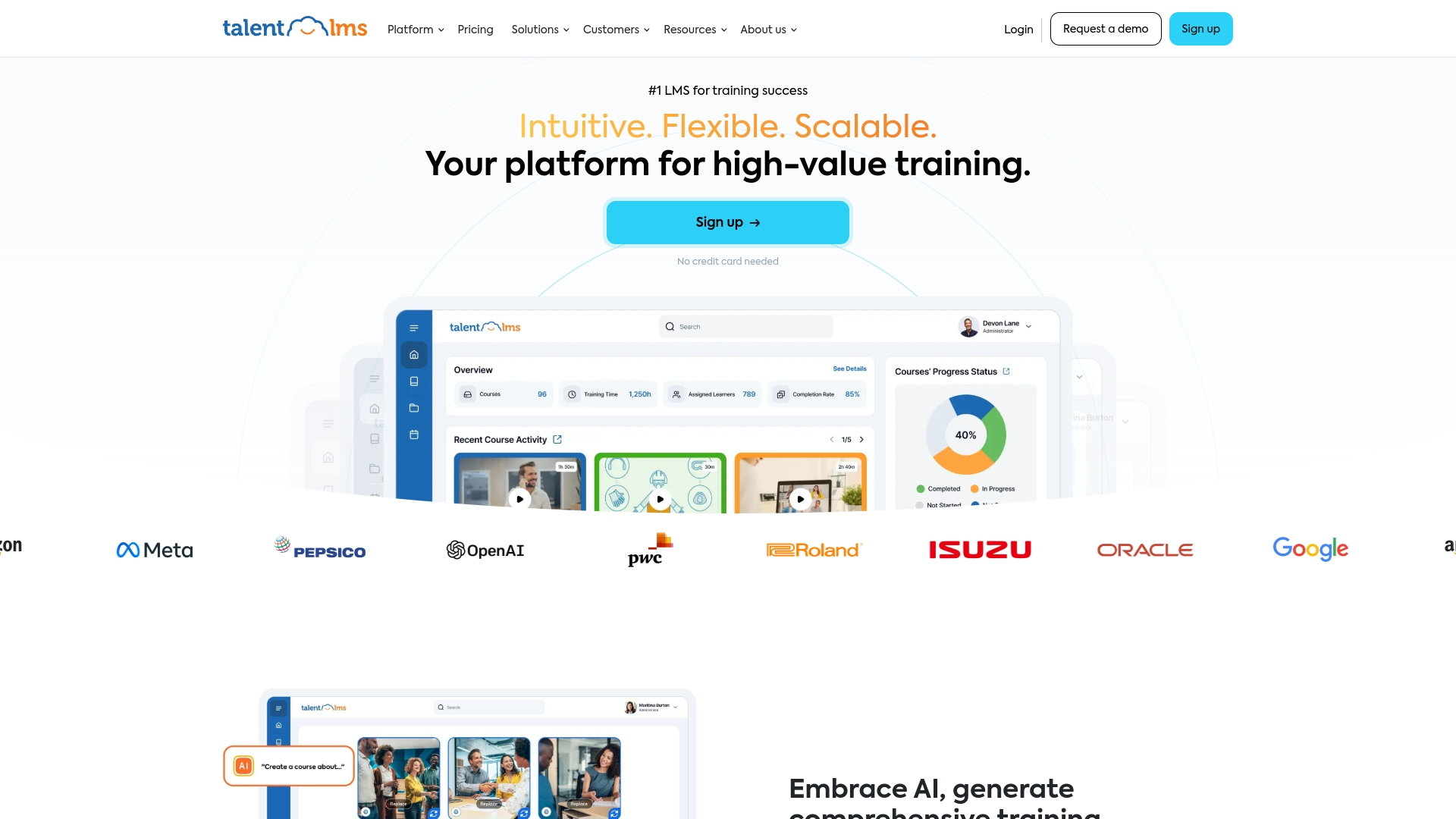
TalentLMS is a practical, affordable option for small and mid-market teams that want AI-assisted course creation and reporting without enterprise complexity. The AI features are less sophisticated than platforms like Docebo or CYPHER, but the ease of use and pricing make it accessible for lean teams.
Best for: SMB and mid-market teams needing straightforward online training without a large implementation budget.
8. Cornerstone
Cornerstone is a long-standing enterprise suite connecting training with performance management, internal mobility, and workforce planning. AI surfaces content aligned to job roles and performance data, making it more of a talent development system than a pure learning platform.
Best for: large enterprises already using Cornerstone for HR and talent management who want learning integrated into the same ecosystem.
9. Fuel50
Fuel50 is a skills and career-pathing tool that maps employee skills, surfaces gaps, and recommends learning, mentors, and role moves to close them. It fits into the skills marketplace and internal mobility space, where learning recommendations serve career development and retention goals.
Best for: HR and talent teams linking training directly to career growth and workforce planning.
10. LinkedIn Learning, Udemy Business, and Coursera for Business
Content marketplaces with AI-driven discovery over large catalogs. They work best as plug-in libraries inside an existing LMS rather than standalone platforms. AI personalizes course recommendations based on role, goals, and browsing behavior.
Best for: organizations that need broad upskilling content and want to integrate it into an existing LMS via a content feed.
Comparing AI learning and development tools
| Platform | Category | Key AI capabilities | Best for |
|---|---|---|---|
| Disco | AI-native cohort platform | AI Program Generator, AskAI, automated nudges, community and cohort tools, personalization | Training businesses, customer academies, enterprise L&D, associations |
| Docebo | Enterprise LMS/LXP | AI content recommendations, skills mapping, analytics, social learning | Large orgs, multi-audience training, compliance |
| CYPHER Learning | AI-heavy enterprise LMS | AI course creation, dynamic paths, skills management, gamification | Enterprise teams focused on AI automation and skills |
| 360Learning | Collaborative learning platform | AI draft courses, quiz creation, skills tagging, automations | Peer-created content, collaborative L&D cultures |
| Sana | AI-native LXP | AI tutor, natural-language Q&A, just-in-time answers, personalization | Teams replacing legacy LMS, flow-of-work learning |
| Articulate 360 | AI authoring tool | Generate courses from docs/decks, assessments, narration, SCORM/xAPI output | L&D teams building SCORM content on top of existing LMS |
| Fuel50 | Skills and career-pathing tool | AI skills mapping, gap analysis, career journey recommendations | HR and talent teams linking training to career growth |
| LinkedIn Learning / Udemy Business | Content marketplace | AI-personalized course discovery over large catalogs | Plug-in content libraries for broad upskilling |
How to choose the right AI tools for your L&D strategy
The right toolset depends on a few factors that vendor demos rarely address directly.
Internal vs. external training
If you're training employees, an enterprise LMS with governance, compliance tracking, and HR integration is the right foundation. If you're running programs for customers, partners, or a paying audience, you need a platform built for engagement and transformation, something like Disco, which is purpose-built for external academies and training businesses.
Scale and team capacity
A lean team running three programs doesn't need Cornerstone. A large organization with thousands of employees across multiple business units likely needs more than a startup-focused platform. Match the tool's complexity to your team's capacity to manage it.
Your content starting point
If you have a large library of existing content (slide decks, documents, recordings), AI authoring tools like Articulate 360 will give you the fastest ROI. If you're building programs from scratch using your organization's IP, a platform with an AI Program Generator like Disco is a better starting point.
Engagement vs. compliance
Compliance training and onboarding checklists need tracking and governance. Transformational programs — leadership, skills development, customer education — need engagement, community, and feedback loops. These require different platforms. Using a compliance-oriented LMS for transformation programs is one of the most common reasons programs fail to move the needle.
Skills strategy maturity
If you have a defined skills framework and want to link training to career pathing and workforce planning, tools like Fuel50 or Cornerstone's skills features are worth evaluating. If skills mapping isn't yet a priority, that layer adds complexity without near-term payoff.
AI tools are only part of the picture
The 2026 L&D adoption data makes the gap clear. 61% of organizations are testing AI in their programs. Only 11% feel confident about where they're headed.
That gap exists because tools get adopted before strategy does. Teams buy AI authoring tools and generate more content. They add AI recommendations to an LMS. Completion rates stay flat.
The organizations seeing real results from AI in learning and development are the ones that pair the right tools with structured program design, human connection, and a clear sense of what transformation they're actually trying to drive.
If you're building programs where engagement and transformation matter, start a free trial or book a demo to see how Disco's AI Program Generator, AskAI, and community tools work together in a real program.


