


White label LMS: how to launch a fully branded elearning platform

TL;DR
The core problem: most learning management systems force a tradeoff between having a powerful platform and having one that looks like yours, so training portals end up branded for the vendor instead of the company running them. A white label LMS, also called a branded LMS, solves this by letting you fully rebrand the platform, logo, colors, and interface as your own. The best ones share six things in common:
- High customization capability. Logos, color schemes, themes, and even the home page can be adjusted so the platform reads as a true white label LMS and branded LMS, not a reskinned template. If learners can tell it's borrowed software, the customization isn't deep enough yet.
- Robust analytics and reporting. Detailed progress reports and real-time dashboards let administrators track completion, engagement, and quiz performance without leaving the platform.
- Seamless integrations. A white label LMS built as a true branded LMS should connect to CRM systems, payment gateways, and tools like Google Workspace so it fits into existing operations instead of sitting apart from them.
- Interactive content creation. Support for cohort-based courses, event series, and self-paced formats gives teams the flexibility to build the kind of learning experience their audience actually needs.
- Collaboration and social learning. Discussion threads, feeds, and direct messaging turn a training portal into a community, and that peer interaction is often what keeps completion rates high.
- Security and compliance. Encryption, secure authentication, and regular backups protect user data and keep the platform aligned with regulatory requirements.
What is White Label LMS?
A white label LMS is a learning management system that a software company builds, but that your organization runs under its own name. Instead of members seeing a third-party product, they see your logo, your colors, and your domain from the moment they log in. The platform underneath is shared infrastructure. Everything a member sees on top of it is yours.
This is what separates a white label elearning platform from a standard LMS. A standard platform puts its own brand front and center: its logo in the header, its own visual identity, its name in the login URL. A white label learning management system removes all of that and replaces it with your organization's identity instead, so the training experience feels like a natural extension of your business rather than a piece of software you're renting.
For a training business, that distinction shows up directly in the sale. Members are paying for your expertise, not a third-party tool, and a fully branded academy reinforces that from the first click. For an internal L&D team or a customer education program, it means employees or customers experience training as part of your company, not as a detour to an unfamiliar outside platform.
In practice, white labeling covers a few layers:
- Visual identity: logo, color palette, favicon, and overall look and feel
- Domain: the platform lives at yourbrand.com, not at a vendor's subdomain
- Structure and content: your programs, your curriculum, organized the way your organization actually teaches
- Member experience: login, navigation, and community features that feel native to your brand rather than borrowed
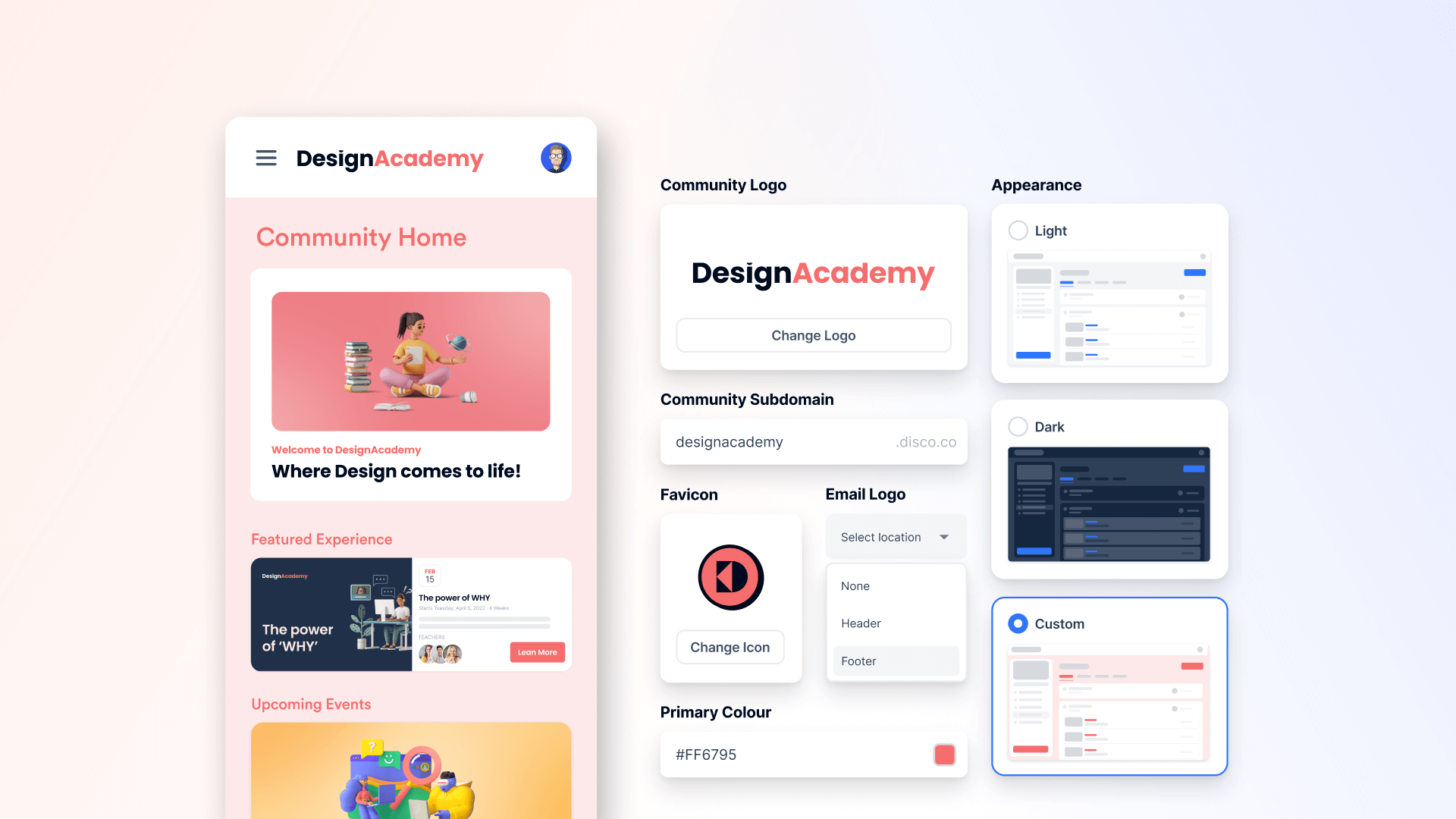
So, imagine having an online training portal that looks and feels like your own – with your logo, color scheme, and even interface design. This is what white label LMS platforms offer.
These platforms distinguish themselves from conventional LMS solutions by allowing organizations to entirely personalize the learning experience, consequently setting a solid brand identity.
In contrast, traditional LMS platforms provide a uniform visual design for all users. White label training materials can be tailored to the organization's needs and branding, offering a custom learning experience.
White Labeling VS Branding
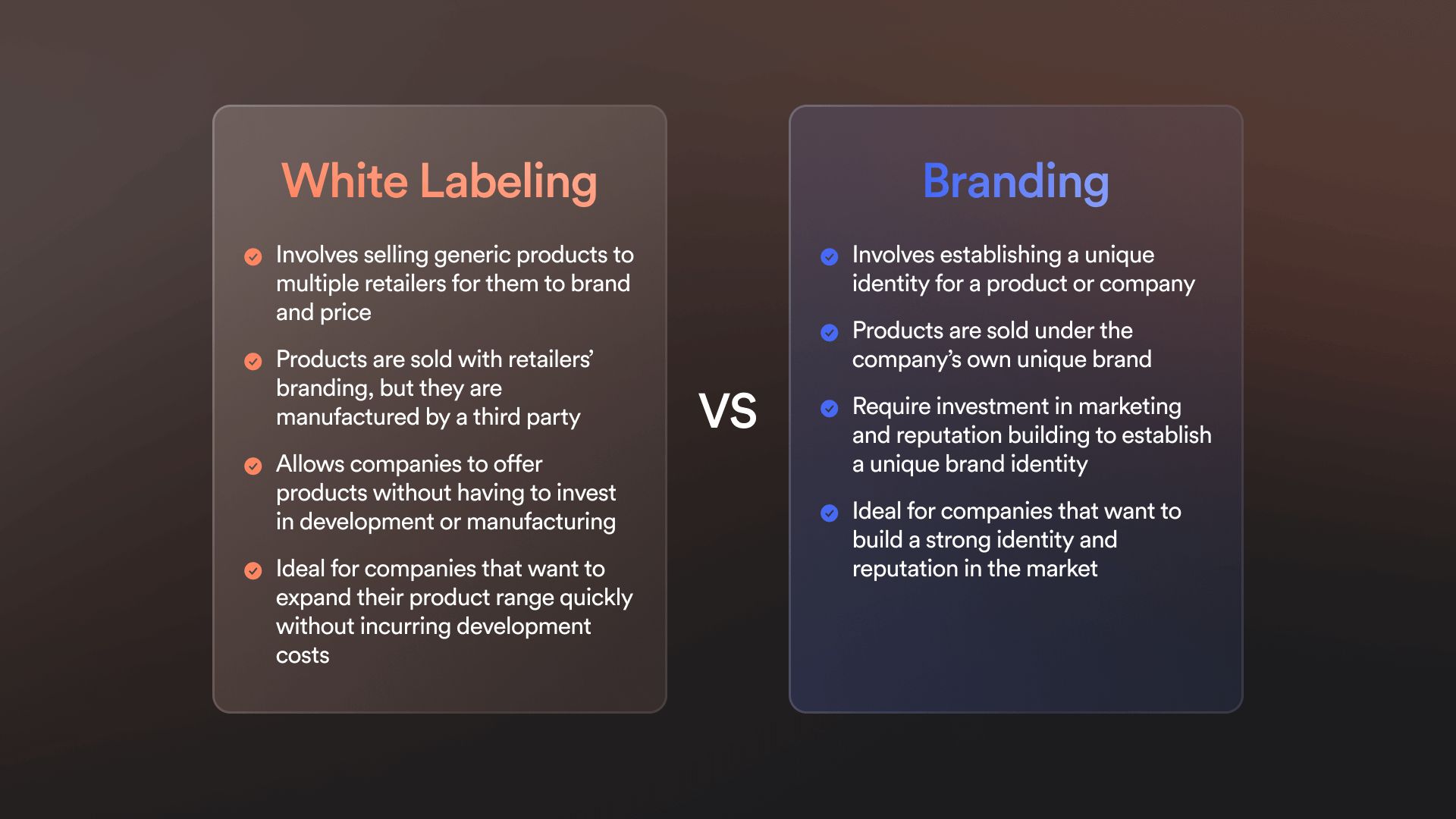
White labeling and branding are two distinct concepts in the business world. White labeling is a practice where a product or service is produced by one company and then rebranded by another company to make it appear as if they had made it.
The process involves selling generic products to multiple retailers, who then apply their brand and price it accordingly. This allows companies to offer products without having to invest in the development or manufacturing process. Essentially, white label products are sold with the branding of the retailer, but they are manufactured by a third party.
On the other hand, branding is the process of establishing a unique identity for a product or company. It involves creating a distinctive name, design, or symbol that identifies and differentiates a product from other products.
Branding is all about building a reputation and identity that resonates with your target audience, and it goes beyond just a logo or tagline. It's about the emotion and perception that your customers associate with your business.
The Significance of White Labeling in E-Learning
White labeling in e-learning holds significance as it allows companies to:
- Create eLearning courses that reflect their brand
- Nurture a consistent and personalized learning experience for their audience
- Have a virtual classroom that feels familiar to learners because it carries the brand's identity.
Moreover, white labeling significantly establishes trust with users by providing a platform that aligns with the company's own branding, devoid of third-party vendor branding. This alignment in brand representation across the white label LMS elevates the organization's credibility and trustworthiness among its users. Hence, the best white label LMS solutions offer extensive customization options to achieve this.
How to Tailor Your Online Course Platform with White Label LMS?
Now that you understand what a white label LMS platform is and its significance, the next step is to tailor your online course platform. A white label LMS grants you the control to mold not just the learning content but also the aesthetics of your online training environment. Remember, consistency in brand representation can significantly enhance your learners' experience.
White label LMS solutions provide extensive customization possibilities, allowing for the modification of the white label education platform's appearance, layout, and design elements to align with the brand's identity. From the color scheme to the login page, every aspect of the platform can be tailored to offer a seamless learning experience.
Brand Integration: Logos, Color Schemes, and More
Brand integration consists of embedding your branding elements into the LMS. This includes your logo, color schemes, and even the tone of language used on the platform. Platforms like Disco LMS offer customization options for incorporating a logo into a white label LMS interface. These platforms provide a white label package that allows you to add your logo and modify the primary color theme.
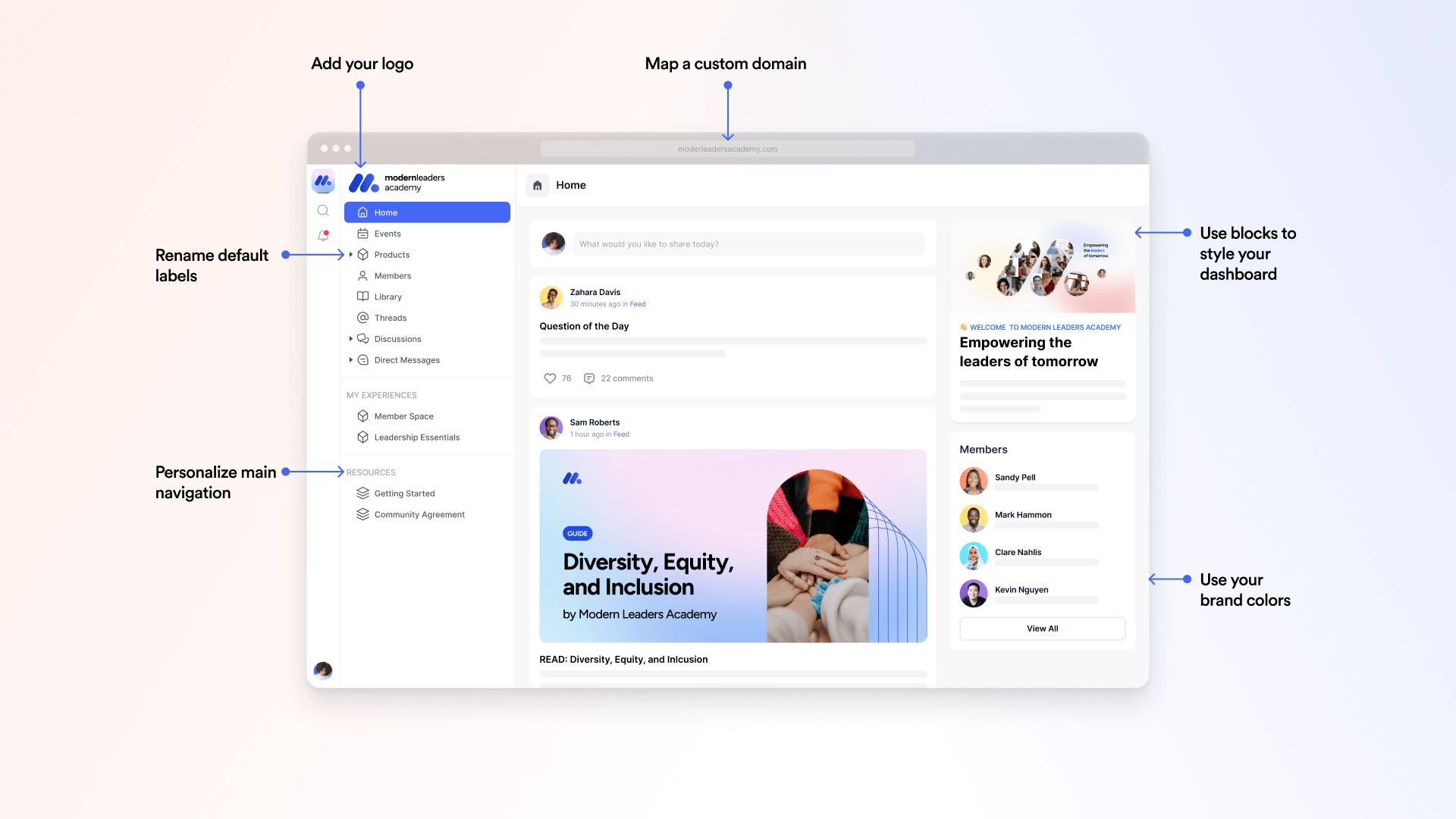
Moreover, customizing color schemes in a white label LMS to match company branding involves adjusting the LMS's provided color palette to match the specific colors of the company's brand. This ensures that your online training platform aligns with your brand identity, providing a cohesive look and feel.
Essential Characteristics of a User-friendly White Label LMS
Besides brand integration, attention should also be given to designing a user-friendly interface. After all, the platform is not just for you to manage courses, but also for your learners to navigate through their learning journey. A user-friendly interface improves:
- usability
- reduces the learning curve
- enhances engagement and motivation
- makes the learning process more efficient.
The essential characteristics of a user-friendly LMS interface include:
- Stress-free start-up
- Personalized flexibility
- Intuitive navigation
- Responsive design
- Clear and concise interface
- Customizable dashboard
- Mobile compatibility
- Robust reporting and analytics
- Collaborative features
These characteristics are important for creating effective white label training courses, including white label courses focused on corporate training.
8 Key Features of The Best White Label LMS Platforms
Not all white label LMS platforms are the same. They vary in aspects like features, user interface, pricing, and others. However, top white label LMS platforms share some common features that make them stand out. These include advanced customization, robust analytics, and seamless integrations with business operations.
Advanced customization features of top white label LMS platforms include:
- The ability to customize the user interface elements such as colors, shapes, and layout to enhance brand recognition and create a unified experience for learners.
- Robust analytics and reporting tools that support advanced reporting for tracking learner progress and engagement, enabling administrators to identify knowledge gaps and measure performance, simplifying reporting processes, and enhancing understanding of the platform's effectiveness.
- Seamless integration with various business operations, supporting integrations with payment gateways, and enabling extensive customization and rebranding.
- Connecting with CRM systems, e-commerce platforms, and internal databases to streamline processes and enhance user experience.
Expert Advice:
All these essential functionalities are present in Disco. The Disco platform is a comprehensive white label LMS solution that incorporates all the essential features for a seamless e-learning experience. It offers a stress-free start-up, personalized flexibility, intuitive navigation, high customization, and robust analytics reporting that caters to users across various devices.
Furthermore, Disco is well-known for its collaborative features that foster community and interactive learning. The platform is widely used by industry experts--from virtual academies, schools, and accelerators, to communities, making it a top choice for the best white label LMS solution.
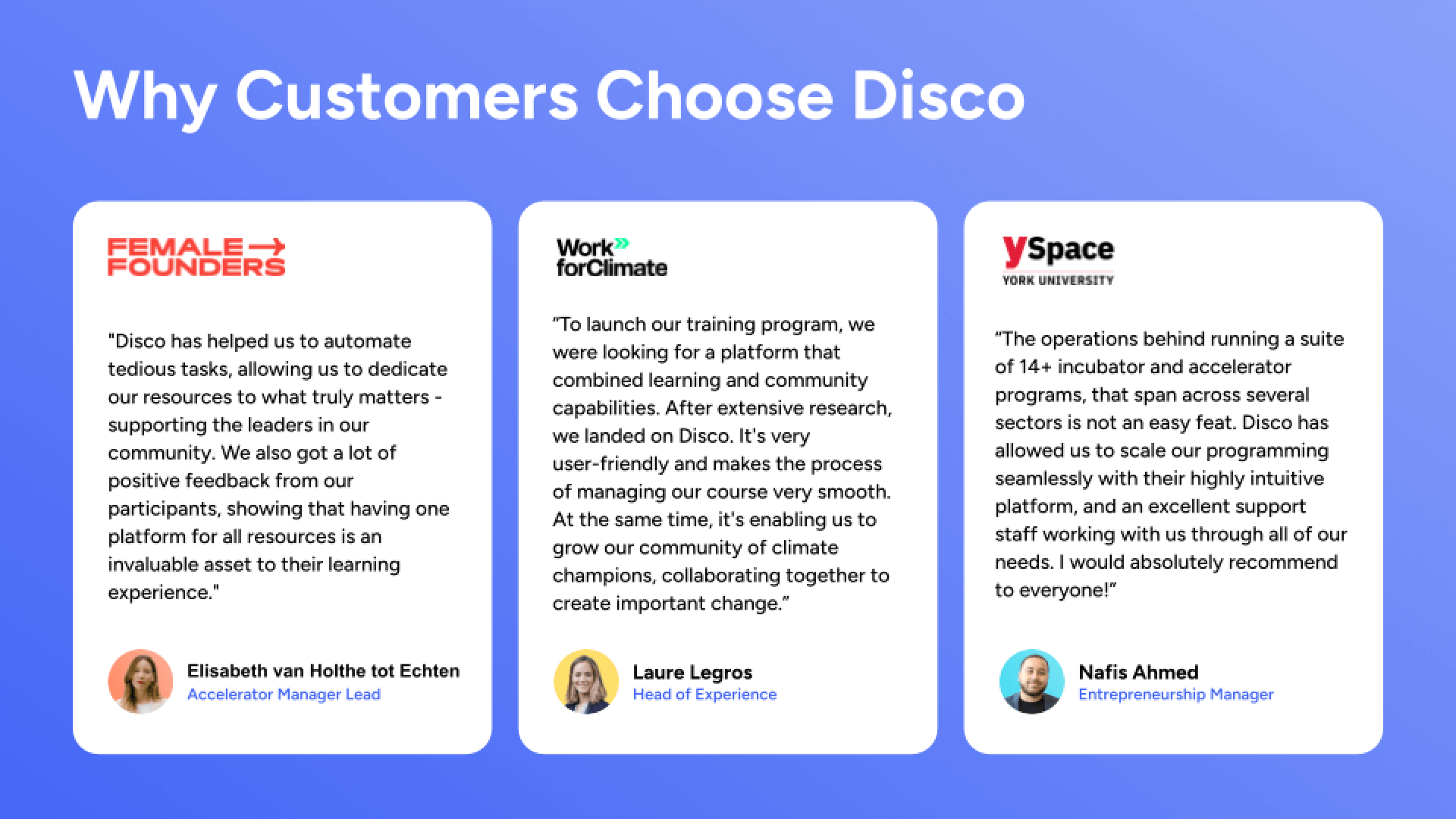
Experience the Disco platform firsthand with our 14-day free trial, and explore pricing options that align with your unique needs. Plus, here's how world-class educational businesses are using Disco:
1. High Customization Capability and Flexibility
Advanced customization in a white label LMS encompasses:
- Adding a company's logo
- Adjusting color schemes
- Applying personalized themes
- Altering the home page
- Utilizing personalized tokens
- Designing a tailored learning experience for users
If you want your white label LMS platform to reflect your brand's identity, choosing a white label LMS that offers advanced customization and flexibility is crucial.
Setting up custom branding in Disco
Sign up at Disco and open the Appearance section under Settings. From there you can set your brand color, upload a logo and favicon, and update your background theme. No logo ready yet? Disco's AI image generator creates one in a single click, so your academy looks finished on day one instead of launching with a placeholder.
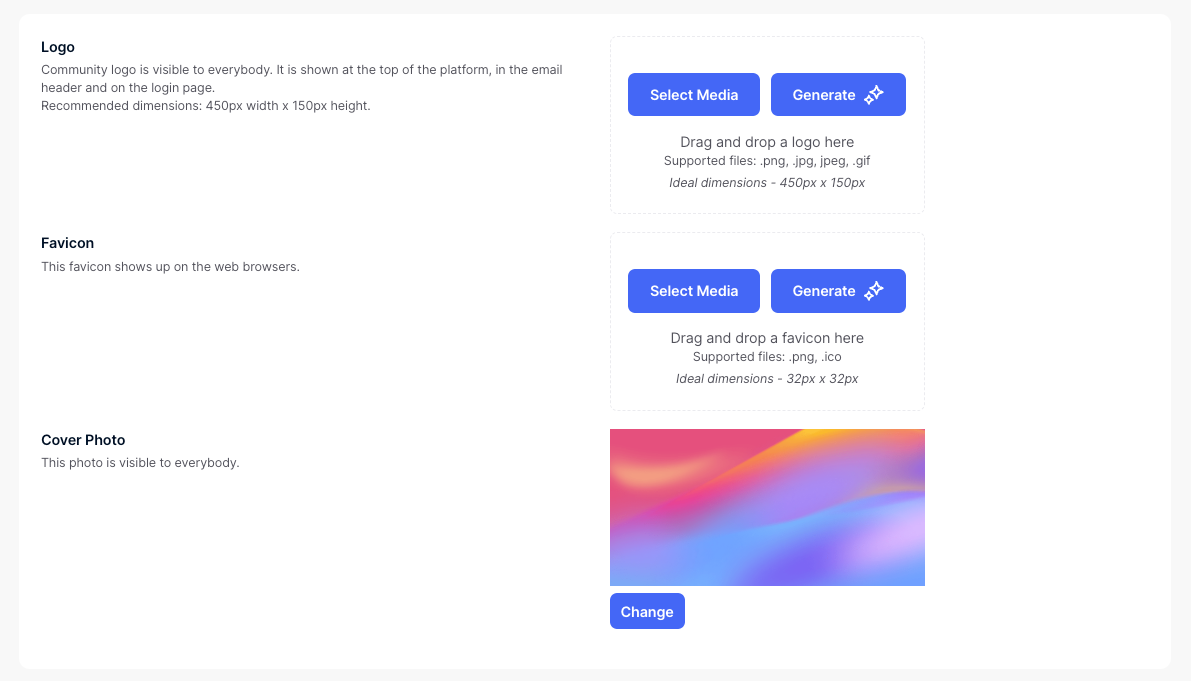
Apart from that, you could also thematize and change the brand color and background color of your entire dashboard.

2. Robust Analytics and Reporting Tools
In e-learning, analytics and reporting tools aid in the collection and evaluation of learners' performance data. This allows for:
- Informed decision-making to enhance course effectiveness
- Customization of content
- Identification of learning obstacles
- Tailored assistance
- Boosting engagement
- Personalizing the learning journey
- Monitoring progress
- Gauging impact
- Optimizing learner performance
Turning on progress tracking and reporting
Every academy comes with built-in progress and completion reporting. Admins can see individual member journeys, quiz and assignment performance, and course completion rates in real time, then use that data to spot where members are getting stuck and adjust content accordingly.
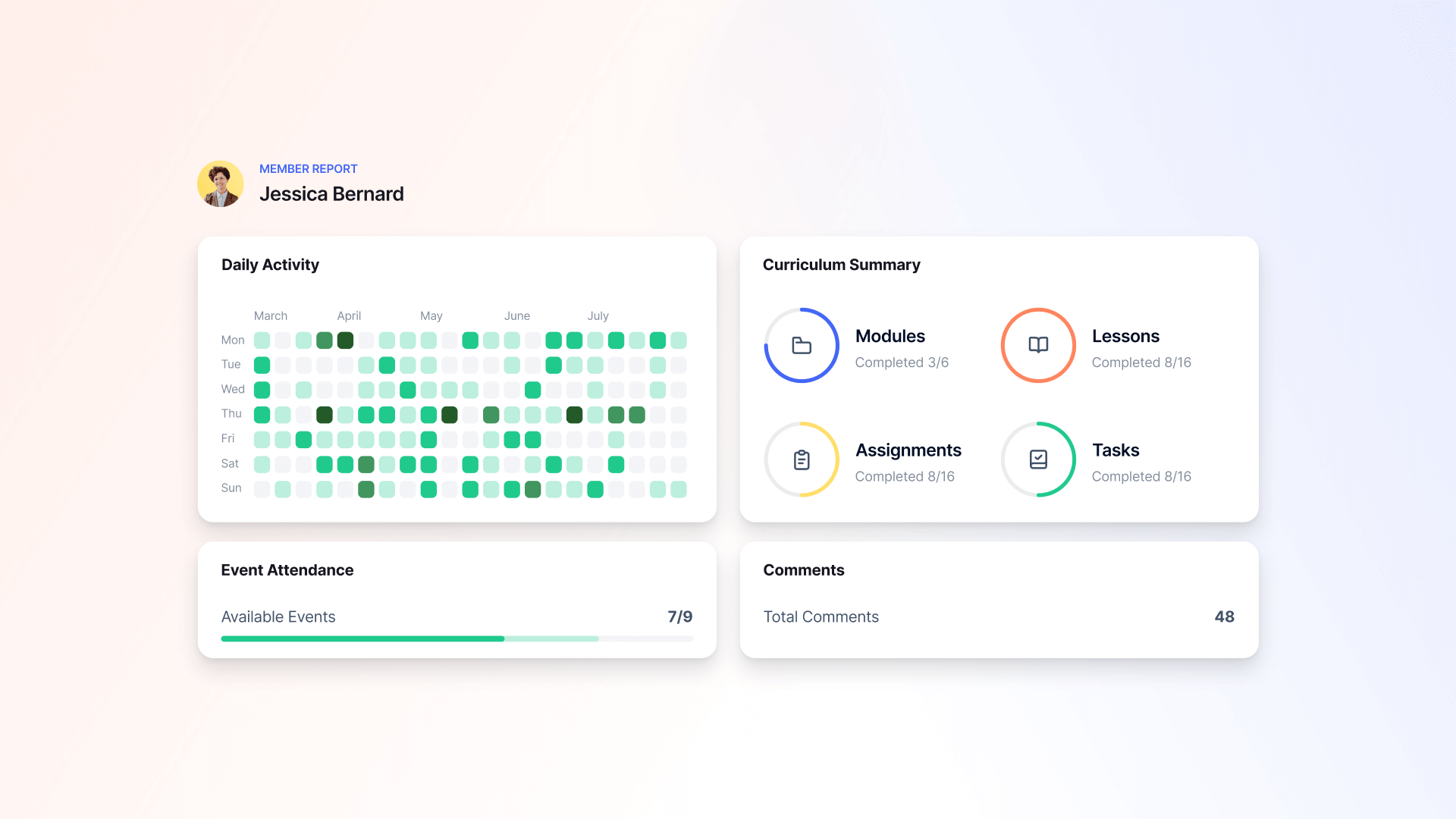
Administrators can easily track the progress of each learner, identify areas of improvement, and tailor the learning experience accordingly.
Moreover, Disco's analytics feature provides in-depth reports on course performance, user engagement, and learning outcomes, allowing educators to make data-driven decisions and improve the effectiveness of their courses.

The platform also provides real-time analytics, enabling immediate feedback and adjustments to the learning process. This robust tracking and reporting capability makes Disco an excellent choice for organizations looking to enhance their e-learning experience.
3. Seamless Integrations with Business Operations
Choosing a white label LMS that seamlessly integrates with your existing business operations and systems is crucial for maintaining a streamlined workflow and ensuring user adoption. A white label LMS can seamlessly integrate with various business operations by:
- Supporting integrations with payment gateways
- Enabling extensive customization and rebranding
- Connecting with CRM systems, e-commerce platforms, and internal databases
For instance, a white label LMS commonly integrates with:
- CRM
- Social networks
- Web conferences
- eCommerce platforms
- Google Apps
These integrations not only streamline processes but also enhance the user experience by providing a unified platform for all learning-related activities.
Connecting your existing tools
Disco connects to the tools your team already runs on: Stripe for payments, Slack for community and notifications, Zoom for live sessions, and Google Analytics or Google Tag Manager for tracking. Set each one up once under Integrations and your branded academy stays part of your existing stack instead of becoming a separate silo.
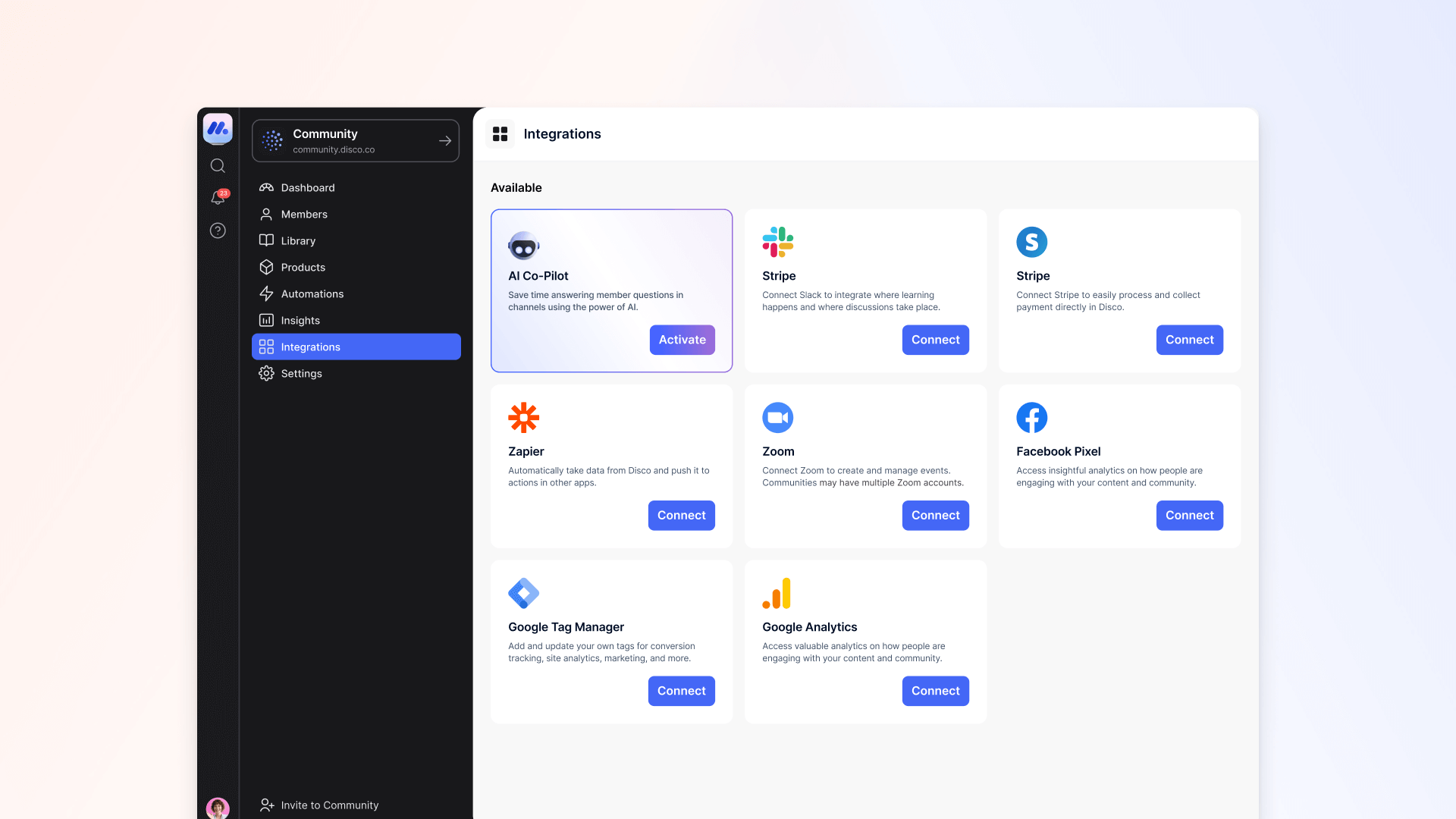
From CRM systems to eCommerce platforms, Disco's advanced integrations facilitate smooth business operations and enhance user experience. It supports integrations with major payment gateways like Stripe, enabling easy and secure transactions. Also, you can activate Disco's AI co-pilot which will serve as a virtual assistant to answer your community's queries.
Furthermore, Disco's integration with Google Tag Manager, Google Analytics, and social networks simplifies content sharing and collaborative learning. With Disco's advanced integrations, e-learning becomes a more efficient and interactive process.
4. Interactive Content Creation Tools
Interactive content creation tools are significant in e-learning as they:
- Improve the learning experience by increasing engagement
- Enable learners to actively participate in the content
- Help in creating interactive content such as infographics, quizzes, and interactive videos
- Keep learners engaged and make learning more fun.
Building your first program
Disco's comprehensive suite of learning tools enables the creation of a wide range of learning products to cater to diverse learning needs. The platform is equipped to support the development of cohort-based courses, event series, and self-paced courses. Each learning product type has unique features that provide an engaging and effective learning experience.
For instance, when you sign up at Disco, you can create a ready-made template of a cohort-based course that allows for scheduled classes and real-time interaction, fostering a sense of community and collaborative learning.

Event series, on the other hand, make it possible to organize and manage multiple events under one roof, ensuring seamless event coordination and participant management. Lastly, self-paced courses give learners the flexibility to learn at their own pace, accommodating individual learning styles and schedules. With Disco's comprehensive learning tool suite, creating tailored and impactful learning products becomes a breeze.
5. Collaboration and Social Learning Features
Collaboration features contribute to the learning experience within a white label LMS platform by fostering community, discussion, and interactive learning. These features offer a space for learners to participate in valuable discussions, exchange ideas, and benefit from each other's knowledge, including activities such as group projects, peer feedback, and debates.
Turning on discussions, feeds, and direct messages
With Disco's interactive features, fostering community and facilitating discussions have never been easier. Users can create discussion threads on various topics, allowing for focused conversations and idea exchange within the community. These threads can be accessed via the platform's "Discussions" tab.
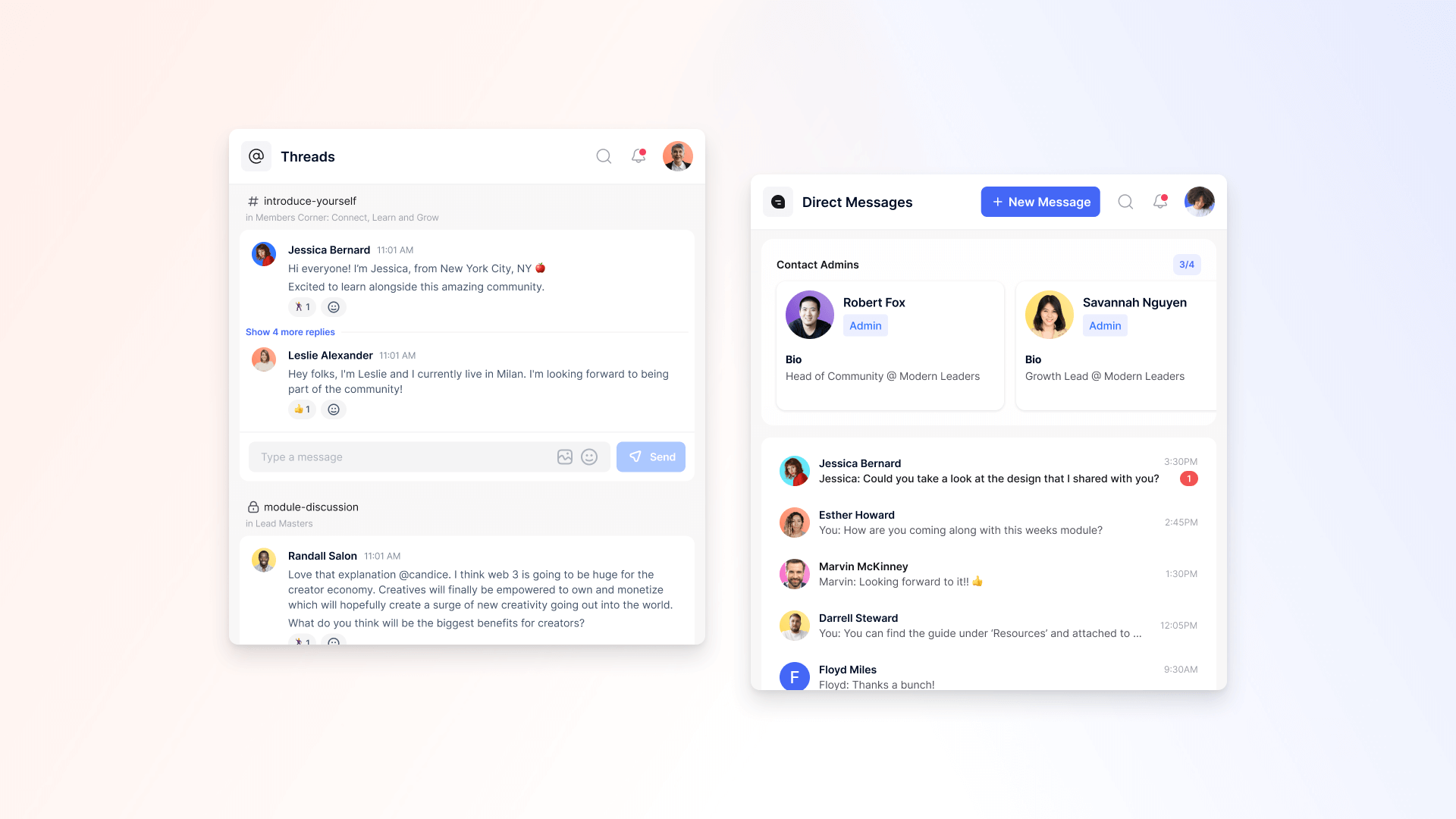
On the other hand, the "Feeds" feature allows for more general conversations and updates, creating a social media-like environment that promotes engagement and interaction. Direct messaging is also available, enabling private conversations between users. Simply click on a user's profile and select "Send Message" to start a private chat. These features make Disco a highly interactive and collaborative e-learning platform.
6. Gamification for Motivation and Engagement
Gamification can improve learner motivation and engagement by providing students with the ability to select their learning paths, granting them autonomy and control over their learning journey. It also promotes collaboration, communication, and healthy competition among learners, nurturing a sense of community and peer acknowledgment.
In online learning, gamification can include a variety of rewards and badges such as:
- digital badges
- medals
- emblems
- achievement-based badges
Additionally, there are tiered badges like Bronze, Silver, and Gold designed to encourage specific behaviors. For instance, Duolingo uses levels, points, and badges to effectively motivate language learners.
7. Efficient Course Development and Distribution
When it comes to course development, white label eLearning platform options, such as white label LMS platforms, offer a variety of tools and methods to streamline the process. With the Disco platform, you can create engaging and dynamic courses that meet your learners' needs.
A white label LMS enhances course management efficiency by offering customizable features such as branding, colors, and logos. They also provide easy course creation, content embedding, and automated processes, which streamline the management of courses for administrators and improve the learning experience for learners.
8. Security and Compliance
Security and compliance should be a top priority when selecting white label LMS software. Ensuring the security of user data and content, and meeting regulatory requirements is crucial. Essential security features to consider include:
- Prioritizing the security of user data, content, and transactions
- Implementing robust security measures like regular database backups, data centers for secure storage, and secure handling of uploaded assets
- Robust security measures such as encryption and secure authentication
White label LMS software can help in meeting regulatory requirements by offering features such as:
- Corporate compliance training programs
- Emphasizing the security of user data
- Enabling the customization of learning portals to align with specific compliance needs
Therefore, when choosing a white label LMS software, it's crucial to prioritize security and compliance to protect user data and ensure regulatory adherence.
Frequently asked questions
What is the advantage of a white label LMS for training businesses?
It keeps your brand consistent from first login to program completion. Members see your colors, your logo, and your identity throughout, which reinforces trust and strengthens engagement.
Does a white label LMS require technical expertise?
Not for the basics. Drag-and-drop tools handle logos, layouts, and color schemes without any code. Deeper customizations, like advanced integrations or a fully custom mobile app, may need developer input, but day-to-day branding is built to be self-serve.
How do these platforms handle custom domains?
Domain mapping lets your platform run under your own web address instead of a third-party one, so every interaction stays under your brand.
Can I update branding after launch?
Yes. Logos, layouts, and color schemes can all be refreshed later without disrupting existing content or member access.


